Search
00
GBAF Logo
trophy
Top StoriesInterviewsBusinessFinanceBankingTechnologyInvestingTradingVideosAwardsMagazinesHeadlinesTrends

Subscribe to our newsletter

Get the latest news and updates from our team.

Global Banking & Finance Review®

Global Banking & Finance Review® - Subscribe to our newsletter

Company

    GBAF Logo
    • About Us
    • Profile
    • Privacy & Cookie Policy
    • Terms of Use
    • Contact Us
    • Advertising
    • Submit Post
    • Latest News
    • Research Reports
    • Press Release
    • Awards▾
      • About the Awards
      • Awards TimeTable
      • Submit Nominations
      • Testimonials
      • Media Room
      • Award Winners
      • FAQ
    • Magazines▾
      • Global Banking & Finance Review Magazine Issue 79
      • Global Banking & Finance Review Magazine Issue 78
      • Global Banking & Finance Review Magazine Issue 77
      • Global Banking & Finance Review Magazine Issue 76
      • Global Banking & Finance Review Magazine Issue 75
      • Global Banking & Finance Review Magazine Issue 73
      • Global Banking & Finance Review Magazine Issue 71
      • Global Banking & Finance Review Magazine Issue 70
      • Global Banking & Finance Review Magazine Issue 69
      • Global Banking & Finance Review Magazine Issue 66
    Top StoriesInterviewsBusinessFinanceBankingTechnologyInvestingTradingVideosAwardsMagazinesHeadlinesTrends

    Global Banking & Finance Review® is a leading financial portal and online magazine offering News, Analysis, Opinion, Reviews, Interviews & Videos from the world of Banking, Finance, Business, Trading, Technology, Investing, Brokerage, Foreign Exchange, Tax & Legal, Islamic Finance, Asset & Wealth Management.
    Copyright © 2010-2026 GBAF Publications Ltd - All Rights Reserved. | Sitemap | Tags | Developed By eCorpIT

    Editorial & Advertiser disclosure

    Global Banking & Finance Review® is an online platform offering news, analysis, and opinion on the latest trends, developments, and innovations in the banking and finance industry worldwide. The platform covers a diverse range of topics, including banking, insurance, investment, wealth management, fintech, and regulatory issues. The website publishes news, press releases, opinion and advertorials on various financial organizations, products and services which are commissioned from various Companies, Organizations, PR agencies, Bloggers etc. These commissioned articles are commercial in nature. This is not to be considered as financial advice and should be considered only for information purposes. It does not reflect the views or opinion of our website and is not to be considered an endorsement or a recommendation. We cannot guarantee the accuracy or applicability of any information provided with respect to your individual or personal circumstances. Please seek Professional advice from a qualified professional before making any financial decisions. We link to various third-party websites, affiliate sales networks, and to our advertising partners websites. When you view or click on certain links available on our articles, our partners may compensate us for displaying the content to you or make a purchase or fill a form. This will not incur any additional charges to you. To make things simpler for you to identity or distinguish advertised or sponsored articles or links, you may consider all articles or links hosted on our site as a commercial article placement. We will not be responsible for any loss you may suffer as a result of any omission or inaccuracy on the website.

    Home > Finance > Factbox-German parties' energy policies in February national election
    Finance

    Factbox-German parties' energy policies in February national election

    Published by Global Banking & Finance Review®

    Posted on January 15, 2025

    3 min read

    Last updated: January 27, 2026

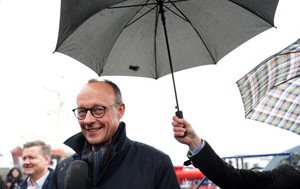
    An infographic detailing the energy policies of major German political parties ahead of the February national election, focusing on their approaches to power prices, renewable energy, and fossil fuels.
    Infographic summarizing energy policies of German parties for February elections - Global Banking & Finance Review
    Why waste money on news and opinion when you can access them for free?

    Take advantage of our newsletter subscription and stay informed on the go!

    Subscribe

    Quick Summary

    German parties outline their energy policies ahead of the February election, focusing on renewables, nuclear energy, and fossil fuels.

    German Parties' Energy Policies for February National Election

    (Reuters) - Voters in Germany, Europe's biggest economy, go to the polls on Feb. 23 in what marks the first elections since Berlin severed its ties with Russia, its decades-long gas supplier.

    Here is how major parties outline their energy policies:

    CDU/CSU

    The conservative Christian Democrats (CDU), who run with Bavarian sister party CSU in the election, promise to cut power prices by 5 euro cents per kilowatt hour (kWh) or more, equivalent to roughly 12% of 2024 prices.

    The party proposes to cut power grid fees that add to customers' costs, partly by raising carbon emissions permit prices, while offering private capital incentives to invest in power grids. Both parties also want reconsider nuclear energy, which was abandoned in 2022, and may revoke a ban on fossil car fuels from 2035.

    CDU leader Friedrich Merz has said a fast shift to hydrogen would not be successful.

    AFD

    The far-right Alternative for Germany (AfD) has said gas, oil heating systems, and hard coal power stations should be kept running. It wants to continue domestic brown coal mining and reverse the withdrawal from nuclear energy. 

    It says the current ruling coalition's "ideological" plans for a transformation towards renewable energy depend on state hand-outs, and will lead to poverty, de-industrialisation and deepen import dependency.

    AfD wants to leave the Paris climate agreement, cut energy taxes, and restart the Nord Stream gas import pipelines from Russia under the Baltic Sea.

    The party's chancellor candidate Alice Weidel has said she would "tear down" wind turbines to save on grid fees that reflect renewables expansion.

    SPD

    The Social Democrats (SPD) say they would continue to subsidise renewable energy, with a transformation fund reimbursing consumers many of the fees collected from them via taxes and levies.

    The party wants to loosen constitutional limits on public debt, so-called debt brake, to raise more money for energy subsidies and remains committed to a green transformation.

    It wants to encourage purchases of German-made electric cars with a temporary tax deduction.

    GREENS

    The Greens party wants to continue promoting renewable energy. It is advanced in its planning for a capacity market design to complement planned gas-to-power plants that should act as a backup to offset volatile wind and solar electricity.

    The party wants to promote electric cars, heat pumps, energy sharing and efficiency, as well as to continue support for low-income consumers. It looks to fund its green policies with more state borrowing.

    (Reporting by Vera Eckert; Editing by Christoph Steitz and Tomasz Janowski)

    Key Takeaways

    • •CDU/CSU aims to cut power prices and reconsider nuclear energy.
    • •AfD supports fossil fuels and leaving the Paris climate agreement.
    • •SPD plans to subsidize renewables and encourage electric cars.
    • •Greens focus on renewable energy and state borrowing for green policies.
    • •Germany's energy policy debate is crucial in the upcoming election.

    Frequently Asked Questions about Factbox-German parties' energy policies in February national election

    1What is the main topic?

    The article discusses the energy policies of German political parties ahead of the February national election.

    2What are CDU/CSU's energy policies?

    They propose cutting power prices, reconsidering nuclear energy, and may revoke the ban on fossil car fuels.

    3What is the AfD's stance on energy?

    AfD supports fossil fuels, wants to leave the Paris climate agreement, and restart Nord Stream pipelines.

    More from Finance

    Explore more articles in the Finance category

    Image for Morning Bid: Fed under pressure as layoffs mount
    Morning Bid: Fed under pressure as layoffs mount
    Image for Exclusive-Intel, AMD notify customers in China of lengthy waits for CPUs
    Exclusive-Intel, AMD notify customers in China of lengthy waits for CPUs
    Image for SocGen lifts profit target as retail bank offsets trading drop
    SocGen lifts profit target as retail bank offsets trading drop
    Image for Germany's PNE loses bid for Vietnam wind project, in new blow to foreign investors
    Germany's PNE loses bid for Vietnam wind project, in new blow to foreign investors
    Image for Toyota CEO Sato to step down, to be replaced by CFO Kon
    Toyota CEO Sato to step down, to be replaced by CFO Kon
    Image for Supply chain chaos becomes aviation's 'new norm' as demand hits records
    Supply chain chaos becomes aviation's 'new norm' as demand hits records
    Image for Hims & Hers' $49 weight-loss pill jolts everyone, except its stock
    Hims & Hers' $49 weight-loss pill jolts everyone, except its stock
    Image for Bitcoin on the cusp of $60,000 as investors flee risky bets
    Bitcoin on the cusp of $60,000 as investors flee risky bets
    Image for Dollar set for strongest week since November, yen firms before polls
    Dollar set for strongest week since November, yen firms before polls
    Image for Stocks dive, silver and cryptos look for cover after rout
    Stocks dive, silver and cryptos look for cover after rout
    Image for Oil set for first weekly decline in seven weeks ahead of US-Iran talks
    Oil set for first weekly decline in seven weeks ahead of US-Iran talks
    Image for Britain expects Arctic security plans to be discussed by NATO next week
    Britain expects Arctic security plans to be discussed by NATO next week
    View All Finance Posts
    Previous Finance PostJanus Henderson CEO hits back at Saba in investment trust battle
    Next Finance PostGerman economy contracts for second consecutive year in 2024