Search
00
GBAF Logo
trophy
Top StoriesInterviewsBusinessFinanceBankingTechnologyInvestingTradingVideosAwardsMagazinesHeadlinesTrends

Subscribe to our newsletter

Get the latest news and updates from our team.

Global Banking & Finance Review®

Global Banking & Finance Review® - Subscribe to our newsletter

Company

    GBAF Logo
    • About Us
    • Profile
    • Privacy & Cookie Policy
    • Terms of Use
    • Contact Us
    • Advertising
    • Submit Post
    • Latest News
    • Research Reports
    • Press Release
    • Awards▾
      • About the Awards
      • Awards TimeTable
      • Submit Nominations
      • Testimonials
      • Media Room
      • Award Winners
      • FAQ
    • Magazines▾
      • Global Banking & Finance Review Magazine Issue 79
      • Global Banking & Finance Review Magazine Issue 78
      • Global Banking & Finance Review Magazine Issue 77
      • Global Banking & Finance Review Magazine Issue 76
      • Global Banking & Finance Review Magazine Issue 75
      • Global Banking & Finance Review Magazine Issue 73
      • Global Banking & Finance Review Magazine Issue 71
      • Global Banking & Finance Review Magazine Issue 70
      • Global Banking & Finance Review Magazine Issue 69
      • Global Banking & Finance Review Magazine Issue 66
    Top StoriesInterviewsBusinessFinanceBankingTechnologyInvestingTradingVideosAwardsMagazinesHeadlinesTrends

    Global Banking & Finance Review® is a leading financial portal and online magazine offering News, Analysis, Opinion, Reviews, Interviews & Videos from the world of Banking, Finance, Business, Trading, Technology, Investing, Brokerage, Foreign Exchange, Tax & Legal, Islamic Finance, Asset & Wealth Management.
    Copyright © 2010-2026 GBAF Publications Ltd - All Rights Reserved. | Sitemap | Tags | Developed By eCorpIT

    Editorial & Advertiser disclosure

    Global Banking & Finance Review® is an online platform offering news, analysis, and opinion on the latest trends, developments, and innovations in the banking and finance industry worldwide. The platform covers a diverse range of topics, including banking, insurance, investment, wealth management, fintech, and regulatory issues. The website publishes news, press releases, opinion and advertorials on various financial organizations, products and services which are commissioned from various Companies, Organizations, PR agencies, Bloggers etc. These commissioned articles are commercial in nature. This is not to be considered as financial advice and should be considered only for information purposes. It does not reflect the views or opinion of our website and is not to be considered an endorsement or a recommendation. We cannot guarantee the accuracy or applicability of any information provided with respect to your individual or personal circumstances. Please seek Professional advice from a qualified professional before making any financial decisions. We link to various third-party websites, affiliate sales networks, and to our advertising partners websites. When you view or click on certain links available on our articles, our partners may compensate us for displaying the content to you or make a purchase or fill a form. This will not incur any additional charges to you. To make things simpler for you to identity or distinguish advertised or sponsored articles or links, you may consider all articles or links hosted on our site as a commercial article placement. We will not be responsible for any loss you may suffer as a result of any omission or inaccuracy on the website.

    Home > Top Stories > NASA spacecraft to study whether Jupiter’s moon Europa can harbor life
    Top Stories

    NASA spacecraft to study whether Jupiter’s moon Europa can harbor life

    Published by Uma Rajagopal

    Posted on October 14, 2024

    4 min read

    Last updated: January 29, 2026

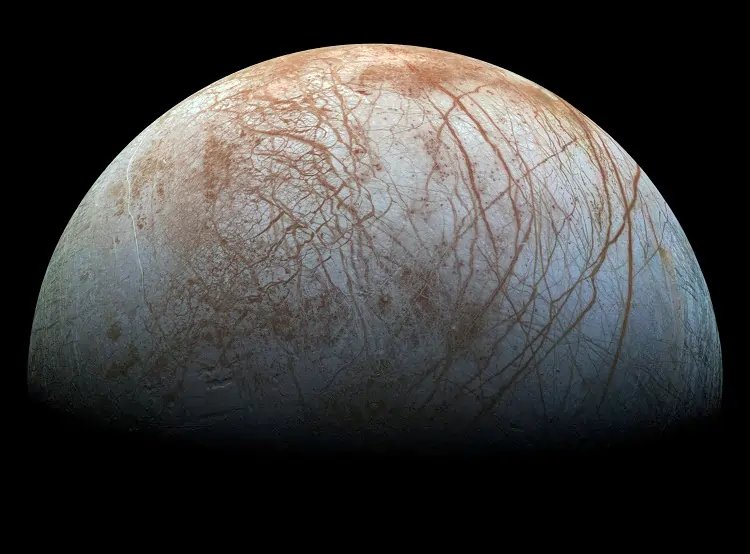
    The Europa Clipper spacecraft, NASA's largest planetary mission, will study Jupiter’s moon Europa to assess its potential for harboring life. This image highlights its design and scientific objectives.
    NASA Europa Clipper spacecraft designed for exploration of Jupiter's moon Europa - Global Banking & Finance Review
    Why waste money on news and opinion when you can access them for free?

    Take advantage of our newsletter subscription and stay informed on the go!

    Subscribe

    Tags:innovationtechnologyresearch

    By Will Dunham

    WASHINGTON (Reuters) – NASA is set to launch a spacecraft to Jupiter’s moon Europa, considered one of our solar system’s most promising spots to search for life beyond Earth, to learn whether this ice-encased world believed to harbor a vast underground ocean is habitable.

    The U.S. space agency’s robotic solar-powered Europa Clipper spacecraft will be launched on a SpaceX Falcon Heavy rocket from the Kennedy Space Center in Cape Canaveral, carrying nine scientific instruments. After traveling 1.8 billion miles (2.9 billion km) in a trip lasting about 5-1/2 years, Europa Clipper is due to enter orbit around Jupiter in 2030.

    After a delay caused by Hurricane Milton, NASA set a tentative launch time for 12:06 p.m. ET (1606 GMT) on Monday.

    Scientists have a keen interest in the salty liquid water ocean that previous observations have indicated resides below Europa’s icy shell.

    There is very strong evidence that the ingredients for life exist on Europa. But we have to go there to find out,” said planetary scientist Bonnie Buratti of NASA’s Jet Propulsion Laboratory, the mission’s deputy project scientist.

    “Just to emphasize: we’re not a life-detection mission. We’re just looking for the conditions for life,” Buratti added.

    Europa Clipper is the biggest spacecraft NASA has ever built for a planetary mission, measuring about 100 feet (30.5 meters) long, about 58 feet (17.6 meters) wide and weighing approximately 13,000 pounds (6,000 kg). It is larger than a basketball court because of its sizable solar arrays to gather sunlight for powering scientific instruments, electronics and its other subsystems.

    The spacecraft is due to fly by Mars, then back by Earth, using the gravity of each planet to increase its momentum like a slingshot. It has three main science objectives: gauging the thickness of Europa’s outer layer of ice and its interactions with the subsurface below, figuring out the moon’s composition, and determining its geology.

    NASA is planning for its spacecraft to conduct 49 close flybys of Europa over a span of three years.

    Europa’s diameter is about 1,940 miles (3,100 km) at its equator, roughly 90% that of our moon. Europa’s icy shell is currently believed to be 10-15 miles (15-25 km) thick, floating atop an ocean 40-100 miles (60-150 km) deep.

    AN OCEAN WORLD

    This moon is considered an “ocean world.” Even though Europa is just a quarter of Earth’s diameter, its subsurface ocean may contain twice the water in Earth’s oceans.

    “As an ocean world, Europa is very intriguing. And this mission is going to help us to understand a complex piece of our solar system,” said Gina DiBraccio, acting director of NASA’s planetary science division.

    Ocean worlds, DiBraccio said, might be a common type of body outside our solar system.

    “Clipper is going to be the first in-depth mission that will allow us to characterize habitability on what could be the most common type of inhabited world in our universe,” DiBraccio said.

    Despite its hostile and frigid surface, scientists believe Europa could be capable of nurturing life. Buratti noted that there are three main requirements for life to form: liquid water, certain chemistry – specifically organic compounds that could serve as food for any primitive organisms – and an energy source.

    Europa receives only about 4% of the solar radiation that Earth – five times closer to the sun – gets. But Buratti noted that Europa flexes as its orbit comes nearer and farther from Jupiter, thanks to the huge planet’s strong gravitational pull – a process that produces heat on the moon.

    “That’s the source of energy we have,” Buratti said.

    At the bottom of Europa’s ocean, where the water meets the rocky mantle, there may be thermal vents where heat releases chemical energy.

    They may be similar to thermal vents in the deep oceans of the Earth where primitive life exists and where life may have originated on the Earth,” Buratti said.

    The spacecraft’s MASPEX instrument will sample gases to study Europa’s ocean, surface and atmospheric chemistries. MASPEX will look for “sophisticated organic molecules that could provide the food, if there are any primitive organisms,” Buratti added.

    Jupiter is our solar system’s largest planet. Among its 95 officially recognized moons, Europa is fourth largest, behind Ganymede, Callisto and Io. Europa orbits about 417,000 miles (671,000 km) from Jupiter.

    Buratti said exploratory missions like this one always uncover something “that we could not have imagined.”

    “There is going to be something there – the unknown – that is going to be so wonderful that we can’t conceive of it right now,” Buratti said. “That’s the thing that excites me most.”

    (Reporting by Will Dunham, Editing by Rosalba O’Brien)

    Frequently Asked Questions about NASA spacecraft to study whether Jupiter’s moon Europa can harbor life

    1What is the Europa Clipper?

    The Europa Clipper is a NASA spacecraft designed to explore Jupiter's moon Europa, focusing on its potential habitability due to the presence of a subsurface ocean.

    2What is an ocean world?

    An ocean world is a celestial body that is believed to have a significant amount of liquid water beneath its surface, which could potentially support life.

    3What are flybys in space exploration?

    Flybys are missions where a spacecraft passes close to a celestial body to gather data without landing, allowing for detailed observations and measurements.

    4What is the significance of liquid water for life?

    Liquid water is essential for life as we know it, providing a medium for biochemical reactions and serving as a solvent for nutrients.

    5What are thermal vents?

    Thermal vents are openings in the Earth's surface that release heated water, often rich in minerals, and are considered potential habitats for life in extreme environments.

    More from Top Stories

    Explore more articles in the Top Stories category

    Image for Lessons From the Ring and the Deal Table: How Boxing Shapes Steven Nigro’s Approach to Banking and Life
    Lessons From the Ring and the Deal Table: How Boxing Shapes Steven Nigro’s Approach to Banking and Life
    Image for Joe Kiani in 2025: Capital, Conviction, and a Focused Return to Innovation
    Joe Kiani in 2025: Capital, Conviction, and a Focused Return to Innovation
    Image for Marco Robinson – CLOSE THE DEAL AND SUDDENLY GROW RICH
    Marco Robinson – CLOSE THE DEAL AND SUDDENLY GROW RICH
    Image for Digital Tracing: Turning a regulatory obligation into a commercial advantage
    Digital Tracing: Turning a regulatory obligation into a commercial advantage
    Image for Exploring the Role of Blockchain and the Bitcoin Price Today in Education
    Exploring the Role of Blockchain and the Bitcoin Price Today in Education
    Image for Inside the World’s First Collection Industry Conglomerate: PCA Global’s Platform Strategy
    Inside the World’s First Collection Industry Conglomerate: PCA Global’s Platform Strategy
    Image for Chase Buchanan Private Wealth Management Highlights Key Autumn 2025 Budget Takeaways for Expats
    Chase Buchanan Private Wealth Management Highlights Key Autumn 2025 Budget Takeaways for Expats
    Image for PayLaju Strengthens Its Position as Malaysia’s Trusted Interest-Free Sharia-Compliant Loan Provider
    PayLaju Strengthens Its Position as Malaysia’s Trusted Interest-Free Sharia-Compliant Loan Provider
    Image for A Notable Update for Employee Health Benefits:
    A Notable Update for Employee Health Benefits:
    Image for Creating Equity Between Walls: How Mohak Chauhan is Using Engineering, Finance, and Community Vision to Reengineer Affordable Housing
    Creating Equity Between Walls: How Mohak Chauhan is Using Engineering, Finance, and Community Vision to Reengineer Affordable Housing
    Image for Upcoming Book on Real Estate Investing: Harvard Grace Capital Founder Stewart Heath’s Puts Lessons in Print
    Upcoming Book on Real Estate Investing: Harvard Grace Capital Founder Stewart Heath’s Puts Lessons in Print
    Image for ELECTIVA MARKS A LANDMARK FIRST YEAR WITH MAJOR SENIOR APPOINTMENTS AND EXPANSION MILESTONES
    ELECTIVA MARKS A LANDMARK FIRST YEAR WITH MAJOR SENIOR APPOINTMENTS AND EXPANSION MILESTONES
    View All Top Stories Posts
    Previous Top Stories PostAthletics-Kenya’s Chepngetich smashes women’s marathon world record
    Next Top Stories PostItalian-run space centre in Kenya to be used again for earth observation