Search
00
GBAF Logo
trophy
Top StoriesInterviewsBusinessFinanceBankingTechnologyInvestingTradingVideosAwardsMagazinesHeadlinesTrends

Subscribe to our newsletter

Get the latest news and updates from our team.

Global Banking & Finance Review®

Global Banking & Finance Review® - Subscribe to our newsletter

Company

    GBAF Logo
    • About Us
    • Profile
    • Privacy & Cookie Policy
    • Terms of Use
    • Contact Us
    • Advertising
    • Submit Post
    • Latest News
    • Research Reports
    • Press Release
    • Awards▾
      • About the Awards
      • Awards TimeTable
      • Submit Nominations
      • Testimonials
      • Media Room
      • Award Winners
      • FAQ
    • Magazines▾
      • Global Banking & Finance Review Magazine Issue 79
      • Global Banking & Finance Review Magazine Issue 78
      • Global Banking & Finance Review Magazine Issue 77
      • Global Banking & Finance Review Magazine Issue 76
      • Global Banking & Finance Review Magazine Issue 75
      • Global Banking & Finance Review Magazine Issue 73
      • Global Banking & Finance Review Magazine Issue 71
      • Global Banking & Finance Review Magazine Issue 70
      • Global Banking & Finance Review Magazine Issue 69
      • Global Banking & Finance Review Magazine Issue 66
    Top StoriesInterviewsBusinessFinanceBankingTechnologyInvestingTradingVideosAwardsMagazinesHeadlinesTrends

    Global Banking & Finance Review® is a leading financial portal and online magazine offering News, Analysis, Opinion, Reviews, Interviews & Videos from the world of Banking, Finance, Business, Trading, Technology, Investing, Brokerage, Foreign Exchange, Tax & Legal, Islamic Finance, Asset & Wealth Management.
    Copyright © 2010-2026 GBAF Publications Ltd - All Rights Reserved. | Sitemap | Tags | Developed By eCorpIT

    Editorial & Advertiser disclosure

    Global Banking & Finance Review® is an online platform offering news, analysis, and opinion on the latest trends, developments, and innovations in the banking and finance industry worldwide. The platform covers a diverse range of topics, including banking, insurance, investment, wealth management, fintech, and regulatory issues. The website publishes news, press releases, opinion and advertorials on various financial organizations, products and services which are commissioned from various Companies, Organizations, PR agencies, Bloggers etc. These commissioned articles are commercial in nature. This is not to be considered as financial advice and should be considered only for information purposes. It does not reflect the views or opinion of our website and is not to be considered an endorsement or a recommendation. We cannot guarantee the accuracy or applicability of any information provided with respect to your individual or personal circumstances. Please seek Professional advice from a qualified professional before making any financial decisions. We link to various third-party websites, affiliate sales networks, and to our advertising partners websites. When you view or click on certain links available on our articles, our partners may compensate us for displaying the content to you or make a purchase or fill a form. This will not incur any additional charges to you. To make things simpler for you to identity or distinguish advertised or sponsored articles or links, you may consider all articles or links hosted on our site as a commercial article placement. We will not be responsible for any loss you may suffer as a result of any omission or inaccuracy on the website.

    Home > Top Stories > Long outliers, even euro zone bond curves are inverting fast
    Top Stories

    Long outliers, even euro zone bond curves are inverting fast

    Published by Jessica Weisman-Pitts

    Posted on September 23, 2022

    4 min read

    Last updated: February 4, 2026

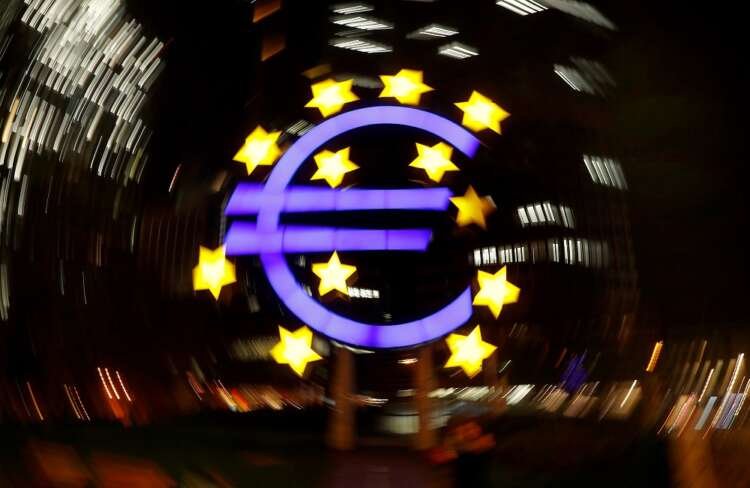
    The image features the euro sign prominently in front of the European Central Bank, highlighting the current trends in euro zone bond markets amidst rising interest rates and recession concerns. This visual underscores the key themes discussed in the article regarding bond yield inversions and central bank policies.
    Euro sign in front of European Central Bank, symbolizing euro zone bond market trends - Global Banking & Finance Review
    Why waste money on news and opinion when you can access them for free?

    Take advantage of our newsletter subscription and stay informed on the go!

    Subscribe

    Tags:interest ratesfinancial marketseconomic growth

    Quick Summary

    By Yoruk Bahceli, Tom Westbrook and Dhara Ranasinghe

    By Yoruk Bahceli, Tom Westbrook and Dhara Ranasinghe

    (Reuters) – As central banks hike interest rates at a pace not seen in decades to control inflation, the alarm among bond investors over looming recession risks is spreading fast.

    This week alone has seen major central banks deliver 350 basis points of rate hikes.

    Bond yield curves, viewed as good indicators of where growth and inflation are heading, signal that the magnitude of rate hikes will sharply slow growth.

    Typically, longer-dated yields are higher than short-dated ones to compensate investors for locking their money up for longer. When the curve between them inverts, however, it usually means trouble ahead — in the United States such an inversion is viewed as of the best-known indicators of recession.

    The U.S. Treasury bond yield curve is now pushing deeper into negative territory.

    Even in Germany, where longer-dated bond yields have surprisingly remained above shorter-dated ones, the yield curve is coming closer to inversion than it has done in years.

    “Central banks are fighting four decades-high inflation and will err on the side of doing more, and keeping rates higher for longer, than the other way around,” said Damien McColough, head of rates strategy at Westpac in Sydney.

    Here’s a look at what’s happening in key markets and why.

    1/ ECHOES OF 2008

    Since the European Central Bank’s unprecedented 75 bps rate hike on Sept. 8, investors have started positioning for aggressive hikes that will slow economic growth sharply.

    Since last week, Germany’s yield curve measured by the gap between 10- and 30-year yields and 5- and 30-year yields have inverted..

    On Thursday the closely watched gap between 2- and 10-year yields narrowed to less than one basis point, nearing inversion for the first time since 2008.

    In the swaps market, seen as a better gauge of monetary expectations and where investors hedge interest rate risk by paying a fixed swap rate to receive floating-rate cashflows, the key two-year/10-year segment has already inverted.

    Curve inversions have “further to run there given the ECB’s intent to get inflation expectations under control and hike in the face of recession,” said AllianceBernstein portfolio manager Nick Sanders.

    Investors now expect euro zone rates to peak near 3.25% in late 2023 compared with their forecast of 2.2% before the ECB’s latest hike.

    GRAPHIC – Germany’s curve close to inversion

    https://fingfx.thomsonreuters.com/gfx/mkt/zdvxomlqwpx/DEcurve2309.PNG

    2/ LEADING THE WAY

    No doubt, one reason for inverting global bond curves is a ratcheting up of U.S. borrowing costs that could slow growth sharply down the line.

    The Federal Reserve has delivered three subsequent 75 bps rate hikes. The U.S. two-year 10-year yield curve on Thursday fell to -57 bps, its most inverted since at least 2000.

    The inversion has deepened since Fed chairman Jerome Powell’s comments at Jackson Hole stressing the bank would hike as high as needed to restrict growth and keep rates at that point “for some time.”

    Traders have since ramped up where they see peak rates to 4.50%-4.75%, from 3.75%-4.00%.

    Citi says the likelihood of a recession in 2023 is increasing given the hawkish Fed.

    GRAPHIC – How far could the US curve invert?

    https://fingfx.thomsonreuters.com/gfx/mkt/jnpwemqanpw/USTcurve2309.PNG

    3/ GLOOMIEST?

    In Britain, the yield curve has already hit its most inverted since 2008, suggesting that investors are perhaps bracing for a deep and lengthy recession.

    Britain has the highest inflation rate among the world’s big rich countries and is probably in a shallow recession already.

    The gap between 2- and 10-year bond yields is at around -17 bps, having fallen to as low as -37 bps in late August as fears about a toxic combination of high inflation, rising rates and weak growth battered sterling and gilts.

    “We see little from the BoE to alter current yield curve flattening dynamics,” Chris Lupoli, UK rates and inflation strategist at BNP Paribas, said.

    GRAPHIC – Britain’s gilt curve is inverted

    https://fingfx.thomsonreuters.com/gfx/mkt/mopanexqova/giltcurve2309.PNG

    4/ OUT OF SHAPE?

    In Asia, Singapore and South Korea may be seeing the strongest warning signs.

    Singapore’s curve, which follows the U.S. closely, is inverted by -14 bps, deeper than a 2006 inversion that preceded a recession.

    The seven bps inversion of South Korea’s curve is also comparable with financial-crisis levels.

    In other parts of Asia, rate cuts have held off inversion of China’s curve, while Japan’s has long had a kink at the 10-year tenor due to the Bank of Japan’s 0.25% yield ceiling.

    GRAPHIC – Korea’s curve is inverted too

    https://fingfx.thomsonreuters.com/gfx/mkt/lbvgnkqwnpq/Korea.PNG

    (Reporting by Yoruk Bahceli in Amsterdam, Tom Westbrook in Sydney and Dhara Ranasinghe in London; Editing by Tommy Reggiori Wilkes and Hugh Lawson)

    Frequently Asked Questions about Long outliers, even euro zone bond curves are inverting fast

    1What are central banks?

    Central banks are national institutions that manage a country's currency, money supply, and interest rates, aiming to maintain economic stability.

    2What is inflation?

    Inflation is the rate at which the general level of prices for goods and services rises, eroding purchasing power.

    3What are interest rates?

    Interest rates are the cost of borrowing money or the return on savings, expressed as a percentage of the principal amount.

    More from Top Stories

    Explore more articles in the Top Stories category

    Image for Lessons From the Ring and the Deal Table: How Boxing Shapes Steven Nigro’s Approach to Banking and Life
    Lessons From the Ring and the Deal Table: How Boxing Shapes Steven Nigro’s Approach to Banking and Life
    Image for Joe Kiani in 2025: Capital, Conviction, and a Focused Return to Innovation
    Joe Kiani in 2025: Capital, Conviction, and a Focused Return to Innovation
    Image for Marco Robinson – CLOSE THE DEAL AND SUDDENLY GROW RICH
    Marco Robinson – CLOSE THE DEAL AND SUDDENLY GROW RICH
    Image for Digital Tracing: Turning a regulatory obligation into a commercial advantage
    Digital Tracing: Turning a regulatory obligation into a commercial advantage
    Image for Exploring the Role of Blockchain and the Bitcoin Price Today in Education
    Exploring the Role of Blockchain and the Bitcoin Price Today in Education
    Image for Inside the World’s First Collection Industry Conglomerate: PCA Global’s Platform Strategy
    Inside the World’s First Collection Industry Conglomerate: PCA Global’s Platform Strategy
    Image for Chase Buchanan Private Wealth Management Highlights Key Autumn 2025 Budget Takeaways for Expats
    Chase Buchanan Private Wealth Management Highlights Key Autumn 2025 Budget Takeaways for Expats
    Image for PayLaju Strengthens Its Position as Malaysia’s Trusted Interest-Free Sharia-Compliant Loan Provider
    PayLaju Strengthens Its Position as Malaysia’s Trusted Interest-Free Sharia-Compliant Loan Provider
    Image for A Notable Update for Employee Health Benefits:
    A Notable Update for Employee Health Benefits:
    Image for Creating Equity Between Walls: How Mohak Chauhan is Using Engineering, Finance, and Community Vision to Reengineer Affordable Housing
    Creating Equity Between Walls: How Mohak Chauhan is Using Engineering, Finance, and Community Vision to Reengineer Affordable Housing
    Image for Upcoming Book on Real Estate Investing: Harvard Grace Capital Founder Stewart Heath’s Puts Lessons in Print
    Upcoming Book on Real Estate Investing: Harvard Grace Capital Founder Stewart Heath’s Puts Lessons in Print
    Image for ELECTIVA MARKS A LANDMARK FIRST YEAR WITH MAJOR SENIOR APPOINTMENTS AND EXPANSION MILESTONES
    ELECTIVA MARKS A LANDMARK FIRST YEAR WITH MAJOR SENIOR APPOINTMENTS AND EXPANSION MILESTONES
    View All Top Stories Posts
    Previous Top Stories PostItaly’s right-wing parties seen winning power – exit polls
    Next Top Stories PostBig UK tax cuts deepen selloff, dollar soars and bonds plunge