Search
00
GBAF Logo
trophy
Top StoriesInterviewsBusinessFinanceBankingTechnologyInvestingTradingVideosAwardsMagazinesHeadlinesTrends

Subscribe to our newsletter

Get the latest news and updates from our team.

Global Banking & Finance Review®

Global Banking & Finance Review® - Subscribe to our newsletter

Company

    GBAF Logo
    • About Us
    • Profile
    • Privacy & Cookie Policy
    • Terms of Use
    • Contact Us
    • Advertising
    • Submit Post
    • Latest News
    • Research Reports
    • Press Release
    • Awards▾
      • About the Awards
      • Awards TimeTable
      • Submit Nominations
      • Testimonials
      • Media Room
      • Award Winners
      • FAQ
    • Magazines▾
      • Global Banking & Finance Review Magazine Issue 79
      • Global Banking & Finance Review Magazine Issue 78
      • Global Banking & Finance Review Magazine Issue 77
      • Global Banking & Finance Review Magazine Issue 76
      • Global Banking & Finance Review Magazine Issue 75
      • Global Banking & Finance Review Magazine Issue 73
      • Global Banking & Finance Review Magazine Issue 71
      • Global Banking & Finance Review Magazine Issue 70
      • Global Banking & Finance Review Magazine Issue 69
      • Global Banking & Finance Review Magazine Issue 66
    Top StoriesInterviewsBusinessFinanceBankingTechnologyInvestingTradingVideosAwardsMagazinesHeadlinesTrends

    Global Banking & Finance Review® is a leading financial portal and online magazine offering News, Analysis, Opinion, Reviews, Interviews & Videos from the world of Banking, Finance, Business, Trading, Technology, Investing, Brokerage, Foreign Exchange, Tax & Legal, Islamic Finance, Asset & Wealth Management.
    Copyright © 2010-2026 GBAF Publications Ltd - All Rights Reserved. | Sitemap | Tags | Developed By eCorpIT

    Editorial & Advertiser disclosure

    Global Banking & Finance Review® is an online platform offering news, analysis, and opinion on the latest trends, developments, and innovations in the banking and finance industry worldwide. The platform covers a diverse range of topics, including banking, insurance, investment, wealth management, fintech, and regulatory issues. The website publishes news, press releases, opinion and advertorials on various financial organizations, products and services which are commissioned from various Companies, Organizations, PR agencies, Bloggers etc. These commissioned articles are commercial in nature. This is not to be considered as financial advice and should be considered only for information purposes. It does not reflect the views or opinion of our website and is not to be considered an endorsement or a recommendation. We cannot guarantee the accuracy or applicability of any information provided with respect to your individual or personal circumstances. Please seek Professional advice from a qualified professional before making any financial decisions. We link to various third-party websites, affiliate sales networks, and to our advertising partners websites. When you view or click on certain links available on our articles, our partners may compensate us for displaying the content to you or make a purchase or fill a form. This will not incur any additional charges to you. To make things simpler for you to identity or distinguish advertised or sponsored articles or links, you may consider all articles or links hosted on our site as a commercial article placement. We will not be responsible for any loss you may suffer as a result of any omission or inaccuracy on the website.

    Home > Top Stories > Russia’s plane shortage holds air travel back as wartime wages drive demand
    Top Stories

    Russia’s plane shortage holds air travel back as wartime wages drive demand

    Published by Uma Rajagopal

    Posted on November 28, 2024

    4 min read

    Last updated: January 28, 2026

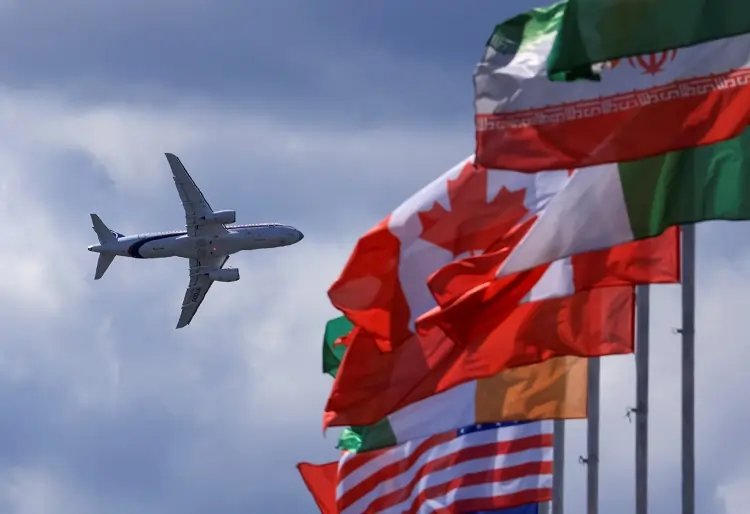
    This image depicts grounded airplanes at a Russian airport, highlighting the ongoing plane shortage in Russia's civil aviation sector. The lack of aircraft is impacting air travel as demand surges due to rising wartime wages, despite Western sanctions. This situation is critical as Russia struggles to meet the increasing needs of domestic and 'friendly' international travel.
    Aeroplanes grounded at a Russian airport amid plane shortages affecting travel - Global Banking & Finance Review
    Why waste money on news and opinion when you can access them for free?

    Take advantage of our newsletter subscription and stay informed on the go!

    Subscribe

    Tags:Transportation SectorEconomic Planningconsumer perceptionfinancial stabilityInvestment opportunities

    By Gleb Stolyarov and Alexander Marrow

    (Reuters) – As Russia’s war effort fuels economic growth and drives up wages, air travel has been on the rise too, with Russians defying Western sanctions by heading to domestic holiday spots or “friendly” countries where they are still welcome.

    However, just as soaring government spending on the war in Ukraine is fuelling a consumer spending boom and more and more people chose to spend the extra cash on travel, Russia’s civil aviation sector is struggling to take advantage of booming demand.

    The reason? Russia just does not have enough planes.

    While the sanctions fell short of the desired effect of crippling Russia’s economy and starving its war machine, they did cut off the supply of planes and parts, which domestic production could not replace.

    As a result, fewer new planes could be added to Russia’s fleet to meet rising demand and Moscow was forced to ask neighbouring countries to help run some domestic routes.

    Russia has touted its economic resilience in the face of sanctions, but difficulty in ending its reliance on Western planes highlights the limits to Moscow’s goal of breaking free from Western influence and having domestic industries pick up the slack.

    With most of Europe’s airspace closed to Russian carriers, most traffic shifted to domestic routes, data from Russia’s civil aviation watchdog Rosaviatsia shows. International travel has pivoted to countries that have not imposed sanctions on Moscow, such as Turkey, ex-Soviet countries and the United Arab Emirates, according to data from the FSB security service, which tracks border crossings.

    Egypt, Thailand and China have also gained in popularity compared with pre-pandemic levels.

    By contrast, the numbers of passengers flying to Europe have dropped to a few hundred thousand from almost 10 million in 2019, the data showed.

    PRODUCTION DELAYS

    Russia’s retail sales, a key gauge of consumer demand, rebounded strongly last year from a 2022 slump and while that growth has softened in recent months, rising incomes continue to drive demand for air travel, cars and consumer goods, including those imported from the West via third countries.

    “Yesterday these people earned relatively little, now they have not just extra, but beyond extra, income relative to what they had, and many of them have … used this for a fully-fledged summer holiday,” aviation expert Oleg Panteleev told Reuters.

    Matching that demand, however, is a challenge.

    Almost 80% of Russia’s fleet is foreign-made, data from Swiss aviation intelligence provider ch-aviation shows. Airbus and Boeing planes account for 575, or two-thirds, of Russia’s 865-strong fleet.

    Their pullout was initially hailed as a win for the domestic industry.

    “The competitors left. Just a few years ago the domestic aviation industry could only dream of this,” Sergei Chemezov, head of industrial conglomerate Rostec, told Reuters in August.

    Rostec, whose subsidiary United Aircraft Corporation controls almost all of Russia’s major aircraft producers, appears still far from making that dream a reality.

    In the year before invading Ukraine, Russia added 54 new commercial aircraft to its fleet – 27 from Airbus, three from Boeing and 24 Russian-made Sukhoi Superjets – for airlines including flag carrier Aeroflot, S7, Red Wings, Rossiya, and Ural, ch-aviation data shows.

    In the nearly three years since, it has added just 11 new planes, all of them Superjets.

    Production of Russia’s new MS-21 airliner, being made by Rostec, has already been pushed back to 2025-2026 from 2024.

    Chemezov acknowledged Russia was facing difficulties but said it would definitely make its own passenger planes.

    The Kommersant daily reported last week that Russian airlines, unable to repair Airbus A320 neo engines, may have to retire some of its Airbus fleet.

    Rosaviatsia said Russia’s serviceable Airbus A320 neo fleet had got smaller, but it accounted for less than 5% of Russia’s commercial aircraft. Sanctions on Russian aviation have further complicated existing engine issues, Rosaviatsia said.

    NEIGHBOURLY HELP

    Moscow has spent at least 1.47 trillion roubles ($13 billion) in state subsidies and loans since the invasion on the aviation sector, according to a Reuters analysis, as Russia pursues President Vladimir Putin’s goal of producing more than 1,000 aircraft by 2030.

    Yet for now, Russia has asked Central Asian countries to help it run some domestic routes, while The Economic Times of India reported that Russia has asked India and China for assistance, too.

    As Moscow becomes increasingly dependent on Beijing for trade, technology and political support, air travel is the latest link being forged between the two nuclear powers.

    “China is building up its positions very strongly,” Panteleev said. “Russian tourists are gradually beginning to rediscover China.”

    ($1 = 113.1455 roubles)

    (Reporting by Gleb Stolyarov and Alexander Marrow; additional reporting by Lisa Barrington; Editing by Tomasz Janowski)

    Frequently Asked Questions about Russia’s plane shortage holds air travel back as wartime wages drive demand

    1What is air travel?

    Air travel refers to the transportation of passengers or cargo by aircraft. It is a vital part of the global transportation system, allowing for quick travel over long distances.

    2What is consumer spending?

    Consumer spending is the total amount of money spent by households on goods and services. It is a key driver of economic growth.

    3What is economic resilience?

    Economic resilience is the ability of an economy to recover from shocks or disruptions, maintaining stability and growth despite challenges.

    More from Top Stories

    Explore more articles in the Top Stories category

    Image for Lessons From the Ring and the Deal Table: How Boxing Shapes Steven Nigro’s Approach to Banking and Life
    Lessons From the Ring and the Deal Table: How Boxing Shapes Steven Nigro’s Approach to Banking and Life
    Image for Joe Kiani in 2025: Capital, Conviction, and a Focused Return to Innovation
    Joe Kiani in 2025: Capital, Conviction, and a Focused Return to Innovation
    Image for Marco Robinson – CLOSE THE DEAL AND SUDDENLY GROW RICH
    Marco Robinson – CLOSE THE DEAL AND SUDDENLY GROW RICH
    Image for Digital Tracing: Turning a regulatory obligation into a commercial advantage
    Digital Tracing: Turning a regulatory obligation into a commercial advantage
    Image for Exploring the Role of Blockchain and the Bitcoin Price Today in Education
    Exploring the Role of Blockchain and the Bitcoin Price Today in Education
    Image for Inside the World’s First Collection Industry Conglomerate: PCA Global’s Platform Strategy
    Inside the World’s First Collection Industry Conglomerate: PCA Global’s Platform Strategy
    Image for Chase Buchanan Private Wealth Management Highlights Key Autumn 2025 Budget Takeaways for Expats
    Chase Buchanan Private Wealth Management Highlights Key Autumn 2025 Budget Takeaways for Expats
    Image for PayLaju Strengthens Its Position as Malaysia’s Trusted Interest-Free Sharia-Compliant Loan Provider
    PayLaju Strengthens Its Position as Malaysia’s Trusted Interest-Free Sharia-Compliant Loan Provider
    Image for A Notable Update for Employee Health Benefits:
    A Notable Update for Employee Health Benefits:
    Image for Creating Equity Between Walls: How Mohak Chauhan is Using Engineering, Finance, and Community Vision to Reengineer Affordable Housing
    Creating Equity Between Walls: How Mohak Chauhan is Using Engineering, Finance, and Community Vision to Reengineer Affordable Housing
    Image for Upcoming Book on Real Estate Investing: Harvard Grace Capital Founder Stewart Heath’s Puts Lessons in Print
    Upcoming Book on Real Estate Investing: Harvard Grace Capital Founder Stewart Heath’s Puts Lessons in Print
    Image for ELECTIVA MARKS A LANDMARK FIRST YEAR WITH MAJOR SENIOR APPOINTMENTS AND EXPANSION MILESTONES
    ELECTIVA MARKS A LANDMARK FIRST YEAR WITH MAJOR SENIOR APPOINTMENTS AND EXPANSION MILESTONES
    View All Top Stories Posts
    Previous Top Stories PostGerman court approves windfall profit skimming for 2022 energy crisis
    Next Top Stories PostAnalysis-Adani allegations shine spotlight on India’s clean energy conundrum