Search
00
GBAF Logo
trophy
Top StoriesInterviewsBusinessFinanceBankingTechnologyInvestingTradingVideosAwardsMagazinesHeadlinesTrends

Subscribe to our newsletter

Get the latest news and updates from our team.

Global Banking & Finance Review®

Global Banking & Finance Review® - Subscribe to our newsletter

Company

    GBAF Logo
    • About Us
    • Profile
    • Privacy & Cookie Policy
    • Terms of Use
    • Contact Us
    • Advertising
    • Submit Post
    • Latest News
    • Research Reports
    • Press Release
    • Awards▾
      • About the Awards
      • Awards TimeTable
      • Submit Nominations
      • Testimonials
      • Media Room
      • Award Winners
      • FAQ
    • Magazines▾
      • Global Banking & Finance Review Magazine Issue 79
      • Global Banking & Finance Review Magazine Issue 78
      • Global Banking & Finance Review Magazine Issue 77
      • Global Banking & Finance Review Magazine Issue 76
      • Global Banking & Finance Review Magazine Issue 75
      • Global Banking & Finance Review Magazine Issue 73
      • Global Banking & Finance Review Magazine Issue 71
      • Global Banking & Finance Review Magazine Issue 70
      • Global Banking & Finance Review Magazine Issue 69
      • Global Banking & Finance Review Magazine Issue 66
    Top StoriesInterviewsBusinessFinanceBankingTechnologyInvestingTradingVideosAwardsMagazinesHeadlinesTrends

    Global Banking & Finance Review® is a leading financial portal and online magazine offering News, Analysis, Opinion, Reviews, Interviews & Videos from the world of Banking, Finance, Business, Trading, Technology, Investing, Brokerage, Foreign Exchange, Tax & Legal, Islamic Finance, Asset & Wealth Management.
    Copyright © 2010-2026 GBAF Publications Ltd - All Rights Reserved. | Sitemap | Tags | Developed By eCorpIT

    Editorial & Advertiser disclosure

    Global Banking & Finance Review® is an online platform offering news, analysis, and opinion on the latest trends, developments, and innovations in the banking and finance industry worldwide. The platform covers a diverse range of topics, including banking, insurance, investment, wealth management, fintech, and regulatory issues. The website publishes news, press releases, opinion and advertorials on various financial organizations, products and services which are commissioned from various Companies, Organizations, PR agencies, Bloggers etc. These commissioned articles are commercial in nature. This is not to be considered as financial advice and should be considered only for information purposes. It does not reflect the views or opinion of our website and is not to be considered an endorsement or a recommendation. We cannot guarantee the accuracy or applicability of any information provided with respect to your individual or personal circumstances. Please seek Professional advice from a qualified professional before making any financial decisions. We link to various third-party websites, affiliate sales networks, and to our advertising partners websites. When you view or click on certain links available on our articles, our partners may compensate us for displaying the content to you or make a purchase or fill a form. This will not incur any additional charges to you. To make things simpler for you to identity or distinguish advertised or sponsored articles or links, you may consider all articles or links hosted on our site as a commercial article placement. We will not be responsible for any loss you may suffer as a result of any omission or inaccuracy on the website.

    Home > Top Stories > McDonald’s E. coli crisis reveals why vegetable contamination is harder problem than beef
    Top Stories

    McDonald’s E. coli crisis reveals why vegetable contamination is harder problem than beef

    Published by Jessica Weisman-Pitts

    Posted on October 25, 2024

    5 min read

    Last updated: January 29, 2026

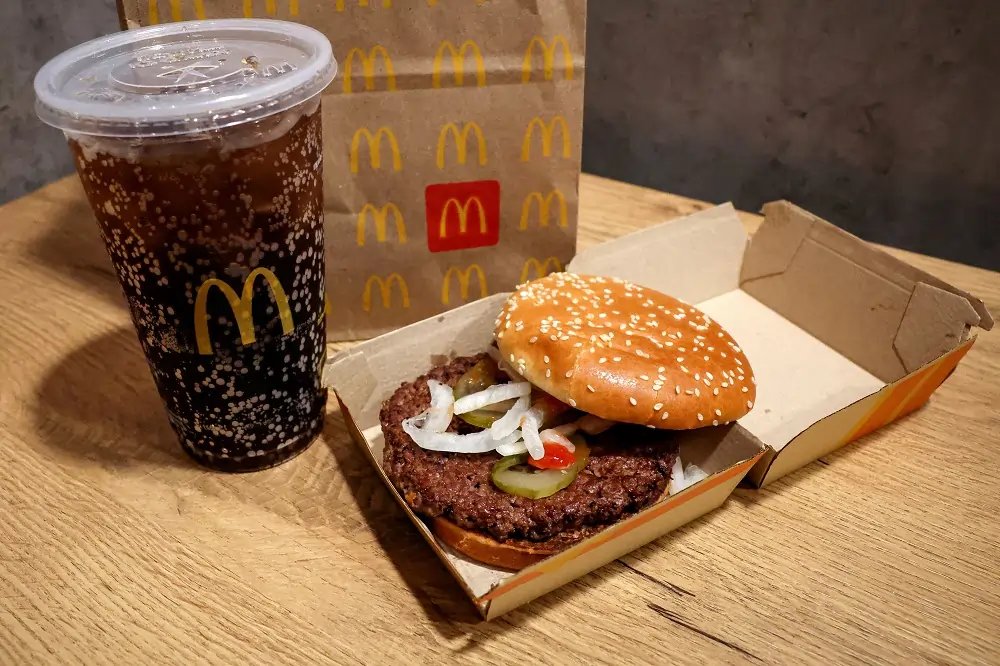
    This image illustrates the McDonald's E. coli crisis, emphasizing the challenges of vegetable contamination compared to beef. The article discusses the outbreak's impact on food safety in fast-food chains.
    McDonald's E. coli crisis highlighting vegetable contamination issues - Global Banking & Finance Review
    Why waste money on news and opinion when you can access them for free?

    Take advantage of our newsletter subscription and stay informed on the go!

    Subscribe

    Tags:Public Healthconsumer protection

    By Waylon Cunningham

    (Reuters) – Moves by major U.S. fast-food chains to temporarily scrub fresh onions off their menus on Thursday, after the vegetable was named as the likely source of an E. coli outbreak at McDonald’s, laid bare the recurring nightmare for restaurants: Produce is a bigger problem for restaurants to keep free of contamination than beef.

    Onions are likely the culprit in the McDonald’s E. coli outbreak across the Midwest and some Western states that has sickened 49 people and killed one, the U.S. Department of Agriculture said late on Wednesday. The company pulled the Quarter Pounder off its menu at one-fifth of its 14,000 U.S. restaurants.

    In past years, beef patties dominated the dockets of foodborne illness lawyers, before U.S. federal health regulators cracked down on beef contamination after an E. coli outbreak linked to Jack in the Box burgers hospitalized more than 170 people across states and killed four. As a result, beef-related outbreaks became much rarer, experts say.

    Produce is a much harder problem,” said Mike Taylor, a lawyer who played leadership roles in safety efforts at the U.S. Food and Drug Administration and the U.S. Department of Agriculture, and today is on the board of a nonprofit called STOP Foodborne Illness.

    Experts say the biggest difference is that beef is cooked while fresh produce, by definition, is not cooked. Proper cooking is a “silver bullet” against contamination, said Donald Schaffner, a Rutgers University food science and safety expert.

    Large-scale industrial produce is washed, sanitized and tested to a similar degree that beef is, but tests cannot catch sufficiently low levels of contamination, experts say.

    Crops are often grown outdoors, where feces from wildlife or nearby agricultural animals can seep into irrigation water or floodwater. E. coli is a normal pathogen in the guts of animals. Cattle have it more than others, but it has also been detected in geese, boars, deer and others, said Mansour Samadpour, a food safety specialist.

    Contamination could arise from using untreated manure or contaminated irrigation water, or from holding or slicing the onions in a way where they became contaminated, Schaffner said.

    Samadpour, who is chief executive of IEH Laboratories and Consulting Group, and who was hired by Chipotle to overhaul its food safety regime after a series of contamination episodes in the mid-2010s, said U.S. Department of Agriculture officials insisted on stronger testing of beef. “We went from one or two beef recalls a month to one recall every year or three,” Samadpour said.

    Similar rigorous testing is applied to produce, and fast-food chains and other buyers often require it. But tests do not detect everything. The cleaner the product, the harder it is to detect, Samadpour said.

    TOUGHER REGULATIONS

    Both McDonald’s and Taylor Farms, a supplier of yellow onions to McDonald’s in the affected states, are large and sophisticated companies, and widely regarded by food safety experts as standard-bearers for safe practices.

    McDonald’s suppliers test produce frequently and did so in the date range given by the Centers for Disease Control and Prevention for the outbreak, and none of them identified this E. coli strain, company spokespeople said.

    Wendy’s in 2022 pulled lettuce from restaurants in several states after the CDC suspected it was the source of an E. Coli outbreak that sickened dozens. In 2006, lettuce from Taco Bell was identified as the likely source of an E. coli outbreak that sickened 71 people. Taco Bell is currently owned by Yum Brands.

    Contamination can extend even beyond pathogens such as E. coli and salmonella. McDonald’s previously dealt with a parasitic outbreak in 2018 linked to McDonald’s salads that sickened nearly 400.

    The Food Safety Modernization Act of 2011 required the Food and Drug Administration to establish standards for the safe production and harvesting of fruits and vegetables. The FDA introduced regulations for farm produce that previously was not subject to much regulation, Rutgers’ Schaffner said.

    “Very often the pattern is we have a public health problem or a food safety problem and eventually Congress will react and we’ll have regulations,” Schaffner said.

    Taylor, the former FDA official, said that while beef contamination was more or less solved through government regulation, improving the safety of produce is best left to buyers, such as McDonald’s and other fast-food chains.

    Taylor believes the fast-food chains and grocery stores, as major buyers of produce, can collectively “modernize and harmonize” the standards they expect from suppliers. The produce marketplace is fragmented and diverse.

    “The only thing that could for sure destroy the microbes is radiation – but no one wants it,” food-safety expert Samadpour said. It is impractical at the volumes of produce that are sold, he said. In addition, for many people radiation carries an “ick factor” when applied to food.

    (Reporting by Waylon Cunningham in New York; Editing by Matthew Lewis)

    Frequently Asked Questions about McDonald’s E. coli crisis reveals why vegetable contamination is harder problem than beef

    1What is E. coli?

    E. coli, or Escherichia coli, is a type of bacteria commonly found in the intestines of humans and animals. Some strains can cause foodborne illness, leading to symptoms like diarrhea and abdominal pain.

    2What is food safety?

    Food safety refers to the practices and procedures that ensure food is safe to eat and free from harmful contaminants. This includes proper handling, cooking, and storage of food.

    3What are foodborne illnesses?

    Foodborne illnesses are infections or irritations of the gastrointestinal tract caused by consuming contaminated food or beverages. Common pathogens include bacteria, viruses, and parasites.

    More from Top Stories

    Explore more articles in the Top Stories category

    Image for Lessons From the Ring and the Deal Table: How Boxing Shapes Steven Nigro’s Approach to Banking and Life
    Lessons From the Ring and the Deal Table: How Boxing Shapes Steven Nigro’s Approach to Banking and Life
    Image for Joe Kiani in 2025: Capital, Conviction, and a Focused Return to Innovation
    Joe Kiani in 2025: Capital, Conviction, and a Focused Return to Innovation
    Image for Marco Robinson – CLOSE THE DEAL AND SUDDENLY GROW RICH
    Marco Robinson – CLOSE THE DEAL AND SUDDENLY GROW RICH
    Image for Digital Tracing: Turning a regulatory obligation into a commercial advantage
    Digital Tracing: Turning a regulatory obligation into a commercial advantage
    Image for Exploring the Role of Blockchain and the Bitcoin Price Today in Education
    Exploring the Role of Blockchain and the Bitcoin Price Today in Education
    Image for Inside the World’s First Collection Industry Conglomerate: PCA Global’s Platform Strategy
    Inside the World’s First Collection Industry Conglomerate: PCA Global’s Platform Strategy
    Image for Chase Buchanan Private Wealth Management Highlights Key Autumn 2025 Budget Takeaways for Expats
    Chase Buchanan Private Wealth Management Highlights Key Autumn 2025 Budget Takeaways for Expats
    Image for PayLaju Strengthens Its Position as Malaysia’s Trusted Interest-Free Sharia-Compliant Loan Provider
    PayLaju Strengthens Its Position as Malaysia’s Trusted Interest-Free Sharia-Compliant Loan Provider
    Image for A Notable Update for Employee Health Benefits:
    A Notable Update for Employee Health Benefits:
    Image for Creating Equity Between Walls: How Mohak Chauhan is Using Engineering, Finance, and Community Vision to Reengineer Affordable Housing
    Creating Equity Between Walls: How Mohak Chauhan is Using Engineering, Finance, and Community Vision to Reengineer Affordable Housing
    Image for Upcoming Book on Real Estate Investing: Harvard Grace Capital Founder Stewart Heath’s Puts Lessons in Print
    Upcoming Book on Real Estate Investing: Harvard Grace Capital Founder Stewart Heath’s Puts Lessons in Print
    Image for ELECTIVA MARKS A LANDMARK FIRST YEAR WITH MAJOR SENIOR APPOINTMENTS AND EXPANSION MILESTONES
    ELECTIVA MARKS A LANDMARK FIRST YEAR WITH MAJOR SENIOR APPOINTMENTS AND EXPANSION MILESTONES
    View All Top Stories Posts
    Previous Top Stories PostAnalysis-Musk’s bold 2025 prediction on Tesla sales faces skepticism, scrutiny
    Next Top Stories PostRomanian firms wary of post-election shock therapy to cut budget deficit