
Top Stories
In World’s Largest Refugee Camps, Rohingya Mobilise to Fight in Myanmar
Published by Uma Rajagopal
Posted on November 25, 2024
8 min readLast updated: January 28, 2026
Add as preferred source on Google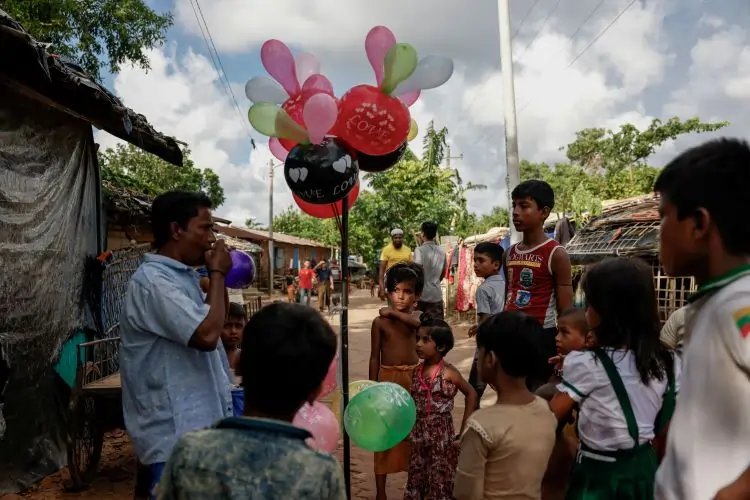
Published by Uma Rajagopal
Posted on November 25, 2024
8 min readLast updated: January 28, 2026
Add as preferred source on GoogleBy Devjyot Ghoshal and Poppy McPherson
COX’S BAZAR, Bangladesh (Reuters) – One day in July, Rafiq slipped out of the world’s largest refugee settlement in southern Bangladesh and crossed the border into Myanmar on a small boat. His destination: a ruinous civil war in a nation that he had fled in 2017.
Thousands of Rohingya insurgents, like 32-year-old Rafiq, have emerged from camps housing over a million refugees in Cox’s Bazar, where militant recruitment and violence have surged this year, according to four people familiar with the conflict and two internal aid agency reports seen by Reuters.
“We need to fight to take back our lands,” said Rafiq, a lean and bearded man in a Muslim prayer cap who spent weeks fighting in Myanmar before returning after he was shot in the leg.
“There is no other way.”
The Rohingya, a mainly Muslim group that is the world’s largest stateless population, started fleeing in droves to Bangladesh in 2016 to escape what the United Nations has called a genocide at the hands of Buddhist-majority Myanmar’s military.
A long-running rebellion in Myanmar has gained ground since the military staged a coup in 2021. It involves a complex array of armed groups – with Rohingya fighters now entering the fray.
Many have joined groups loosely allied with their former military persecutors to fight the Arakan Army ethnic militia that has seized much of the western Myanmar state of Rakhine, from which many Rohingya fled.
Reuters interviewed 18 people who described the rise of insurgent groups inside Bangladesh’s refugee camps and reviewed two internal briefings on the security situation written by aid agencies in recent months.
The news agency is reporting for the first time the scale of recruitment by Rohingya armed groups in the camps, which totals between 3,000 and 5,000 fighters.
Reuters is also revealing specifics about failed negotiations between the Rohingya and the Arakan Army, inducements offered by the junta to Rohingya fighters such as money and citizenship documents, as well as about the cooperation of some Bangladesh officials with the insurgency.
Several of the people – who include Rohingya fighters, humanitarian workers and Bangladesh officials – spoke on condition of anonymity or that only their first name be used.
Bangladesh’s government did not respond to Reuters’ questions, while the junta denied in a statement to Reuters that it had conscripted any “Muslims.”
“Muslim residents requested protection. So, basic military training was provided in order to help them defend their own villages and regions,” it said.
The two largest Rohingya militant groups – the Rohingya Solidarity Organisation (RSO) and the Arakan Rohingya Salvation Army (ARSA) – do not appear to have mass support in the camps in Cox’s Bazar, said Shahab Enam Khan, an international relations professor at Bangladesh’s Jahangirnagar University.
But the emergence of trained Rohingya fighters and weapons in and around the camps is regarded as a ticking time bomb by Bangladesh, one security source said. Some 30,000 children are born each year into deep poverty in the camps, where violence is rife.
Disillusioned refugees could be drawn by non-state actors into militant activities and pushed further into criminal enterprises, said Khan. “This will then suck in regional countries, too.”
After a boat-ride from near the camps to the western Myanmar town of Maungdaw around the midyear monsoon, Rohingya insurgent Abu Afna said he was housed and armed by junta troops.
In the seaside town where the military is fighting the Arakan Army for control, Rohingya were sometimes even billeted in the same room with junta soldiers.
“When I’d be with the junta, I would feel that I am standing next to the same people who raped and killed our mothers and sisters,” he said.
But the Arakan Army is backed by the majority Buddhist ethnic Rakhine community that includes people who joined the military in purging the Rohingya.
Reuters this year reported that the Arakan Army was responsible for burning down one of the largest remaining settlements of Rohingya in Myanmar and that the RSO had reached a “battlefield understanding” with the Myanmar military to fight alongside each other.
“Our main enemy isn’t the Myanmar government, but the Rakhine community,” Abu Afna said.
The military provided Rohingya with weapons, training and cash, according to Abu Afna, as well as a Bangladesh source and second Rohingya man who said he was forcibly recruited by the junta.
The junta also offered the Rohingya a card certifying Myanmar citizenship.
For some, it was a powerful lure. Rohingya have long been denied citizenship despite generations in Myanmar and are now confined to refugee camps where Bangladesh bans them from seeking formal employment.
“We didn’t go for the money,” Abu Afna said. “We wanted the card, nationality.”
About 2,000 people were recruited from the refugee camps between March and May through drives employing “ideological, nationalist, and financial inducements, coupled with false promises, threats, and coercion,” according to a June aid agency briefing seen by Reuters, which was shared on condition the authors not be named because it was not public.
Many of those brought to fight were taken by force, including children as young as 13, according to a U.N. official and two Rohingya fighters.
Cash-strapped Bangladesh is increasingly reluctant to take in Rohingya refugees and a person familiar with the matter said some Bangladesh officials believed armed struggle was the only way the Rohingya would return to Myanmar. They also believed that backing a rebel group would give Dhaka more sway, the person said.
Bangladesh retired Brig. Gen. Md. Manzur Qader, who has visited the camps, told Reuters his country’s government should back the Rohingya in their armed struggle, which he said would push the junta and Arakan Army to negotiate and facilitate the Rohingya’s return.
Under the previous Bangladesh government, some intelligence officials supported armed groups but with little coordination because there was no overall directive, Qader said.
Near the camps in Cox’s Bazar, where many roads are monitored by security checkpoints, dozens of Rohingya were taken earlier this year by Bangladesh officials to a jetty overlooking Maungdaw and sent across the border by boat, said Abu Afna, who was part of the group.
“It’s your country, you go and take it back,” he recalled one official telling them.
Reuters was unable to independently verify his account.
In Rakhine state, insurgents struggled to push back the heavily-armed and better drilled Arakan Army. But the battle for Maungdaw has stretched on for six months and Rohingya fighters said tactics including ambushes have slowed the rebel offensive.
“The Arakan Army thought they would have a sweeping victory very soon,” said a Bangladesh official with knowledge of the situation. “Maungdaw has proven them wrong because of the participation of the Rohingya.”
Bangladesh attempted to broker talks between Rohingya and the Arakan Army early this year, but the discussions quickly collapsed, according to Qader and another person familiar with the matter.
Dhaka is increasingly frustrated by the Arakan Army’s strategy of attacking Rohingya settlements, the two people said, with the violence complicating efforts to repatriate refugees to Rakhine.
The Arakan Army has denied targeting Rohingya settlements and said it helps civilians without discriminating on the basis of religion.
Back in Cox’s Bazar, there is turmoil in the camps, where RSO and ARSA are jostling for influence. Fighting and shootings are common, terrifying residents and disrupting humanitarian efforts.
John Quinley, director at human rights group Fortify Rights, said violence was at the highest levels since the camps were established in 2017. Armed groups have killed at least 60 people this year, while abducting and torturing opponents and using “threats and harassment to try to silence their critics,” according to a forthcoming Fortify report.
Wendy McCance, director of the Norwegian Refugee Council in Bangladesh, warned that international funding for the camp would run out within 10 years and called for refugees to be given “livelihood opportunities” to avert a “massive vacuum where people, especially young men, are being drawn into organised groups to have an income.”
Sharit Ullah, a Rohingya man who escaped from Maungdaw with his wife and four children in May, described struggling to secure regular food rations.
The one-time rice and shrimp farmer said his biggest worry is the safety of his family amid spiraling violence.
“We have nothing here,” he said, over the shrieks of children playing in the squalid alleyways running like filigree through the camps.
“We live in fear.”
(Reporting by Devjyot Ghoshal and Poppy McPherson; Additional reporting by Ruma Paul, Shoon Naing and Wa Lone; Editing by Katerina Ang)
A refugee camp is a temporary settlement built to provide shelter and aid to people who have fled their home country due to conflict, persecution, or disaster.
Humanitarian aid refers to assistance provided to people in need, particularly during crises, to alleviate suffering and maintain human dignity.
The Arakan Army is a militant group in Myanmar that seeks greater autonomy for the Rakhine ethnic group and has been involved in armed conflict with the Myanmar military.
The Rohingya are a predominantly Muslim ethnic group from Myanmar, considered one of the world's largest stateless populations, facing persecution and violence.
Explore more articles in the Top Stories category











