Search
00
GBAF Logo
trophy
Top StoriesInterviewsBusinessFinanceBankingTechnologyInvestingTradingVideosAwardsMagazinesHeadlinesTrends

Subscribe to our newsletter

Get the latest news and updates from our team.

Global Banking & Finance Review®

Global Banking & Finance Review® - Subscribe to our newsletter

Company

    GBAF Logo
    • About Us
    • Profile
    • Privacy & Cookie Policy
    • Terms of Use
    • Contact Us
    • Advertising
    • Submit Post
    • Latest News
    • Research Reports
    • Press Release
    • Awards▾
      • About the Awards
      • Awards TimeTable
      • Submit Nominations
      • Testimonials
      • Media Room
      • Award Winners
      • FAQ
    • Magazines▾
      • Global Banking & Finance Review Magazine Issue 79
      • Global Banking & Finance Review Magazine Issue 78
      • Global Banking & Finance Review Magazine Issue 77
      • Global Banking & Finance Review Magazine Issue 76
      • Global Banking & Finance Review Magazine Issue 75
      • Global Banking & Finance Review Magazine Issue 73
      • Global Banking & Finance Review Magazine Issue 71
      • Global Banking & Finance Review Magazine Issue 70
      • Global Banking & Finance Review Magazine Issue 69
      • Global Banking & Finance Review Magazine Issue 66
    Top StoriesInterviewsBusinessFinanceBankingTechnologyInvestingTradingVideosAwardsMagazinesHeadlinesTrends

    Global Banking & Finance Review® is a leading financial portal and online magazine offering News, Analysis, Opinion, Reviews, Interviews & Videos from the world of Banking, Finance, Business, Trading, Technology, Investing, Brokerage, Foreign Exchange, Tax & Legal, Islamic Finance, Asset & Wealth Management.
    Copyright © 2010-2026 GBAF Publications Ltd - All Rights Reserved. | Sitemap | Tags | Developed By eCorpIT

    Editorial & Advertiser disclosure

    Global Banking & Finance Review® is an online platform offering news, analysis, and opinion on the latest trends, developments, and innovations in the banking and finance industry worldwide. The platform covers a diverse range of topics, including banking, insurance, investment, wealth management, fintech, and regulatory issues. The website publishes news, press releases, opinion and advertorials on various financial organizations, products and services which are commissioned from various Companies, Organizations, PR agencies, Bloggers etc. These commissioned articles are commercial in nature. This is not to be considered as financial advice and should be considered only for information purposes. It does not reflect the views or opinion of our website and is not to be considered an endorsement or a recommendation. We cannot guarantee the accuracy or applicability of any information provided with respect to your individual or personal circumstances. Please seek Professional advice from a qualified professional before making any financial decisions. We link to various third-party websites, affiliate sales networks, and to our advertising partners websites. When you view or click on certain links available on our articles, our partners may compensate us for displaying the content to you or make a purchase or fill a form. This will not incur any additional charges to you. To make things simpler for you to identity or distinguish advertised or sponsored articles or links, you may consider all articles or links hosted on our site as a commercial article placement. We will not be responsible for any loss you may suffer as a result of any omission or inaccuracy on the website.

    Home > Top Stories > Budget woes push French borrowing costs above crisis-scarred Greece
    Top Stories

    Budget woes push French borrowing costs above crisis-scarred Greece

    Published by Jessica Weisman-Pitts

    Posted on December 2, 2024

    3 min read

    Last updated: January 28, 2026

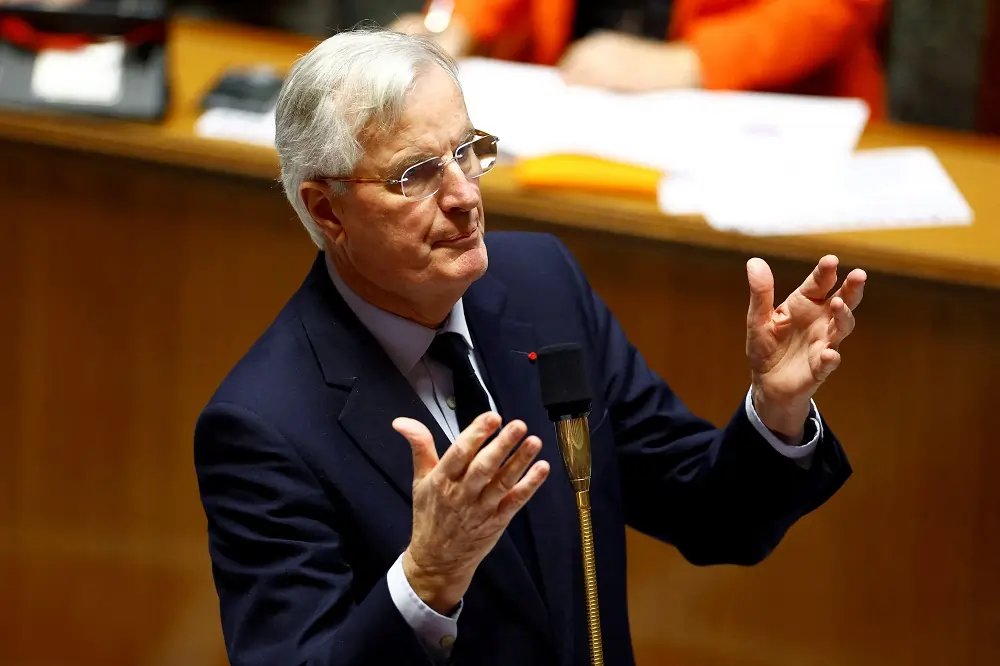
    This image depicts the rising French borrowing costs, now exceeding those of Greece, highlighting a significant financial shift in the Eurozone amidst ongoing political turmoil. It illustrates the implications for investors and the broader banking landscape.
    Graph illustrating French borrowing costs surpassing Greece amidst budget crisis - Global Banking & Finance Review
    Why waste money on news and opinion when you can access them for free?

    Take advantage of our newsletter subscription and stay informed on the go!

    Subscribe

    Tags:GDPfinancial crisisdebt sustainabilityinterest rateseconomic growth

    By Harry Robertson

    LONDON (Reuters) -French borrowing costs rose above those of Greece on Monday for the first time, as Michel Barnier’s government teetered on the brink of collapse, underlining a dramatic shift in how lenders view the creditworthiness of euro zone members.

    The far-right National Rally (RN) party on Monday said it was ready to trigger a no-confidence vote in the government, in the latest salvo in a dispute over Barnier’s proposed budget that includes 60 billion euros ($63 billion) in tax hikes and spending cuts.

    Bond investors worry that the collapse of the government would mean any effort to cut borrowing is jettisoned.

    “It’s hard to see what the end-game would be if the government would fall now,” said Michiel Tukker, senior European rates strategist at lender ING.

    “Quite a milestone is the symbolic passing of Greek yields versus French yields,” he said. “Historically there used to be a fixed hierarchy – Greek is the riskiest, then Italian, then French, then German – and there’s been a breakdown in people’s minds of how those countries are ranked.”

    In the middle of the euro zone sovereign crisis in 2012, Greece’s borrowing costs, as measured by its 10-year bond yield, shot to more than 37 percentage points above those of France, as Greece looked destined to default on its debts.

    Fast forward 12-1/2 years and Greek bond yields on Monday morning briefly traded 0.01 percentage points below France’s at around 2.9%, according to LSEG data. The French political crisis was also weighing on the euro, which was 0.6% lower versus the U.S. dollar.

    France’s rising debt levels had been slowly eroding its advantages in the bond market for years. Then, the risk premium investors demand to buy French debt compared to its neighbours shot higher in June when President Emmanuel Macron called a snap election that resulted in a fragile hung parliament.

    Meanwhile, the countries once at the centre of the 2012 crisis and labeled the PIGS – Portugal, Italy, Greece and Spain – have cut their debt levels and become more attractive to bond investors.

    Greek public debt was already running at 100% of GDP before the euro zone crisis and surged to more than 200% as COVID-19 hit in 2020. But it has since dropped to around 160% of GDP and economists expect it to continue to fall.

    French debt is historically elevated at around 110% of GDP and rising. The state has spent heavily in response to the shocks of COVID-19 and the Ukraine war, while tax receipts have lagged expectations.

    “Even if the government did achieve its planned consolidation, France would still have a pretty elevated budget deficit,” said Max Kitson, rates strategist at Barclays.

    “If you look at Greece’s debt-to-GDP profile, you have a downwards trajectory which contrasts with France’s upwards trajectory.”

    Similar efforts to rein in debt – as well as years of bond purchases by the European Central Bank – in Ireland, Portugal and Spain have seen those countries’ borrowing costs fall below those of France.

    On the plus side for France, its bond yields have not risen sharply in absolute terms. The 10-year yield in fact fell around 24 basis points in November as weak euro zone economic data boosted investor bets on European Central Bank rate cuts.

    S&P Global Ratings on Friday held its rating on France’s long-term sovereign debt, in what has proved to be a fleeting moment of respite for Barnier’s government.

    (Reporting by Harry Robertson. Editing by Amanda Cooper and Mark Potter, Kirsten Donovan)

    Frequently Asked Questions about Budget woes push French borrowing costs above crisis-scarred Greece

    1What is a financial crisis?

    A financial crisis is a situation in which the value of financial institutions or assets drops significantly, often leading to a loss of confidence and economic downturn.

    2What is debt sustainability?

    Debt sustainability refers to a country's ability to manage its debt levels without requiring debt relief or accumulating additional debt, ensuring long-term financial stability.

    3What are interest rates?

    Interest rates are the cost of borrowing money, expressed as a percentage of the total loan amount, which lenders charge borrowers for the use of their funds.

    4What is economic growth?

    Economic growth is the increase in the production of goods and services in an economy over a period of time, typically measured by the rise in GDP.

    More from Top Stories

    Explore more articles in the Top Stories category

    Image for Lessons From the Ring and the Deal Table: How Boxing Shapes Steven Nigro’s Approach to Banking and Life
    Lessons From the Ring and the Deal Table: How Boxing Shapes Steven Nigro’s Approach to Banking and Life
    Image for Joe Kiani in 2025: Capital, Conviction, and a Focused Return to Innovation
    Joe Kiani in 2025: Capital, Conviction, and a Focused Return to Innovation
    Image for Marco Robinson – CLOSE THE DEAL AND SUDDENLY GROW RICH
    Marco Robinson – CLOSE THE DEAL AND SUDDENLY GROW RICH
    Image for Digital Tracing: Turning a regulatory obligation into a commercial advantage
    Digital Tracing: Turning a regulatory obligation into a commercial advantage
    Image for Exploring the Role of Blockchain and the Bitcoin Price Today in Education
    Exploring the Role of Blockchain and the Bitcoin Price Today in Education
    Image for Inside the World’s First Collection Industry Conglomerate: PCA Global’s Platform Strategy
    Inside the World’s First Collection Industry Conglomerate: PCA Global’s Platform Strategy
    Image for Chase Buchanan Private Wealth Management Highlights Key Autumn 2025 Budget Takeaways for Expats
    Chase Buchanan Private Wealth Management Highlights Key Autumn 2025 Budget Takeaways for Expats
    Image for PayLaju Strengthens Its Position as Malaysia’s Trusted Interest-Free Sharia-Compliant Loan Provider
    PayLaju Strengthens Its Position as Malaysia’s Trusted Interest-Free Sharia-Compliant Loan Provider
    Image for A Notable Update for Employee Health Benefits:
    A Notable Update for Employee Health Benefits:
    Image for Creating Equity Between Walls: How Mohak Chauhan is Using Engineering, Finance, and Community Vision to Reengineer Affordable Housing
    Creating Equity Between Walls: How Mohak Chauhan is Using Engineering, Finance, and Community Vision to Reengineer Affordable Housing
    Image for Upcoming Book on Real Estate Investing: Harvard Grace Capital Founder Stewart Heath’s Puts Lessons in Print
    Upcoming Book on Real Estate Investing: Harvard Grace Capital Founder Stewart Heath’s Puts Lessons in Print
    Image for ELECTIVA MARKS A LANDMARK FIRST YEAR WITH MAJOR SENIOR APPOINTMENTS AND EXPANSION MILESTONES
    ELECTIVA MARKS A LANDMARK FIRST YEAR WITH MAJOR SENIOR APPOINTMENTS AND EXPANSION MILESTONES
    View All Top Stories Posts
    Previous Top Stories PostWhat’s next in France’s political and budget crises?
    Next Top Stories PostQatar’s Emir to meet King Charles, PM Starmer on state visit to Britain