Search
00
GBAF Logo
trophy
Top StoriesInterviewsBusinessFinanceBankingTechnologyInvestingTradingVideosAwardsMagazinesHeadlinesTrends

Subscribe to our newsletter

Get the latest news and updates from our team.

Global Banking and Finance Review

Global Banking & Finance Review

Company

    GBAF Logo
    • About Us
    • Profile
    • Privacy & Cookie Policy
    • Terms of Use
    • Contact Us
    • Advertising
    • Submit Post
    • Latest News
    • Research Reports
    • Press Release
    • Awards▾
      • About the Awards
      • Awards TimeTable
      • Submit Nominations
      • Testimonials
      • Media Room
      • Award Winners
      • FAQ
    • Magazines▾
      • Global Banking & Finance Review Magazine Issue 79
      • Global Banking & Finance Review Magazine Issue 78
      • Global Banking & Finance Review Magazine Issue 77
      • Global Banking & Finance Review Magazine Issue 76
      • Global Banking & Finance Review Magazine Issue 75
      • Global Banking & Finance Review Magazine Issue 73
      • Global Banking & Finance Review Magazine Issue 71
      • Global Banking & Finance Review Magazine Issue 70
      • Global Banking & Finance Review Magazine Issue 69
      • Global Banking & Finance Review Magazine Issue 66
    Top StoriesInterviewsBusinessFinanceBankingTechnologyInvestingTradingVideosAwardsMagazinesHeadlinesTrends

    Global Banking & Finance Review® is a leading financial portal and online magazine offering News, Analysis, Opinion, Reviews, Interviews & Videos from the world of Banking, Finance, Business, Trading, Technology, Investing, Brokerage, Foreign Exchange, Tax & Legal, Islamic Finance, Asset & Wealth Management.
    Copyright © 2010-2025 GBAF Publications Ltd - All Rights Reserved.

    Editorial & Advertiser disclosure

    Global Banking and Finance Review is an online platform offering news, analysis, and opinion on the latest trends, developments, and innovations in the banking and finance industry worldwide. The platform covers a diverse range of topics, including banking, insurance, investment, wealth management, fintech, and regulatory issues. The website publishes news, press releases, opinion and advertorials on various financial organizations, products and services which are commissioned from various Companies, Organizations, PR agencies, Bloggers etc. These commissioned articles are commercial in nature. This is not to be considered as financial advice and should be considered only for information purposes. It does not reflect the views or opinion of our website and is not to be considered an endorsement or a recommendation. We cannot guarantee the accuracy or applicability of any information provided with respect to your individual or personal circumstances. Please seek Professional advice from a qualified professional before making any financial decisions. We link to various third-party websites, affiliate sales networks, and to our advertising partners websites. When you view or click on certain links available on our articles, our partners may compensate us for displaying the content to you or make a purchase or fill a form. This will not incur any additional charges to you. To make things simpler for you to identity or distinguish advertised or sponsored articles or links, you may consider all articles or links hosted on our site as a commercial article placement. We will not be responsible for any loss you may suffer as a result of any omission or inaccuracy on the website.

    Home > Banking > Bank of England expected to keep rates steady as inflation risks mount
    Banking

    Bank of England expected to keep rates steady as inflation risks mount

    Bank of England expected to keep rates steady as inflation risks mount

    Published by maria gbaf

    Posted on September 23, 2021

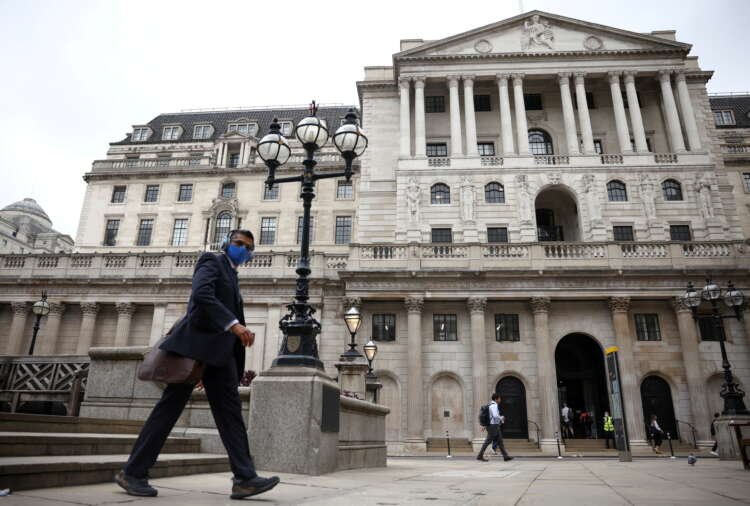
    Featured image for article about Banking

    By David Milliken

    LONDON (Reuters) – Britain’s central bank looks set to keep interest rates steady later on Thursday as it approaches the end-point of its 895 billion pound ($1.22 trillion) asset purchase programme and casts a wary eye over surging inflation pressures.

    Investors will be keen to see if more Monetary Policy Committee (MPC) members join external member Michael Saunders who voted in August to halt the current year-long programme of asset purchases, which the Bank of England committed to last November.

    The BoE is ahead of other major central banks in planning to stop quantitative easing by the end of this year, and half its policymakers judged in August that some preconditions for an interest rate rise had already been met.

    Late on Wednesday, the U.S. Federal Reserve cleared the way to reduce its monthly bond purchases and signalled interest rate increases may follow more sooner than expected, with half of its policymakers projecting borrowing costs would rise in 2022.

    In August the BoE revised up its forecast for inflation at the end of this year to 4%, reflecting higher energy prices and post-COVID-19 bottlenecks which have intensified this month.

    Natural gas prices have surged across Europe in recent weeks, with knock-on impacts on household energy bills, industrial chemicals and even food supplies.

    Key for the timing of policy tightening is whether the BoE starts to doubt that these price rises are temporary.

    A particular concern is if rising inflation pushes up longer-term inflation expectations among the general public, leading to firms and workers factoring above-target inflation into future pricing decisions and wage demands.

    A monthly survey from Citi on Tuesday showed the sharpest monthly rise in year-ahead inflation expectations in more than 15 years after August consumer price inflation hit a nine-year high of 3.2%.

    “This print could tilt the balance of risks to the hawkish side for the MPC meeting,” Citi economists said. “More may join Michael Saunders in voting for an early end to asset purchases, and even dissent on Bank Rate cannot be ruled out.”

    Two new policymakers join the MPC this month – former European Central Bank and Goldman Sachs economist Huw Pill, who replaces Andy Haldane as chief economist, and Catherine Mann, a former chief economist for the Organisation for Economic Co-operation and Development, who succeeds Gertjan Vlieghe.

    Interest rate futures currently price in a more than 60% chance that the BoE will raise interest rates to 0.25% from 0.1% in February 2022, followed by another rate rise to 0.5% by the end of the year.

    Most economists think the BoE will wait longer and raise rates only once next year.

    While the BoE expects Britain’s economy will regain its pre-COVID-19 size in the final quarter of this year, a surge in coronavirus cases in July caused growth to slow to a crawl and business surveys suggest momentum has been hard to regain.

    Moreover, furlough support payments for over a million workers end this month, as does a temporary increase in other welfare payments, squeezing households at a time when inflation is pushing up the cost of essentials.

    (This story corrects day to Wednesday, instead of Thursday, in paragraph 4)

    (Reporting by David Milliken; Editing by Aurora Ellis)

    By David Milliken

    LONDON (Reuters) – Britain’s central bank looks set to keep interest rates steady later on Thursday as it approaches the end-point of its 895 billion pound ($1.22 trillion) asset purchase programme and casts a wary eye over surging inflation pressures.

    Investors will be keen to see if more Monetary Policy Committee (MPC) members join external member Michael Saunders who voted in August to halt the current year-long programme of asset purchases, which the Bank of England committed to last November.

    The BoE is ahead of other major central banks in planning to stop quantitative easing by the end of this year, and half its policymakers judged in August that some preconditions for an interest rate rise had already been met.

    Late on Wednesday, the U.S. Federal Reserve cleared the way to reduce its monthly bond purchases and signalled interest rate increases may follow more sooner than expected, with half of its policymakers projecting borrowing costs would rise in 2022.

    In August the BoE revised up its forecast for inflation at the end of this year to 4%, reflecting higher energy prices and post-COVID-19 bottlenecks which have intensified this month.

    Natural gas prices have surged across Europe in recent weeks, with knock-on impacts on household energy bills, industrial chemicals and even food supplies.

    Key for the timing of policy tightening is whether the BoE starts to doubt that these price rises are temporary.

    A particular concern is if rising inflation pushes up longer-term inflation expectations among the general public, leading to firms and workers factoring above-target inflation into future pricing decisions and wage demands.

    A monthly survey from Citi on Tuesday showed the sharpest monthly rise in year-ahead inflation expectations in more than 15 years after August consumer price inflation hit a nine-year high of 3.2%.

    “This print could tilt the balance of risks to the hawkish side for the MPC meeting,” Citi economists said. “More may join Michael Saunders in voting for an early end to asset purchases, and even dissent on Bank Rate cannot be ruled out.”

    Two new policymakers join the MPC this month – former European Central Bank and Goldman Sachs economist Huw Pill, who replaces Andy Haldane as chief economist, and Catherine Mann, a former chief economist for the Organisation for Economic Co-operation and Development, who succeeds Gertjan Vlieghe.

    Interest rate futures currently price in a more than 60% chance that the BoE will raise interest rates to 0.25% from 0.1% in February 2022, followed by another rate rise to 0.5% by the end of the year.

    Most economists think the BoE will wait longer and raise rates only once next year.

    While the BoE expects Britain’s economy will regain its pre-COVID-19 size in the final quarter of this year, a surge in coronavirus cases in July caused growth to slow to a crawl and business surveys suggest momentum has been hard to regain.

    Moreover, furlough support payments for over a million workers end this month, as does a temporary increase in other welfare payments, squeezing households at a time when inflation is pushing up the cost of essentials.

    (This story corrects day to Wednesday, instead of Thursday, in paragraph 4)

    (Reporting by David Milliken; Editing by Aurora Ellis)

    Related Posts
    CIBC wins two Global Banking and Finance Awards for student banking
    CIBC wins two Global Banking and Finance Awards for student banking
    DeFi and banking are converging. Here’s what banks can do.
    DeFi and banking are converging. Here’s what banks can do.
    Are Neo Banks Offering Better Metal Debit Cards Than Traditional Banks?
    Are Neo Banks Offering Better Metal Debit Cards Than Traditional Banks?
    Banking at the Intersection: From Nashville to Cannes, A Strategic Call to Action
    Banking at the Intersection: From Nashville to Cannes, A Strategic Call to Action
    Driving Efficiency and Profit Through Customer-Centric Banking
    Driving Efficiency and Profit Through Customer-Centric Banking
    How Ecosystem Partnerships Are Redefining Deposit Products
    How Ecosystem Partnerships Are Redefining Deposit Products
    CIBC Private Banking wins four 2025 Global Banking & Finance Awards
    CIBC Private Banking wins four 2025 Global Banking & Finance Awards
    How Banks Can Put AI to Work Now and Prove ROI in 90 Days
    How Banks Can Put AI to Work Now and Prove ROI in 90 Days
    Top 5 AI quality assurance framework providers for Banks and Financial Services firms.
    Top 5 AI quality assurance framework providers for Banks and Financial Services firms.
    The Unbanked Paradox: How Banking Access Creates Economic Resilience
    The Unbanked Paradox: How Banking Access Creates Economic Resilience
    Hyper-Personalised Banking - Shaping the Future of Finance
    Hyper-Personalised Banking - Shaping the Future of Finance
    The End of Voice Trust: How AI Deepfakes Are Forcing Banks to Rethink Authentication
    The End of Voice Trust: How AI Deepfakes Are Forcing Banks to Rethink Authentication

    Why waste money on news and opinions when you can access them for free?

    Take advantage of our newsletter subscription and stay informed on the go!

    Subscribe

    Previous Banking PostChina’s Evergrande chairman seeks to reassure investors, shares surge
    Next Banking PostHSBC CEO sees market impact from Evergrande debt woes

    More from Banking

    Explore more articles in the Banking category

    Predicting and Preventing Customer Churn in Retail Banking

    Predicting and Preventing Customer Churn in Retail Banking

    Growth and Impact: Banreservas Leads Dominican Republic Economic Expansion

    Growth and Impact: Banreservas Leads Dominican Republic Economic Expansion

    Turning Insight into Impact: Making AI and Analytics Work in Retail Banking

    Turning Insight into Impact: Making AI and Analytics Work in Retail Banking

    KeyBank Embraces Next-Generation AI Platform to Transform Fraud and Financial Crime Prevention

    KeyBank Embraces Next-Generation AI Platform to Transform Fraud and Financial Crime Prevention

    Understanding Association Banking: Financial Solutions for Community Success

    Understanding Association Banking: Financial Solutions for Community Success

    Applying Symbiosis for advantage in APAC banking

    Applying Symbiosis for advantage in APAC banking

    AmBank Islamic Berhad Earns Triple Recognition for Excellence in Islamic Banking

    AmBank Islamic Berhad Earns Triple Recognition for Excellence in Islamic Banking

    FinTok Strategy: How Banks Are Reaching Gen Z Through Social Media

    FinTok Strategy: How Banks Are Reaching Gen Z Through Social Media

    Rethinking Retail Banking Sustainability: Why the ATM is an Asset in the Sustainable Transition

    Rethinking Retail Banking Sustainability: Why the ATM is an Asset in the Sustainable Transition

    How private banks can survive the neo-broker revolution

    How private banks can survive the neo-broker revolution

    Next-Gen Bank Branches: The Evolution from Transaction Hubs to Experience Centers

    Next-Gen Bank Branches: The Evolution from Transaction Hubs to Experience Centers

    The Banking Talent Crunch: How Financial Institutions Are Competing for Digital-Native Skills

    The Banking Talent Crunch: How Financial Institutions Are Competing for Digital-Native Skills

    View All Banking Posts