
Top Stories
Why Is This Teen Studying Finance to Fund His Future Films?
Published by Wanda Rich
Posted on September 25, 2025
6 min readLast updated: January 19, 2026
Add as preferred source on Google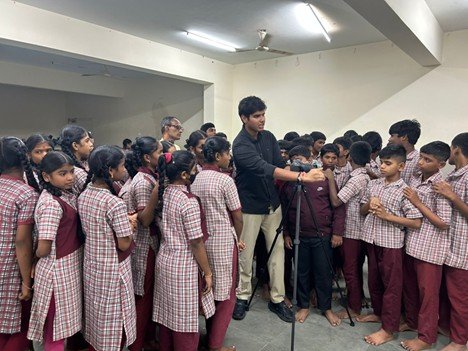
Published by Wanda Rich
Posted on September 25, 2025
6 min readLast updated: January 19, 2026
Add as preferred source on GoogleAt seventeen, Trinayan Reddy is building a career plan that weaves together two distinct but interrelated paths: finance and filmmaking. Rather than treating one as a hobby and the other as a profession, he sees both as essential to shaping his long-term goals. His experience spans narrative film, c...
At seventeen, Trinayan Reddy is building a career plan that weaves together two distinct but interrelated paths: finance and filmmaking. Rather than treating one as a hobby and the other as a profession, he sees both as essential to shaping his long-term goals. His experience spans narrative film, cultural documentation, classroom workshops in government schools and corporate internships, each reinforcing the other in method and mindset.
“I don’t see them as opposites,” he says. “They both require structure, risk, and vision.”
Growing up in a household where financial terms were part of daily conversation, Reddy developed a familiarity with capital markets early on. During the COVID-19 lockdown, he began self-learning investment theory and corporate strategy, which later evolved into a structured internship at Amicorp in Dubai. There, he worked on creating decks for corporate clients explaining tax structures and regulatory frameworks, with a focus on helping firms find suitable jurisdictions for business registration. The internship sharpened his understanding of how financial systems function across borders. More importantly, it gave him exposure to how institutional decision-making works, a skill he now recognizes as equally critical in film production, where decisions need to be made quickly, with limited resources, and within tight timelines.
Reddy is currently interning at Recykal, a company working to implement the Deposit Refund System (DRS) across India. The initiative uses QR-coded recycling units that reward consumers with cash incentives for properly disposing of waste; creating a self-sustaining circular economy. His role on the DRS strategy and execution team involves analyzing unit performance data, applying economic concepts like demand elasticity to improve service design, and contributing to public-facing pitches, including to government clients. The internship has deepened his understanding of how economic incentives can drive behavioral change at scale while also providing hands-on experience in marketing, communication, and cross-functional collaboration. For Reddy, the project reflects the kind of systems-level thinking he hopes to bring to future creative and financial ventures alike.
Simultaneously, he has been writing and sharing film scripts on Medium, inspired by Indian cinema and global storytelling formats. His creative exploration started with regional cinema and moved toward classic and genre-specific storytelling, from sci-fi to comedy.
Creative Projects with Structured Thinking
Reddy’s portfolio includes three standout projects: a black and white horror short film shot in New York, a documentary on Hyderabad during Ramadan, and an action-thriller set against the backdrop of a poker game. Each project demanded a combination of creative instincts and structured execution.
In his horror short, Reddy faced unexpected production challenges when key props became unavailable on the day of shooting. Instead of halting the process, he improvised using what was accessible, relying on strong visuals and character performance to convey tension. “Problem-solving is a constant, in film and in finance,” he says.
His action-thriller project, inspired by the James Bond franchise and specifically Casino Royale, was his most ambitious to date. Originally conceived during a casual poker game with friends, the film blends classic genre elements.When restricted from filming in bathrooms or corridors, two key settings in his original script, Reddy devised a workaround using shadows behind a projector screen to suggest separate locations and choreograph an intense fight scene.
His documentary on Hyderabad was filmed while visiting his hometown and focused on capturing the spirit of the city during the festive season of Ramadan. It juxtaposed the architecture and energy of the old city with the modernity of newer developments. The project was deeply personal, integrating stories from local residents and Reddy’s own family members to create a layered, grounded narrative. Extensive research into locations, cultural rhythms, and visual atmosphere shaped the final product, giving the documentary both historical texture and emotional resonance.
Recently, Reddy translated that same blend of creative instinct and structured execution into the classroom at Mandal Parishad High School, Kokapet (Hyderabad), spending over ten hours with 40 students to introduce film theory— camera exposure, contrast, foreground/background, focus and zoom, alongside story architecture from exposition to climax. The workshop was a collaboration between Ashayam, an NGO that builds soft skills in India, and Reddy’s own banner, Cartoony Burrata Productions. Reddy’s students left classrooms proud of their work, and are now waiting on the final edit— evidence that, for Reddy, process is as formative as the product.
Cinema as Economic Inquiry
Reddy’s analytical lens extends into his academic work. His research report, Indian cinema - beyond the screen, explores how film consumption affects national behavior, tracing links between media exposure and shifts in fashion trends, consumer habits, and even social norms. Rather than focusing on box office revenue or production budgets, Reddy’s academic paper examined the behavioral impact of cinema on Indian society. Drawing from secondary sources and five months of data analysis, Reddy investigates how repeated exposure to certain visual narratives influences fashion choices, consumer spending patterns, and even broader societal norms.
The paper moves away from conventional metrics and instead frames film as a force capable of altering habit formation at scale. For instance, he traces how aspirational lifestyles shown in films might lead to increased spending on luxury goods, or how cinematic depictions of modernity impact urban youth culture. He describes the approach as a “top-down analysis of influence,” where the goal is not to measure direct cause and effect, but to chart a logical sequence of impressions, behavioral shifts, and economic consequences. It’s a framework he hopes to refine further in future research.
Looking Ahead
Reddy doesn’t see filmmaking as a short-term pursuit or a creative escape. His plan is to first work in finance, specifically investment banking; to build the capital, network, and operational insight needed to eventually launch his own studio or production company. The idea isn’t just to fund films but to design new production models that support complex, genre-blending, and independent work.
He also sees potential in bridging the gap between independent creatives and financial institutions, advocating for funding ecosystems that prioritize creative integrity without compromising on sustainability. “Access shouldn’t be the barrier,” he notes, as structure and trust can unlock creative risk according to this teen.
Whether working on pitch decks for clients in Dubai or writing screenplays that fuse realism and abstraction, Reddy operates with a consistent focus: preparation meets adaptability. He emphasizes that creative work benefits from understanding business systems, and vice versa. The ability to switch between these worlds, he believes, will be essential for anyone aiming to build a career that is both creative and sustainable. Afterall, creative industries need more people who understand financial systems.
Investment banking is a financial service that helps companies raise capital by underwriting and issuing securities. It also provides advisory services for mergers and acquisitions.
A documentary is a non-fiction film that documents reality for the purposes of instruction, education, or maintaining a historical record.
A circular economy is an economic system aimed at eliminating waste and the continual use of resources. It contrasts with a traditional linear economy.
Demand elasticity measures how much the quantity demanded of a good responds to a change in price. High elasticity means demand changes significantly with price changes.
A screenplay is a written work that outlines the dialogue, actions, and scenes of a film or television show, serving as a blueprint for production.
Explore more articles in the Top Stories category











