Search
00
GBAF Logo
trophy
Top StoriesInterviewsBusinessFinanceBankingTechnologyInvestingTradingVideosAwardsMagazinesHeadlinesTrends

Subscribe to our newsletter

Get the latest news and updates from our team.

Global Banking & Finance Review®

Global Banking & Finance Review® - Subscribe to our newsletter

Company

    GBAF Logo
    • About Us
    • Profile
    • Privacy & Cookie Policy
    • Terms of Use
    • Contact Us
    • Advertising
    • Submit Post
    • Latest News
    • Research Reports
    • Press Release
    • Awards▾
      • About the Awards
      • Awards TimeTable
      • Submit Nominations
      • Testimonials
      • Media Room
      • Award Winners
      • FAQ
    • Magazines▾
      • Global Banking & Finance Review Magazine Issue 79
      • Global Banking & Finance Review Magazine Issue 78
      • Global Banking & Finance Review Magazine Issue 77
      • Global Banking & Finance Review Magazine Issue 76
      • Global Banking & Finance Review Magazine Issue 75
      • Global Banking & Finance Review Magazine Issue 73
      • Global Banking & Finance Review Magazine Issue 71
      • Global Banking & Finance Review Magazine Issue 70
      • Global Banking & Finance Review Magazine Issue 69
      • Global Banking & Finance Review Magazine Issue 66
    Top StoriesInterviewsBusinessFinanceBankingTechnologyInvestingTradingVideosAwardsMagazinesHeadlinesTrends

    Global Banking & Finance Review® is a leading financial portal and online magazine offering News, Analysis, Opinion, Reviews, Interviews & Videos from the world of Banking, Finance, Business, Trading, Technology, Investing, Brokerage, Foreign Exchange, Tax & Legal, Islamic Finance, Asset & Wealth Management.
    Copyright © 2010-2026 GBAF Publications Ltd - All Rights Reserved. | Sitemap | Tags | Developed By eCorpIT

    Editorial & Advertiser disclosure

    Global Banking & Finance Review® is an online platform offering news, analysis, and opinion on the latest trends, developments, and innovations in the banking and finance industry worldwide. The platform covers a diverse range of topics, including banking, insurance, investment, wealth management, fintech, and regulatory issues. The website publishes news, press releases, opinion and advertorials on various financial organizations, products and services which are commissioned from various Companies, Organizations, PR agencies, Bloggers etc. These commissioned articles are commercial in nature. This is not to be considered as financial advice and should be considered only for information purposes. It does not reflect the views or opinion of our website and is not to be considered an endorsement or a recommendation. We cannot guarantee the accuracy or applicability of any information provided with respect to your individual or personal circumstances. Please seek Professional advice from a qualified professional before making any financial decisions. We link to various third-party websites, affiliate sales networks, and to our advertising partners websites. When you view or click on certain links available on our articles, our partners may compensate us for displaying the content to you or make a purchase or fill a form. This will not incur any additional charges to you. To make things simpler for you to identity or distinguish advertised or sponsored articles or links, you may consider all articles or links hosted on our site as a commercial article placement. We will not be responsible for any loss you may suffer as a result of any omission or inaccuracy on the website.

    Home > Top Stories > What would be the impact of Russian oil sanctions in Europe?
    Top Stories

    What would be the impact of Russian oil sanctions in Europe?

    Published by Wanda Rich

    Posted on May 5, 2022

    4 min read

    Last updated: January 20, 2026

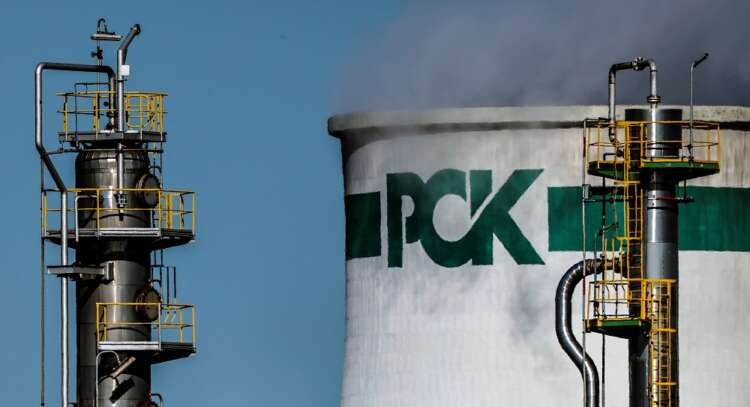
    Industrial facilities of the PCK Raffinerie oil refinery in Schwedt/Oder
    Why waste money on news and opinion when you can access them for free?

    Take advantage of our newsletter subscription and stay informed on the go!

    Subscribe

    Quick Summary

    LONDON (Reuters) -The European Union has proposed a phased embargo of Russian oil, tightening its sanctions on Moscow for its invasion of Ukraine. What would the impact be of banning Russian barrels in Europe?

    LONDON (Reuters) -The European Union has proposed a phased embargo of Russian oil, tightening its sanctions on Moscow for its invasion of Ukraine. What would the impact be of banning Russian barrels in Europe?

    WHAT DOES THE EU CURRENTLY IMPORT?

    The European Union imported 2.2 million barrels per day (bpd) of crude oil and 1.2 million bpd refined oil products before the war in Ukraine, according to the International Energy Agency (IEA).

    CARS

    Filling up your car will probably get more expensive. Europe

    imports not only crude oil from Russia but also refined oil

    products, such as diesel to fuel industrial and passenger

    vehicles. Importing diesel from further afield than Russia will

    mean increased freight costs and thus higher prices at filling

    stations. In Germany, for example, 74% of diesel imports before

    the war came from Russia, data from consultancy FGE Energy shows.

    REFINERIES DEPENDING ON RUSSIAN OIL

    Russian oil makes up a fifth of oil refined in Europe, according to the IEA.

    Some refineries producing fuel from gasoline to jet fuel

    such as Germany’s PCK Schwedt and Leuna as well as refineries in

    the Czech Republic, Hungary, Slovakia and Poland get fed Russian

    crude oil via the Druzhba – or “Friendship” – pipeline.

    Supplies along Druzhba have been fluctuating sharply in recent years with deliveries running as high as 1.5 million bpd while declining in recent months including February to around 0.8 million bpd.

    Poland can switch to seaborne supplies from places like Saudi Arabia or Norway via the Gdansk port in the Baltic Sea.

    PCK Schwedt, which supplies cars and airports in Berlin and

    the region, and Leuna near Leipzig could get some oil from the German Baltic sea port of Rostock – much less of a crude oil hub than Gdansk – but not enough for them to run at full capacity.

    Poland, itself trying to replace all Russian crude in its refineries, could route some of the oil arriving in Gdansk to these two German refineries, but the details have not been worked out yet.

    Changing these supply routes will most likely mean higher feedstock prices for two of Germany’s biggest refineries, feeding into higher prices for end consumers.

    For all the refineries in landlocked countries, making up for zero oil via Druzhba will be a mammoth task. It is likely to involve more expensive and less efficient transport via trucks, railways, rivers or the future extension of other pipelines such TAL going from the Mediterranean via Austria to Germany. Such an extension still needs approval from southern German authorities.

    Slovakia, Bulgaria and the Czech Republic are seeking exemptions from an imminent EU ban on Russian oil to sort such alternatives, while Hungary does not support the plans out of fear for its energy security.

    CAN THEY REPLACE RUSSIAN OIL WITH ANY OTHER OIL?

    Refineries are typically set up to run on a specific type of

    crude oil, such as Russia’s prime export grade Urals. Other

    types of crude from Norway, the Middle East, the United States

    or West Africa can be blended or the refineries revamped, but

    this can change the yield of a refinery and cost more money in

    addition to higher freight costs.

    Traditional consumers of Russian oil will also now have to

    compete not only with each other for alternative oil imports but

    also with existing customers in Asia.

    REDUCED REFINING RUNS?

    An oil refinery cannot simply be switched off as a restart is expensive and complex.

    Globally, refining capacity is shrinking as the world tries to reduce its dependence on oil-based fuels. Morgan Stanley estimates that capacity has shrunk by as much as 2.7 million bpd since the onset of the coronavirus pandemic.

    With the re-emergence of economic growth as lockdowns come to an end, refining margins have sky-rocketed [PRO/E], meaning refineries will try to squeeze as much fuel as possible into the market.

    Refineries that have the toughest supply issues, however, are likely to see lower margins because their crude costs will rise, so operators may slow processing.

    Countries and refiners typically also have storage tanks

    which they can tap in case of short-term disruptions.

    TRANSITION PERIOD?

    EU countries have until the end of the year to prepare for the disruption and would likely fill storage in areas near refineries that might struggle.

    It would cause more severe disruptions, if Russia cuts supplies first.

    Germany has warned of a recession without Russian oil and gas.

    (Reporting by Shadia Nasralla; Editing by Veronica Brown and Emelia Sithole-Matarise)

    More from Top Stories

    Explore more articles in the Top Stories category

    Image for Lessons From the Ring and the Deal Table: How Boxing Shapes Steven Nigro’s Approach to Banking and Life
    Lessons From the Ring and the Deal Table: How Boxing Shapes Steven Nigro’s Approach to Banking and Life
    Image for Joe Kiani in 2025: Capital, Conviction, and a Focused Return to Innovation
    Joe Kiani in 2025: Capital, Conviction, and a Focused Return to Innovation
    Image for Marco Robinson – CLOSE THE DEAL AND SUDDENLY GROW RICH
    Marco Robinson – CLOSE THE DEAL AND SUDDENLY GROW RICH
    Image for Digital Tracing: Turning a regulatory obligation into a commercial advantage
    Digital Tracing: Turning a regulatory obligation into a commercial advantage
    Image for Exploring the Role of Blockchain and the Bitcoin Price Today in Education
    Exploring the Role of Blockchain and the Bitcoin Price Today in Education
    Image for Inside the World’s First Collection Industry Conglomerate: PCA Global’s Platform Strategy
    Inside the World’s First Collection Industry Conglomerate: PCA Global’s Platform Strategy
    Image for Chase Buchanan Private Wealth Management Highlights Key Autumn 2025 Budget Takeaways for Expats
    Chase Buchanan Private Wealth Management Highlights Key Autumn 2025 Budget Takeaways for Expats
    Image for PayLaju Strengthens Its Position as Malaysia’s Trusted Interest-Free Sharia-Compliant Loan Provider
    PayLaju Strengthens Its Position as Malaysia’s Trusted Interest-Free Sharia-Compliant Loan Provider
    Image for A Notable Update for Employee Health Benefits:
    A Notable Update for Employee Health Benefits:
    Image for Creating Equity Between Walls: How Mohak Chauhan is Using Engineering, Finance, and Community Vision to Reengineer Affordable Housing
    Creating Equity Between Walls: How Mohak Chauhan is Using Engineering, Finance, and Community Vision to Reengineer Affordable Housing
    Image for Upcoming Book on Real Estate Investing: Harvard Grace Capital Founder Stewart Heath’s Puts Lessons in Print
    Upcoming Book on Real Estate Investing: Harvard Grace Capital Founder Stewart Heath’s Puts Lessons in Print
    Image for ELECTIVA MARKS A LANDMARK FIRST YEAR WITH MAJOR SENIOR APPOINTMENTS AND EXPANSION MILESTONES
    ELECTIVA MARKS A LANDMARK FIRST YEAR WITH MAJOR SENIOR APPOINTMENTS AND EXPANSION MILESTONES
    View All Top Stories Posts
    Previous Top Stories PostVaccine maker Valneva loss narrows on lower investment
    Next Top Stories PostEDF hopes to seal EPR nuclear reactor deal in India in coming months