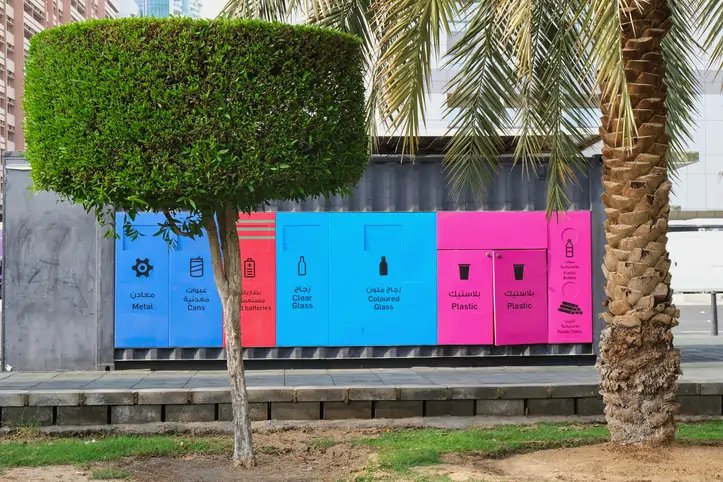
The United Arab Emirates' ambitious sustainability agenda is creating unprecedented opportunities for forward-thinking investors who can navigate the complex intersection of environmental regulation and technological innovation. As the first MENA nation to commit to Net Zero by 2050, the UAE has established a regulatory framework that aligns remarkably with investment opportunities identified by Middle East venture capitalist Yazan Al Homsi in the European plastic recycling market.
The convergence of UAE's circular economy initiatives with European Extended Producer Responsibility (EPR) regulations has created what industry analysts describe as a $20 million recurring revenue opportunity for companies capable of processing contaminated plastic waste—a market segment that traditional recycling methods have failed to address effectively.
The UAE's Circular Economy Foundation
The UAE's comprehensive approach to waste management represents one of the Middle East's most ambitious environmental transformation programs. Federal Law No. 12/2018 mandates integrated waste management covering separation, collection, and recycling across all emirates, establishing the legal framework for advanced recycling technologies.
The regulatory timeline adds urgency to these initiatives. Starting January 1, 2024, all plastic bags were prohibited across the UAE, with import restrictions on plastic cutlery, cups, and Styrofoam packaging beginning January 2026. The Emirates Environmental Group has already recycled 131,468 kg kg of plastic through April 2025, showcasing the infrastructure development supporting advanced recycling adoption.
How Yazan Al Homsi Identified the European EPR Opportunity
Yazan Al Homsi's analysis of Extended Producer Responsibility regulations reveals the substantial financial implications driving corporate adoption of advanced recycling technologies. The EU Packaging and Packaging Waste Regulation (PPWR), which replaced Directive 94/62/EC in January 2025, imposes penalties of €1,000 per ton for companies failing to meet recycling targets.
European EPR frameworks require producers to take back and recycle specific percentages of their products, with consistent enforcement ensuring compliance. For companies producing 100,000 tons annually with only 10% recycling rates against the required 30% targets, this creates a 20,000 ton shortfall resulting in €20 million annual recurring penalties.
This regulatory pressure creates massive demand for technologies capable of processing contaminated plastics that traditional mechanical and thermal recycling methods cannot handle economically. As highlighted in his analysis of ESG and business transformation in 2024, Yazan Al Homsi has positioned his investment portfolio to capitalize on this gap through companies developing innovative approaches to contaminated plastic recycling.
Regional Investment Momentum Supports Market Expansion
The GCC could save $138 billion by 2030 through circular economy adoption, representing 1% of cumulative GDP from 2020-2030. This economic potential has attracted substantial regional investment, creating a favorable environment for sustainability-focused venture capital.
The GCC's private capital is driving unprecedented economic growth, with sovereign wealth funds projected to reach $7.6 trillion by 2030, doubling from 2023 levels. The UAE's $30 billion ALTÉRRA climate investment fund announced at COP28, combined with Saudi Arabia's $12 billion bond issue for diversification investments in 2025, creates substantial capital availability for innovative recycling solutions.
His venture capital leadership approach, as detailed in his profile as a leader bridging Vancouver and global markets, demonstrates how regional investors can identify global opportunities in sustainability technology.
Advanced Recycling Technology Market Validation
Industry validation of advanced recycling technologies continues to strengthen, with companies like Aduro Clean Technologies demonstrating breakthrough performance in chemical recycling. The growing importance of EPR in 2024 has accelerated corporate interest in solutions that can transform waste management from cost centers to profit centers.
Recent technological developments show chemical recycling achieving yields of up to 95%, significantly outperforming traditional methods. Continuous flow unit experimentation has validated the commercial viability of processing contaminated plastic waste streams.
The technology addresses critical limitations in current recycling infrastructure. Unlike conventional methods requiring extensive pre-sorting and cleaning, advanced chemical recycling can process mixed and contaminated plastics without degrading output quality.
The UAE's Net Zero 2050 strategy provides the regulatory framework supporting adoption of these breakthrough technologies, while the UNEP Global Plastics Treaty creates international momentum for advanced recycling solutions.
Future Outlook for UAE-European Market Alignment
Four key trends in plastic recycling for 2024 indicate accelerating adoption of advanced technologies. The alignment between UAE's sustainability framework and European regulatory requirements creates a compelling investment environment for technologies addressing contaminated plastic waste.
The $300 billion opportunity in contaminated plastic recycling represents one of the most significant market openings in the sustainability sector. Extended Producer Responsibility frameworks continue expanding globally, creating additional market opportunities beyond Europe.
The convergence of regulatory pressure, technological advancement, and capital availability positions the UAE as a strategic hub for companies developing solutions for the European market. As EPR regulations intensify and recycling targets increase, the $20 million recurring revenue opportunity identified by investors like Yazan Al Homsi represents just the beginning of a fundamental transformation in global plastic waste management.
With the UAE's Net Zero 2050 commitment driving domestic demand for advanced recycling technologies and European EPR penalties creating substantial recurring revenue opportunities, the alignment between regional sustainability initiatives and international regulatory frameworks has created one of the most compelling investment landscapes in the clean technology sector.