Search
00
GBAF Logo
trophy
Top StoriesInterviewsBusinessFinanceBankingTechnologyInvestingTradingVideosAwardsMagazinesHeadlinesTrends

Subscribe to our newsletter

Get the latest news and updates from our team.

Global Banking & Finance Review®

Global Banking & Finance Review® - Subscribe to our newsletter

Company

    GBAF Logo
    • About Us
    • Profile
    • Privacy & Cookie Policy
    • Terms of Use
    • Contact Us
    • Advertising
    • Submit Post
    • Latest News
    • Research Reports
    • Press Release
    • Awards▾
      • About the Awards
      • Awards TimeTable
      • Submit Nominations
      • Testimonials
      • Media Room
      • Award Winners
      • FAQ
    • Magazines▾
      • Global Banking & Finance Review Magazine Issue 79
      • Global Banking & Finance Review Magazine Issue 78
      • Global Banking & Finance Review Magazine Issue 77
      • Global Banking & Finance Review Magazine Issue 76
      • Global Banking & Finance Review Magazine Issue 75
      • Global Banking & Finance Review Magazine Issue 73
      • Global Banking & Finance Review Magazine Issue 71
      • Global Banking & Finance Review Magazine Issue 70
      • Global Banking & Finance Review Magazine Issue 69
      • Global Banking & Finance Review Magazine Issue 66
    Top StoriesInterviewsBusinessFinanceBankingTechnologyInvestingTradingVideosAwardsMagazinesHeadlinesTrends

    Global Banking & Finance Review® is a leading financial portal and online magazine offering News, Analysis, Opinion, Reviews, Interviews & Videos from the world of Banking, Finance, Business, Trading, Technology, Investing, Brokerage, Foreign Exchange, Tax & Legal, Islamic Finance, Asset & Wealth Management.
    Copyright © 2010-2026 GBAF Publications Ltd - All Rights Reserved. | Sitemap | Tags | Developed By eCorpIT

    Editorial & Advertiser disclosure

    Global Banking & Finance Review® is an online platform offering news, analysis, and opinion on the latest trends, developments, and innovations in the banking and finance industry worldwide. The platform covers a diverse range of topics, including banking, insurance, investment, wealth management, fintech, and regulatory issues. The website publishes news, press releases, opinion and advertorials on various financial organizations, products and services which are commissioned from various Companies, Organizations, PR agencies, Bloggers etc. These commissioned articles are commercial in nature. This is not to be considered as financial advice and should be considered only for information purposes. It does not reflect the views or opinion of our website and is not to be considered an endorsement or a recommendation. We cannot guarantee the accuracy or applicability of any information provided with respect to your individual or personal circumstances. Please seek Professional advice from a qualified professional before making any financial decisions. We link to various third-party websites, affiliate sales networks, and to our advertising partners websites. When you view or click on certain links available on our articles, our partners may compensate us for displaying the content to you or make a purchase or fill a form. This will not incur any additional charges to you. To make things simpler for you to identity or distinguish advertised or sponsored articles or links, you may consider all articles or links hosted on our site as a commercial article placement. We will not be responsible for any loss you may suffer as a result of any omission or inaccuracy on the website.

    Home > Top Stories > U.S. exports, business spending may salvage second-quarter GDP
    Top Stories

    U.S. exports, business spending may salvage second-quarter GDP

    Published by Jessica Weisman-Pitts

    Posted on July 27, 2022

    5 min read

    Last updated: February 5, 2026

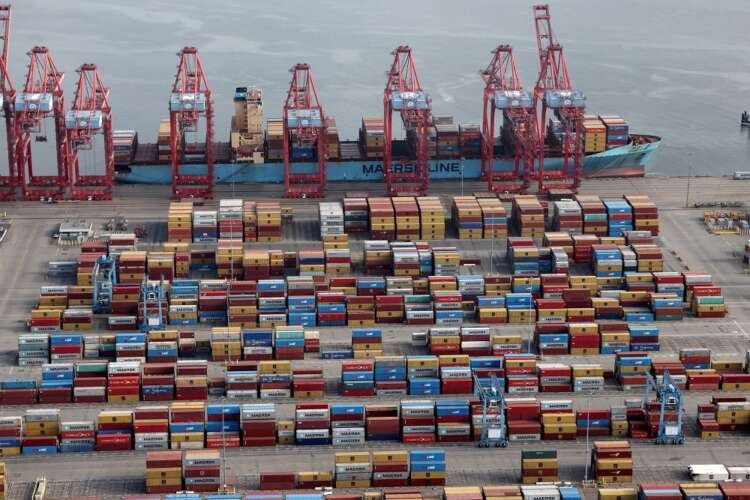
    A bustling port scene showing shipping containers being unloaded, reflecting the surge in U.S. exports crucial for economic recovery in the second quarter. This image highlights trade dynamics and their significance in GDP estimates.
    Shipping containers being unloaded at a port, illustrating U.S. exports and economy - Global Banking & Finance Review
    Tags:GDPbusiness investmenteconomic growthfinancial markets

    By Lucia Mutikani

    WASHINGTON (Reuters) – The U.S. trade deficit in goods narrowed sharply in June as exports surged, while business spending on equipment remained strong, reducing the risk that the economy contracted again in the second quarter.

    The better-than-expected reports from the Commerce Department on Wednesday left economists scrambling to upgrade their gross domestic product estimates for the last quarter, which had ranged from negative to barely growing. The data were published ahead of the release on Thursday of the advance second-quarter GDP estimate.

    A raft of soft housing data as well as weak business and consumer sentiment surveys had raised expectations for a second straight quarterly negative GDP reading, exacerbating worries of a recession.

    JPMorgan now expects the economy grew at a 1.4% annualized rate instead of the previously forecast 0.7% pace.

    “This morning’s data leaves us more convinced that second-quarter GDP will not decline in tomorrow’s release,” said Veronica Clark, an economist at Citigroup in New York.

    The goods trade deficit shrank 5.6% to $98.2 billion, the smallest since last November. Goods exports increased $4.4 billion to $181.5 billion. There were strong gains in exports of food and industrial goods. But fewer capital and consumer goods as well as motor vehicles and parts were exported.

    Imports of goods fell $1.5 billion to $279.7 billion. They were pulled down by imports of motor vehicles and food. Imports of consumer and capital goods, however, increased strongly.

    Trade has subtracted from GDP for seven straight quarters and the anticipated contribution to GDP from the smaller gap is likely to offset an expected drag from inventories.

    While businesses continue to rebuild inventory, the pace has slowed from what was seen in the fourth quarter of 2021 and the first three months of this year. With consumer spending slowing, business are also cautious about accumulating too much stock.

    Walmart on Monday said it needed more price cuts to pare inventories.

    The Commerce Department also reported on Wednesday that wholesale inventories increased 1.9% in June, while stocks at retailers rose 2.0%. Retail inventories were boosted by a 3.1% jump in motor vehicle stocks.

    Excluding motor vehicles, retail inventories increased 1.6%. This component goes into the calculation of GDP.

    “We now expect narrowing in the trade deficit in the second quarter to provide even more support for headline GDP growth than we had previously anticipated, and we also expect less of a drag from inventories than our earlier forecast,” said Daniel Silver, an economist at JPMorgan in New York.

    According to a Reuters survey of economists, GDP likely increased at a 0.5% annualized rate in the second quarter. The survey was conducted before Wednesday’s data. The economy contracted at a 1.6% pace in the first quarter.

    Investors have been nervous about another negative quarterly GDP reading, which would mean a technical recession. The White House is vigorously pushing back against recession chatter as it seeks to calm voters ahead of the Nov. 8 midterm elections that will decide whether President Joe Biden’s Democratic Party retains control of the U.S. Congress.

    But GDP is only one of the many indicators tracked by the National Bureau of Economic Research, which is the official arbiter of recessions in the United States. As such, a second straight quarter of contraction in GDP would not mean the economy was in recession.

    Stocks on Wall Street were higher. The dollar dipped against a basket of currencies. U.S. Treasury prices rose.

    COOLING ACTIVITY

    Economic activity is cooling as the Federal Reserve aggressively tightens monetary policy to tame inflation. The U.S. central bank on Wednesday raised its policy rate by another three-quarters of a percentage point, bringing the total interest rate hikes since March to 225 basis points.

    Despite the rising interest rates and mounting recession fears, businesses are still investing in equipment. In another report on Wednesday, the Commerce Department said orders for non-defense capital goods excluding aircraft, a closely watched proxy for business spending plans, rose 0.5% last month, matching May’s increase.

    Economists polled by Reuters had forecast these so-called core capital goods orders would gain 0.2%. Orders advanced 10.1% on a year-on-year basis in June.

    There were big increases in orders for computers and electronic products as well as electrical equipment, appliances,

    and components. But orders for machinery dipped.

    Core capital goods shipments advanced 0.7% after rising 1.0% in May. Core capital goods shipments are used to calculate equipment spending in the GDP measurement.

    “Some of the increase is attributed to higher prices but the absence of a sustained decline in orders suggests that businesses are still investing despite tighter financial market conditions, drop in sentiment and worries about a recession,” said Ryan Sweet, a senior economist at Moody’s Analytics in West Chester, Pennsylvania.

    Orders for durable goods, items ranging from toasters to aircraft that are meant to last three years or more, surged 1.9% in June after rising 0.8% in May. They were boosted by a 5.1% jump in orders for transportation equipment. Motor vehicle orders increased 1.5. Orders for defense aircraft soared 80.6%.

    Unfilled durable goods orders increased 0.7%, which should keep manufacturing humming for a while. Inventories rose 0.4%.

    “Tighter financial conditions will make capital expenditure projects more expensive, but higher interest rates won’t completely derail business investment prospects,” said Lydia Boussour, lead U.S. economist at Oxford Economics in New York.

    (Reporting by Lucia Mutikani; Editing by Paul Simao, Andrea Ricci and Chizu Nomiyama)

    Frequently Asked Questions about U.S. exports, business spending may salvage second-quarter GDP

    1What is a trade deficit?

    A trade deficit occurs when a country's imports exceed its exports, leading to a negative balance of trade. It indicates that a country is buying more from other countries than it is selling to them.

    2What is business investment?

    Business investment refers to the purchase of goods and services by businesses to enhance their production capacity or efficiency, which can lead to economic growth.

    3What is consumer spending?

    Consumer spending is the total amount of money spent by households on goods and services. It is a key driver of economic growth and reflects consumer confidence.

    4What is monetary policy?

    Monetary policy is the process by which a central bank manages the money supply and interest rates to influence economic activity, inflation, and employment.

    Why waste money on news and opinion when you can access them for free?

    Take advantage of our newsletter subscription and stay informed on the go!

    Subscribe

    More from Top Stories

    Explore more articles in the Top Stories category

    Image for Lessons From the Ring and the Deal Table: How Boxing Shapes Steven Nigro’s Approach to Banking and Life
    Lessons From the Ring and the Deal Table: How Boxing Shapes Steven Nigro’s Approach to Banking and Life
    Image for Joe Kiani in 2025: Capital, Conviction, and a Focused Return to Innovation
    Joe Kiani in 2025: Capital, Conviction, and a Focused Return to Innovation
    Image for Marco Robinson – CLOSE THE DEAL AND SUDDENLY GROW RICH
    Marco Robinson – CLOSE THE DEAL AND SUDDENLY GROW RICH
    Image for Digital Tracing: Turning a regulatory obligation into a commercial advantage
    Digital Tracing: Turning a regulatory obligation into a commercial advantage
    Image for Exploring the Role of Blockchain and the Bitcoin Price Today in Education
    Exploring the Role of Blockchain and the Bitcoin Price Today in Education
    Image for Inside the World’s First Collection Industry Conglomerate: PCA Global’s Platform Strategy
    Inside the World’s First Collection Industry Conglomerate: PCA Global’s Platform Strategy
    Image for Chase Buchanan Private Wealth Management Highlights Key Autumn 2025 Budget Takeaways for Expats
    Chase Buchanan Private Wealth Management Highlights Key Autumn 2025 Budget Takeaways for Expats
    Image for PayLaju Strengthens Its Position as Malaysia’s Trusted Interest-Free Sharia-Compliant Loan Provider
    PayLaju Strengthens Its Position as Malaysia’s Trusted Interest-Free Sharia-Compliant Loan Provider
    Image for A Notable Update for Employee Health Benefits:
    A Notable Update for Employee Health Benefits:
    Image for Creating Equity Between Walls: How Mohak Chauhan is Using Engineering, Finance, and Community Vision to Reengineer Affordable Housing
    Creating Equity Between Walls: How Mohak Chauhan is Using Engineering, Finance, and Community Vision to Reengineer Affordable Housing
    Image for Upcoming Book on Real Estate Investing: Harvard Grace Capital Founder Stewart Heath’s Puts Lessons in Print
    Upcoming Book on Real Estate Investing: Harvard Grace Capital Founder Stewart Heath’s Puts Lessons in Print
    Image for ELECTIVA MARKS A LANDMARK FIRST YEAR WITH MAJOR SENIOR APPOINTMENTS AND EXPANSION MILESTONES
    ELECTIVA MARKS A LANDMARK FIRST YEAR WITH MAJOR SENIOR APPOINTMENTS AND EXPANSION MILESTONES
    View All Top Stories Posts
    Previous Top Stories PostStrong results lift Europe’s STOXX 600 to near seven-week highs
    Next Top Stories PostLloyds, Reckitt drive gains in Britain’s FTSE 100