
Top Stories
Sterling Collapses as Investors Fly Into Dollars
Published by Uma Rajagopal
Posted on September 26, 2022
3 min readLast updated: February 4, 2026
Add as preferred source on Google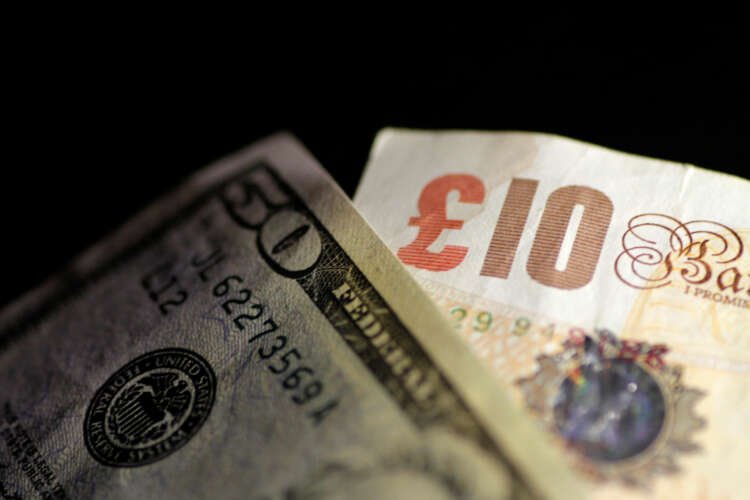
Published by Uma Rajagopal
Posted on September 26, 2022
3 min readLast updated: February 4, 2026
Add as preferred source on GoogleBy Tom Westbrook
SYDNEY (Reuters) – Sterling slumped to a record low on Monday, prompting speculation of an emergency response from the Bank of England, as confidence evaporated in Britain’s plan to borrow its way out of trouble, with spooked investors piling in to U.S. dollars.
Broadening worry that high interest rates will hurt growth hit Asia’s currencies and equities too, with exporters from Japanese carmakers to Australian miners hit hard.
The pound plunged nearly 5% at one point to $1.0327, breaking below 1985 lows. Moves were exacerbated by thinner liquidity in the Asia session, but even after stumbling back to $1.05 the currency is still down some 7% in just two sessions.
“You’ve got to buy the dollar as a risk off-trade. There is nowhere else to go,” said Rabobank strategist Michael Every in Singapore.
“The BOE are going to have to step in today, surely, at which point everyone’s going to end up with massively higher mortgage rates to try and stabilise sterling.”
The collapse sent the dollar higher broadly and it hit multi-year peaks on the Aussie, kiwi and yuan and a new 20-year top of $0.9528 per euro.
In stocks, MSCI’s broadest index of Asia-Pacific shares outside Japan was down 1% to a two-year low. It is heading for a monthly loss of 11%, the largest since March 2020. Japan’s Nikkei fell 2.2%.
S&P 500 futures fell 0.5%.
Last week, stocks and bonds crumbled after the United States and half a dozen other countries raised rates and projected pain ahead. Japan intervened in currency trade to support the yen. Investors lost confidence in Britain’s economic management.
The Nasdaq lost more than 5% for the second week running. The S&P 500 fell 4.8%. [.N]
Gilts suffered their heaviest selling in three decades on Friday and on Monday the pound made a 37-year low at $1.0765 as investors reckon planned tax cuts will stretch government finances to the limit. [GB/]
Sterling is down 11% this quarter. [GBP/]
Five-year gilt yields rose 94 basis points last week, by far the biggest weekly jump recorded in Refinitiv data stretching back to the mid 1980s. Treasuries tanked as well last week, with two-year yields up 35 bps to 4.2140% and benchmark 10-year yields up 25 bps to 3.6970%. [US/]
The euro wobbled to a two-decade low at $0.9660 as risks rise of war escalating in Ukraine, before steadying at $0.9686.
In Italy, a right-wing alliance led by Giorgia Meloni’s Brothers of Italy party was on course for a clear majority in the next parliament, as expected. Some took heart from a middling performance by eurosceptics The League.
“I expect relatively little impact considering that the League, the party with the least pro-European stance, seems to have come out weak,” said Giuseppe Sersale, fund manager and strategist at Anthilia in Milan.
Oil and gold steadied after drops against the rising dollar last week. Gold hit a more-than two-year low on Friday and bought $1,643 an ounce on Monday. Brent crude futures sat at $86.29.[GOL/][O/R]
(Additional reporting by Danilo Masoni in Milan; Editing by Sam Holmes)
Sterling is the official currency of the United Kingdom, symbolized as GBP. It is used in England, Scotland, Wales, and Northern Ireland.
Interest rates are the cost of borrowing money or the return on savings, expressed as a percentage. They are set by central banks and influence economic activity.
A financial crisis is a situation where financial assets suddenly lose a large part of their nominal value, often leading to economic instability.
Foreign currency refers to money that is not the domestic currency of a country. It is used in international trade and investment.
A trading platform is software that allows investors to buy and sell financial securities, including stocks, bonds, and currencies.
Explore more articles in the Top Stories category











