Search
00
GBAF Logo
trophy
Top StoriesInterviewsBusinessFinanceBankingTechnologyInvestingTradingVideosAwardsMagazinesHeadlinesTrends

Subscribe to our newsletter

Get the latest news and updates from our team.

Global Banking & Finance Review®

Global Banking & Finance Review® - Subscribe to our newsletter

Company

    GBAF Logo
    • About Us
    • Profile
    • Privacy & Cookie Policy
    • Terms of Use
    • Contact Us
    • Advertising
    • Submit Post
    • Latest News
    • Research Reports
    • Press Release
    • Awards▾
      • About the Awards
      • Awards TimeTable
      • Submit Nominations
      • Testimonials
      • Media Room
      • Award Winners
      • FAQ
    • Magazines▾
      • Global Banking & Finance Review Magazine Issue 79
      • Global Banking & Finance Review Magazine Issue 78
      • Global Banking & Finance Review Magazine Issue 77
      • Global Banking & Finance Review Magazine Issue 76
      • Global Banking & Finance Review Magazine Issue 75
      • Global Banking & Finance Review Magazine Issue 73
      • Global Banking & Finance Review Magazine Issue 71
      • Global Banking & Finance Review Magazine Issue 70
      • Global Banking & Finance Review Magazine Issue 69
      • Global Banking & Finance Review Magazine Issue 66
    Top StoriesInterviewsBusinessFinanceBankingTechnologyInvestingTradingVideosAwardsMagazinesHeadlinesTrends

    Global Banking & Finance Review® is a leading financial portal and online magazine offering News, Analysis, Opinion, Reviews, Interviews & Videos from the world of Banking, Finance, Business, Trading, Technology, Investing, Brokerage, Foreign Exchange, Tax & Legal, Islamic Finance, Asset & Wealth Management.
    Copyright © 2010-2026 GBAF Publications Ltd - All Rights Reserved. | Sitemap | Tags | Developed By eCorpIT

    Editorial & Advertiser disclosure

    Global Banking & Finance Review® is an online platform offering news, analysis, and opinion on the latest trends, developments, and innovations in the banking and finance industry worldwide. The platform covers a diverse range of topics, including banking, insurance, investment, wealth management, fintech, and regulatory issues. The website publishes news, press releases, opinion and advertorials on various financial organizations, products and services which are commissioned from various Companies, Organizations, PR agencies, Bloggers etc. These commissioned articles are commercial in nature. This is not to be considered as financial advice and should be considered only for information purposes. It does not reflect the views or opinion of our website and is not to be considered an endorsement or a recommendation. We cannot guarantee the accuracy or applicability of any information provided with respect to your individual or personal circumstances. Please seek Professional advice from a qualified professional before making any financial decisions. We link to various third-party websites, affiliate sales networks, and to our advertising partners websites. When you view or click on certain links available on our articles, our partners may compensate us for displaying the content to you or make a purchase or fill a form. This will not incur any additional charges to you. To make things simpler for you to identity or distinguish advertised or sponsored articles or links, you may consider all articles or links hosted on our site as a commercial article placement. We will not be responsible for any loss you may suffer as a result of any omission or inaccuracy on the website.

    Home > Top Stories > Shenzhen accelerates China’s driverless car dreams
    Top Stories

    Shenzhen accelerates China’s driverless car dreams

    Published by Jessica Weisman-Pitts

    Posted on August 1, 2022

    4 min read

    Last updated: February 5, 2026

    The image captures a driverless robotaxi in Shenzhen's bustling Futian district, highlighting advancements in autonomous vehicle technology. This represents Shenzhen's commitment to revolutionizing urban transport with AVs and is tied to the article's focus on new regulations and trials for autonomous vehicles.
    Driverless robotaxi navigating a busy street in Shenzhen, showcasing AV technology - Global Banking & Finance Review
    Why waste money on news and opinion when you can access them for free?

    Take advantage of our newsletter subscription and stay informed on the go!

    Subscribe

    Tags:innovationtechnologyfinancial services

    By David Kirton

    SHENZHEN, China (Reuters) – On a busy downtown street three delivery bikes suddenly dart over the pedestrian crossing ahead of the car. On the car’s dashboard they look like small 3D blue blocks from a 1990s video game.

    The steering wheel turns itself a notch and the vehicle slows to a gentle halt, while the safety driver looks on from the passenger seat.

    The vehicle is one of a hundred sensor-laden robotaxis belonging to start up DeepRoute.ai cruising the dense central Futian business district in China’s southern tech hub Shenzhen, giving 50,000 trial rides to passengers in the last year.

    While the United States is regarded as taking an early lead in testing autonomous vehicle (AV) technology, in Shenzhen the industry appears to be changing gears, with trial robotaxis fast becoming a common sight.

    Baidu Inc’s Apollo unit, Toyota Motor Corp-backed Pony, Nissan-backed Weride, Alibaba-backed Auto X and Deeproute have all been running trials navigating the city’s difficult environment, with frequent jaywalkers and ubiquitous e-scooters.

    Shenzhen, a city of 18 million, has now brought in China’s clearest AV regulations. From Monday registered AVs will be allowed to operate without a driver in the driving seat across a broad swath of the city, but a driver must still be present in the vehicle.

    So far, Chinese cities have allowed robotaxis to operate on a more limited basis with permission of local authorities, but Shenzhen’s regulations for the first time provide a crucial framework for liability in the event of an accident.

    If the AV has a driver behind the wheel, the driver will be liable in an accident. If the car is completely driverless, the owner of the vehicle will be responsible. If a defect causes an accident, the car owner can seek compensation from the manufacturer.

    “If you want more cars, eventually there will be accidents, so these regulations are very important for mass deployment,” said Maxwell Zhou, DeepRoute’s CEO, speaking at the company’s offices in a tech park near the Hong Kong border.

    “This is not true driverless but it’s a big milestone.”

    GEAR SHIFT

    So far the United States has raced ahead in AV trials, with California greenlighting public-road tests from 2014, allowing Alphabet Inc’s Waymo LLC, Cruise and Tesla to rack up millions of miles in road testing.

    But China has its foot on the accelerator, with Beijing making AV a key area in its latest five year plan. Shenzhen wants its smart vehicle industry to reach revenues of 200 billion yuan by 2025.

    In May last year Cruise Chief Executive Dan Amann warned President Joe Biden that U.S. safety regulations risked the country’s AV industry falling behind China, with the latter’s “top down, centrally directed approach”.

    Deeproute aims to have 1,000 robotaxis with safety drivers on Shenzhen’s roads in the next few years, when more detailed regulations are expected.

    But in a city with a state-owned fleet of 22,000 electric taxis from Shenzhen-based BYD, where a 20-km (12-mile) trip costs about 60 yuan ($9), production costs for AVs will need to come down before robotaxis are commercially viable, Zhou said.

    Deeproute and other robotaxi companies are banking on mass production to lower costs and gather data. Deeproute sells its driving solutions to carmarkers for around $3,000.

    Zhou looks to Shenzhen’s DJI Technology Co as a role model, with the company utilising lower hardware costs and integrated supply chains to make it the dominant player in the commercial drone space worldwide.

    On July 21 Baidu announced a new AV with a detachable steering wheel it will use for robotaxis next year, at 250,000 yuan a unit, almost half the price of its previous generation.

    “We are moving towards a future where taking a robotaxi will be half the cost of taking a taxi today,” Baidu’s chief executive Robin Li said at the Baidu World conference.

    FROGS IN A WELL

    Shenzhen’s supply chain and lower costs give it a major production advantage over Silicon Valley, but AV solution maker David Chang does not want to be constrained to one market.

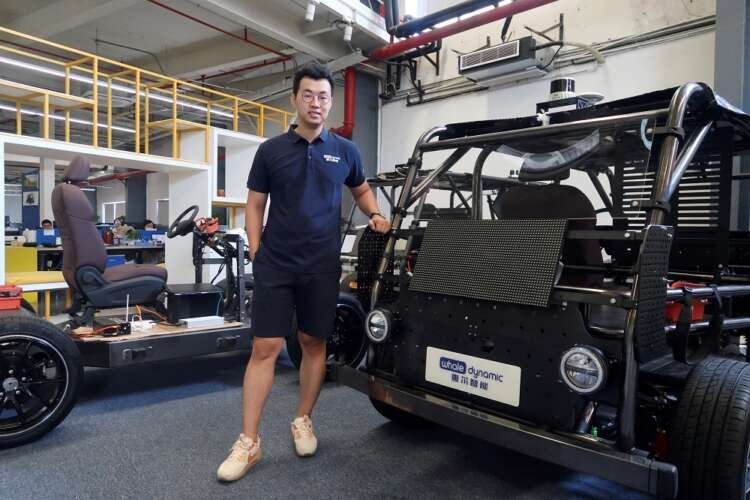
    “In Shenzhen the capital cost is one third to California, because we have the battery suppliers, we have the sensors, we have most of the integration,” said the CEO and founder of Shenzhen-based Whale Dynamic.

    “But the revenue is one twelfth to California, so it might not be a fancy business to do,” he said.

    Deeproute, Weride and Pony.ai also have offices in Silicon Valley, with R&D teams and testing in both locations.

    “We don’t want to shrink ourselves into a well and fight with other frogs. We want to jump out of that well,” said Chang.

    ($1 = 6.7433 Chinese yuan renminbi)

    (This story refiles to correct spelling in paragraph 4 to sight (not site))

    (Reporting by David Kirton; Editing by Michael Perry)

    Frequently Asked Questions about Shenzhen accelerates China’s driverless car dreams

    1What is an autonomous vehicle?

    An autonomous vehicle is a car or truck that is capable of traveling without human input. It uses a combination of sensors, cameras, and artificial intelligence to navigate and drive.

    2What are robotaxis?

    Robotaxis are self-driving taxis that operate without a human driver. They are designed to transport passengers using autonomous technology.

    3What is the significance of AV regulations?

    AV regulations are important as they establish legal frameworks for the operation of autonomous vehicles, ensuring safety, liability, and integration into existing transportation systems.

    4What is the role of DeepRoute.ai?

    DeepRoute.ai is a startup focused on developing autonomous driving technology, including robotaxis, and has conducted extensive trials in Shenzhen.

    5What are the economic implications of AV technology?

    The economic implications of AV technology include potential job creation in tech and transportation sectors, as well as shifts in urban mobility and infrastructure development.

    More from Top Stories

    Explore more articles in the Top Stories category

    Image for Lessons From the Ring and the Deal Table: How Boxing Shapes Steven Nigro’s Approach to Banking and Life
    Lessons From the Ring and the Deal Table: How Boxing Shapes Steven Nigro’s Approach to Banking and Life
    Image for Joe Kiani in 2025: Capital, Conviction, and a Focused Return to Innovation
    Joe Kiani in 2025: Capital, Conviction, and a Focused Return to Innovation
    Image for Marco Robinson – CLOSE THE DEAL AND SUDDENLY GROW RICH
    Marco Robinson – CLOSE THE DEAL AND SUDDENLY GROW RICH
    Image for Digital Tracing: Turning a regulatory obligation into a commercial advantage
    Digital Tracing: Turning a regulatory obligation into a commercial advantage
    Image for Exploring the Role of Blockchain and the Bitcoin Price Today in Education
    Exploring the Role of Blockchain and the Bitcoin Price Today in Education
    Image for Inside the World’s First Collection Industry Conglomerate: PCA Global’s Platform Strategy
    Inside the World’s First Collection Industry Conglomerate: PCA Global’s Platform Strategy
    Image for Chase Buchanan Private Wealth Management Highlights Key Autumn 2025 Budget Takeaways for Expats
    Chase Buchanan Private Wealth Management Highlights Key Autumn 2025 Budget Takeaways for Expats
    Image for PayLaju Strengthens Its Position as Malaysia’s Trusted Interest-Free Sharia-Compliant Loan Provider
    PayLaju Strengthens Its Position as Malaysia’s Trusted Interest-Free Sharia-Compliant Loan Provider
    Image for A Notable Update for Employee Health Benefits:
    A Notable Update for Employee Health Benefits:
    Image for Creating Equity Between Walls: How Mohak Chauhan is Using Engineering, Finance, and Community Vision to Reengineer Affordable Housing
    Creating Equity Between Walls: How Mohak Chauhan is Using Engineering, Finance, and Community Vision to Reengineer Affordable Housing
    Image for Upcoming Book on Real Estate Investing: Harvard Grace Capital Founder Stewart Heath’s Puts Lessons in Print
    Upcoming Book on Real Estate Investing: Harvard Grace Capital Founder Stewart Heath’s Puts Lessons in Print
    Image for ELECTIVA MARKS A LANDMARK FIRST YEAR WITH MAJOR SENIOR APPOINTMENTS AND EXPANSION MILESTONES
    ELECTIVA MARKS A LANDMARK FIRST YEAR WITH MAJOR SENIOR APPOINTMENTS AND EXPANSION MILESTONES
    View All Top Stories Posts
    Previous Top Stories PostBritish financial watchdog toughens rules on high-risk product ads
    Next Top Stories PostHSBC lifts FTSE 100 to fresh June highs, Quilter surges on takeover chatter