Search
00
GBAF Logo
trophy
Top StoriesInterviewsBusinessFinanceBankingTechnologyInvestingTradingVideosAwardsMagazinesHeadlinesTrends

Subscribe to our newsletter

Get the latest news and updates from our team.

Global Banking & Finance Review®

Global Banking & Finance Review® - Subscribe to our newsletter

Company

    GBAF Logo
    • About Us
    • Profile
    • Privacy & Cookie Policy
    • Terms of Use
    • Contact Us
    • Advertising
    • Submit Post
    • Latest News
    • Research Reports
    • Press Release
    • Awards▾
      • About the Awards
      • Awards TimeTable
      • Submit Nominations
      • Testimonials
      • Media Room
      • Award Winners
      • FAQ
    • Magazines▾
      • Global Banking & Finance Review Magazine Issue 79
      • Global Banking & Finance Review Magazine Issue 78
      • Global Banking & Finance Review Magazine Issue 77
      • Global Banking & Finance Review Magazine Issue 76
      • Global Banking & Finance Review Magazine Issue 75
      • Global Banking & Finance Review Magazine Issue 73
      • Global Banking & Finance Review Magazine Issue 71
      • Global Banking & Finance Review Magazine Issue 70
      • Global Banking & Finance Review Magazine Issue 69
      • Global Banking & Finance Review Magazine Issue 66
    Top StoriesInterviewsBusinessFinanceBankingTechnologyInvestingTradingVideosAwardsMagazinesHeadlinesTrends

    Global Banking & Finance Review® is a leading financial portal and online magazine offering News, Analysis, Opinion, Reviews, Interviews & Videos from the world of Banking, Finance, Business, Trading, Technology, Investing, Brokerage, Foreign Exchange, Tax & Legal, Islamic Finance, Asset & Wealth Management.
    Copyright © 2010-2026 GBAF Publications Ltd - All Rights Reserved. | Sitemap | Tags | Developed By eCorpIT

    Editorial & Advertiser disclosure

    Global Banking & Finance Review® is an online platform offering news, analysis, and opinion on the latest trends, developments, and innovations in the banking and finance industry worldwide. The platform covers a diverse range of topics, including banking, insurance, investment, wealth management, fintech, and regulatory issues. The website publishes news, press releases, opinion and advertorials on various financial organizations, products and services which are commissioned from various Companies, Organizations, PR agencies, Bloggers etc. These commissioned articles are commercial in nature. This is not to be considered as financial advice and should be considered only for information purposes. It does not reflect the views or opinion of our website and is not to be considered an endorsement or a recommendation. We cannot guarantee the accuracy or applicability of any information provided with respect to your individual or personal circumstances. Please seek Professional advice from a qualified professional before making any financial decisions. We link to various third-party websites, affiliate sales networks, and to our advertising partners websites. When you view or click on certain links available on our articles, our partners may compensate us for displaying the content to you or make a purchase or fill a form. This will not incur any additional charges to you. To make things simpler for you to identity or distinguish advertised or sponsored articles or links, you may consider all articles or links hosted on our site as a commercial article placement. We will not be responsible for any loss you may suffer as a result of any omission or inaccuracy on the website.

    Home > Top Stories > Scientists show how to turn lunar soil fertile for agriculture
    Top Stories

    Scientists show how to turn lunar soil fertile for agriculture

    Published by Jessica Weisman-Pitts

    Posted on November 9, 2023

    4 min read

    Last updated: January 31, 2026

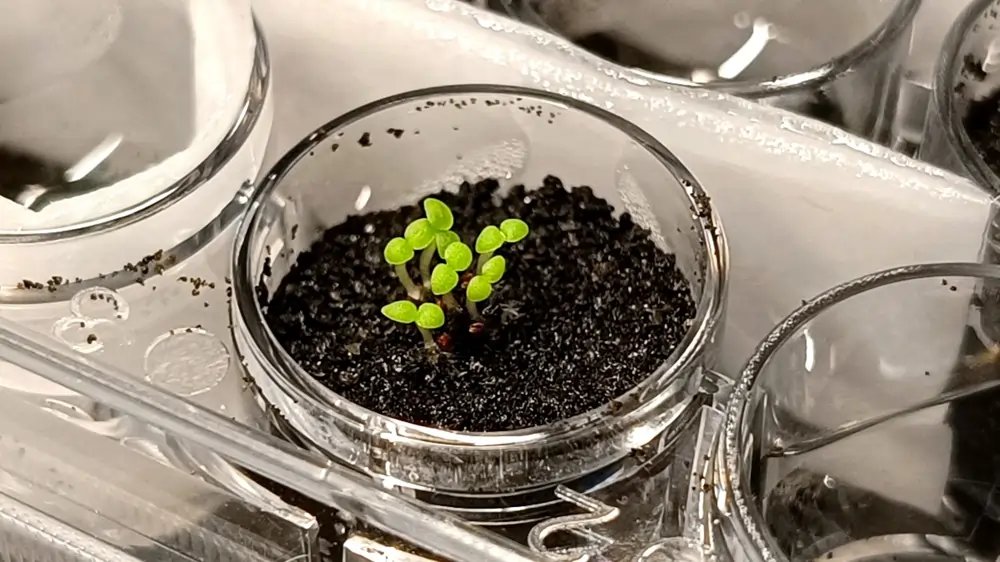
    The image depicts simulated lunar soil with thriving plants, illustrating scientists' breakthrough in making lunar regolith fertile for agriculture, a critical step for future lunar colonization.
    Lunar soil with plants growing, showcasing agriculture possibilities on the moon - Global Banking & Finance Review
    Why waste money on news and opinion when you can access them for free?

    Take advantage of our newsletter subscription and stay informed on the go!

    Subscribe

    Tags:innovationresearchsustainabilityagricultural sectorstechnology

    Scientists show how to turn lunar soil fertile for agriculture

    By Will Dunham

    WASHINGTON (Reuters) – If humankind is ever to establish long-term bases on the moon, there will be a need for a regular source of food. It is not practical, however, to think you can plant corn or wheat in plain lunar soil in greenhouses on the moon and expect a bumper crop – or any crop at all.

    But scientists are taking steps toward making moon agriculture a real possibility. Researchers said on Thursday they have found a way to turn inhospitable lunar soil fertile by introducing bacteria that enhance the availability of phosphorus, an important plant nutrient.

    They performed experiments growing a relative of tobacco using simulated moon soil, more properly called lunar regolith, in a laboratory in China. They found that such soil treated with three species of bacteria produced plants with longer stems and roots as well as heavier and wider clusters of leaves compared to the same soil without the microbes.

    The action of the bacteria, the researchers said, made the soil more acidic. This resulting low pH environment caused insoluble phosphate-containing minerals to dissolve and release the phosphorus in them, increasing phosphorus availability for the plants.

    “The importance of these findings is that we may be able to use these microbes to turn the lunar regolith into bio-friendly substrate for plant cultivation in future lunar greenhouses,” said researcher Yitong Xia of the China Agricultural University in Beijing, lead author of the study published in the journal Communications Biology.

    In a study published last year, researchers in the United States grew a flowering weed called Arabidopsis thaliana in 12 thimble-sized containers, each bearing a gram of actual moon soil collected during NASA missions more than a half century ago.

    Arabidopsis, also called thale cress, is a plant widely used in scientific research. In that study, Arabidopsis did grow, but not as robustly in the lunar soil as in volcanic ash from Earth used for comparative purposes, suggesting that lunar soil could use a little help to become more fertile.

    The new research involved benth, scientific name Nicotiana benthamiana, another plant often used in research.

    The study used simulated regolith rather than the real thing because genuine lunar soil, as one might imagine, is in short supply on Earth. The researchers used volcanic material from the Changbai mountains of China’s Jilin Province to create soil with similar chemical and physical properties to lunar regolith.

    The three bacteria used in the study were: Bacillus mucilaginosus, Bacillus megaterium and Pseudomonas fluorescens. The researchers tested other bacteria as well, but those did not produce the same beneficial effects.

    “Considering the huge scientific and economic potential of the moon, we will need to set up manned lunar bases in the future. But how can we provide food, oxygen and water for the crew members? Of course we can carry them to the moon by rockets, but that is economically unsustainable. A greenhouse for plant cultivation on the moon could greatly reduce the need of Earth-moon transportation,” Xia said.

    A plant cultivation system on the moon could help meet long-term food and oxygen requirements for human crews, Xia added. Plants produce oxygen as a byproduct of photosynthesis, the biological process in which they turn sunlight into energy.

    “We have several ways to grow plants on the moon, including transporting horticultural soil to the moon, building up a hydroponic system (growing plants without soil) or using soil substitute like hydrogels (gels whose liquid component is water). Those methods do not need lunar soil, but all of them would consume huge carrying capability on rockets, making these plans very expensive,” Xia said.

    “In contrast, our technique, which is a kind of in-situ resource utilization, applies microbial improvement to the lunar soil, making it more fertile and capable for plant cultivation,” Xia added. “Our study achieved the same goal with much less consumption of carrying capability comparing with other plans.”

    (Reporting by Will Dunham, Editing by Rosalba O’Brien)

    Frequently Asked Questions about Scientists show how to turn lunar soil fertile for agriculture

    1What is lunar regolith?

    Lunar regolith is the layer of loose, fragmented material covering the solid bedrock of the Moon. It consists of dust, soil, and broken rocks, making it challenging for agriculture without modification.

    2What is phosphorus?

    Phosphorus is a vital nutrient for plants, essential for photosynthesis and energy transfer. It plays a key role in plant growth and development, particularly in root formation and flowering.

    3What is in-situ resource utilization?

    In-situ resource utilization refers to the practice of using materials found on-site, such as lunar soil, to support human activities, like agriculture, rather than transporting resources from Earth.

    More from Top Stories

    Explore more articles in the Top Stories category

    Image for Lessons From the Ring and the Deal Table: How Boxing Shapes Steven Nigro’s Approach to Banking and Life
    Lessons From the Ring and the Deal Table: How Boxing Shapes Steven Nigro’s Approach to Banking and Life
    Image for Joe Kiani in 2025: Capital, Conviction, and a Focused Return to Innovation
    Joe Kiani in 2025: Capital, Conviction, and a Focused Return to Innovation
    Image for Marco Robinson – CLOSE THE DEAL AND SUDDENLY GROW RICH
    Marco Robinson – CLOSE THE DEAL AND SUDDENLY GROW RICH
    Image for Digital Tracing: Turning a regulatory obligation into a commercial advantage
    Digital Tracing: Turning a regulatory obligation into a commercial advantage
    Image for Exploring the Role of Blockchain and the Bitcoin Price Today in Education
    Exploring the Role of Blockchain and the Bitcoin Price Today in Education
    Image for Inside the World’s First Collection Industry Conglomerate: PCA Global’s Platform Strategy
    Inside the World’s First Collection Industry Conglomerate: PCA Global’s Platform Strategy
    Image for Chase Buchanan Private Wealth Management Highlights Key Autumn 2025 Budget Takeaways for Expats
    Chase Buchanan Private Wealth Management Highlights Key Autumn 2025 Budget Takeaways for Expats
    Image for PayLaju Strengthens Its Position as Malaysia’s Trusted Interest-Free Sharia-Compliant Loan Provider
    PayLaju Strengthens Its Position as Malaysia’s Trusted Interest-Free Sharia-Compliant Loan Provider
    Image for A Notable Update for Employee Health Benefits:
    A Notable Update for Employee Health Benefits:
    Image for Creating Equity Between Walls: How Mohak Chauhan is Using Engineering, Finance, and Community Vision to Reengineer Affordable Housing
    Creating Equity Between Walls: How Mohak Chauhan is Using Engineering, Finance, and Community Vision to Reengineer Affordable Housing
    Image for Upcoming Book on Real Estate Investing: Harvard Grace Capital Founder Stewart Heath’s Puts Lessons in Print
    Upcoming Book on Real Estate Investing: Harvard Grace Capital Founder Stewart Heath’s Puts Lessons in Print
    Image for ELECTIVA MARKS A LANDMARK FIRST YEAR WITH MAJOR SENIOR APPOINTMENTS AND EXPANSION MILESTONES
    ELECTIVA MARKS A LANDMARK FIRST YEAR WITH MAJOR SENIOR APPOINTMENTS AND EXPANSION MILESTONES
    View All Top Stories Posts
    Previous Top Stories PostSurgeons in New York announce world’s first eye transplant
    Next Top Stories PostEU set to weaken new car, truck pollution rules