Search
00
GBAF Logo
trophy
Top StoriesInterviewsBusinessFinanceBankingTechnologyInvestingTradingVideosAwardsMagazinesHeadlinesTrends

Subscribe to our newsletter

Get the latest news and updates from our team.

Global Banking & Finance Review®

Global Banking & Finance Review® - Subscribe to our newsletter

Company

    GBAF Logo
    • About Us
    • Profile
    • Privacy & Cookie Policy
    • Terms of Use
    • Contact Us
    • Advertising
    • Submit Post
    • Latest News
    • Research Reports
    • Press Release
    • Awards▾
      • About the Awards
      • Awards TimeTable
      • Submit Nominations
      • Testimonials
      • Media Room
      • Award Winners
      • FAQ
    • Magazines▾
      • Global Banking & Finance Review Magazine Issue 79
      • Global Banking & Finance Review Magazine Issue 78
      • Global Banking & Finance Review Magazine Issue 77
      • Global Banking & Finance Review Magazine Issue 76
      • Global Banking & Finance Review Magazine Issue 75
      • Global Banking & Finance Review Magazine Issue 73
      • Global Banking & Finance Review Magazine Issue 71
      • Global Banking & Finance Review Magazine Issue 70
      • Global Banking & Finance Review Magazine Issue 69
      • Global Banking & Finance Review Magazine Issue 66
    Top StoriesInterviewsBusinessFinanceBankingTechnologyInvestingTradingVideosAwardsMagazinesHeadlinesTrends

    Global Banking & Finance Review® is a leading financial portal and online magazine offering News, Analysis, Opinion, Reviews, Interviews & Videos from the world of Banking, Finance, Business, Trading, Technology, Investing, Brokerage, Foreign Exchange, Tax & Legal, Islamic Finance, Asset & Wealth Management.
    Copyright © 2010-2026 GBAF Publications Ltd - All Rights Reserved. | Sitemap | Tags | Developed By eCorpIT

    Editorial & Advertiser disclosure

    Global Banking & Finance Review® is an online platform offering news, analysis, and opinion on the latest trends, developments, and innovations in the banking and finance industry worldwide. The platform covers a diverse range of topics, including banking, insurance, investment, wealth management, fintech, and regulatory issues. The website publishes news, press releases, opinion and advertorials on various financial organizations, products and services which are commissioned from various Companies, Organizations, PR agencies, Bloggers etc. These commissioned articles are commercial in nature. This is not to be considered as financial advice and should be considered only for information purposes. It does not reflect the views or opinion of our website and is not to be considered an endorsement or a recommendation. We cannot guarantee the accuracy or applicability of any information provided with respect to your individual or personal circumstances. Please seek Professional advice from a qualified professional before making any financial decisions. We link to various third-party websites, affiliate sales networks, and to our advertising partners websites. When you view or click on certain links available on our articles, our partners may compensate us for displaying the content to you or make a purchase or fill a form. This will not incur any additional charges to you. To make things simpler for you to identity or distinguish advertised or sponsored articles or links, you may consider all articles or links hosted on our site as a commercial article placement. We will not be responsible for any loss you may suffer as a result of any omission or inaccuracy on the website.

    Home > Top Stories > Russia’s grinding battlefield gains seen driven by new tactics
    Top Stories

    Russia’s grinding battlefield gains seen driven by new tactics

    Published by Wanda Rich

    Posted on June 27, 2022

    4 min read

    Last updated: February 6, 2026

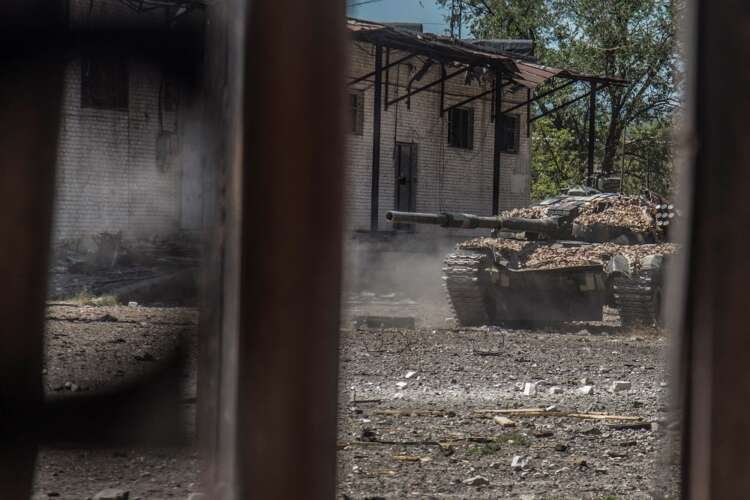
    A devastated urban landscape in Sievierodonetsk showcases the impact of Russia's slow and grinding offensive tactics during the Ukraine conflict, emphasizing strategic shifts in the ongoing war.
    Destruction in Sievierodonetsk, highlighting Russia's new battlefield tactics - Global Banking & Finance Review
    Why waste money on news and opinion when you can access them for free?

    Take advantage of our newsletter subscription and stay informed on the go!

    Subscribe

    Tags:financial crisisinvestmentmarket capitalisationeconomic growthfinancial stability

    By Tom Balmforth

    KYIV (Reuters) -It took Russia weeks of fierce fighting, an untold number of casualties, and relentless shelling before the exhausted Ukrainian defenders of Sievierodonetsk received orders to quit its smouldering wreckage.

    “Remaining in positions smashed to pieces over many months just for the sake of staying there does not make sense,” Serhiy Gaidai, governor of the wider region, said on Ukrainian television on Friday.

    With a reported 90% of the industrial city’s buildings damaged, most of its around 100,000 residents long gone, and with limited strategic value beyond a sprawling chemicals plant, it does not look like much of a prize.

    But its capture, confirmed by both sides on Saturday, is likely to be hailed by Russia as evidence that its switch from its early and unsuccessful attempts at “lightning warfare” to a much slower grinding offensive which relies more on long-range shelling rather than close-quarters combat, is paying off.

    Sievierodonetsk would be the biggest Ukrainian city Russia has captured since it took the port of Mariupol last month.

    “Our military has changed tactics,” said one Russian government official.

    “They know how to do it now. Yes it’s slow, but the strategy works and it means far less casualties,” said the official, who declined to be named because they were not authorised to speak on the subject.

    Konrad Muzyka, a Poland-based military analyst, said the tactical change meant Moscow could commit fewer troops to offensives amid unconfirmed Western suggestions that Russia is experiencing manpower problems.

    “Whatever they did, it is working for them,” said Muzyka.

    “Another thing is we don’t know what’s going on with the Ukrainians; their manpower, losses and so on. From their point of view officially, everything is rosy. But it certainly is not this way.”

    Moscow calls its invasion, which began on Feb. 24, a “special military operation” to protect Russian speakers from Ukrainians intent on taking Kyiv into NATO, a move Russia says it cannot accept.

    The West and Ukraine say Russia is waging an unjustified war of aggression designed to halt Kyiv’s legitimate westwards drift and accuse the Kremlin of trying to recreate parts of the Russian Empire.

    ‘FIRST WORLD WAR APPROACH’

    The fall of Sievierodonetsk leaves only one other major settlement in Ukraine’s Luhansk region outside the control of Russia and its proxies – the nearby twin city of Lysychansk, which lies across the Siverskyi Donets River and on high ground, making it harder to overwhelm.

    Luhansk is one of two regions which make up the wider Donbas area whose capture by Russian forces on behalf of proxy separatists is framed by Moscow as one of its main aims.

    Ukrainian analysts say Kyiv is forcing Russia to pay a high price for its creeping progress.

    The length of time Sievierodonetsk’s defenders held out slowed Russian efforts elsewhere and sucked up Moscow’s finite resources, they say.

    “Our forces had to withdraw and conduct a tactical retreat because there was essentially nothing left there to defend,” said Oleksander Musiyenko, a Kyiv-based military analyst.

    “There was no city left there and, secondly, we could not allow them (Ukrainian forces) to be encircled. Everything could be a lot worse if Russia’s troops had been able to take Sievierodonetsk in the space of a day three weeks ago,” he said.

    One Moscow-based military analyst who declined to be named, citing Russia’s wartime censorship laws, compared the fighting around Sievierodonetsk to World War One, saying Russian forces had advanced only around 100 metres a day for the last month.

    Russia’s aims at this point in the conflict were less about gaining territory, he suggested, and more about inflicting maximum casualties.

    “Russia’s strategy is a First World War approach of breaking your opponents. It could work – there is some evidence that Ukrainian morale is a problem,” said the analyst.

    If, as seems likely, Russia continues with the same tactics, its offensive against Ukraine, which says it has just taken delivery of new long-range U.S. weapons designed to help it dual with Russian artillery, could be protracted.

    Russia still faces major obstacles in its campaign to control Donbas as Ukraine still controls almost half of the Donetsk region, the other region it is targeting, including the heavily fortified cities of Sloviansk and Kramatorsk, both of which are larger than Sievierodonetsk.

    Russia’s attention is turning swiftly to the city of Lysychansk across the river where Ukrainian forces have heavily fortified positions, the last major part of the Luhansk region it does not control.

    “We have to understand that they (Russia) will probably try to attack the city from two or three sides,” said Musiyenko.

    (Additional reporting by Reuters reporters; Editing by Alistair Bell and Jon Boyle)

    Frequently Asked Questions about Russia’s grinding battlefield gains seen driven by new tactics

    1What is a financial crisis?

    A financial crisis is a situation where financial assets suddenly lose a large part of their nominal value, leading to a loss of confidence in financial institutions and markets.

    2What is market capitalisation?

    Market capitalisation is the total market value of a company's outstanding shares, calculated by multiplying the share price by the total number of shares.

    3What is economic growth?

    Economic growth refers to an increase in the production of goods and services in an economy over a period, typically measured by GDP.

    4What is financial stability?

    Financial stability is a condition where the financial system operates effectively, allowing for the smooth functioning of financial markets and institutions.

    5What is investment?

    Investment is the act of allocating resources, usually money, in order to generate income or profit, typically through the purchase of assets.

    More from Top Stories

    Explore more articles in the Top Stories category

    Image for Lessons From the Ring and the Deal Table: How Boxing Shapes Steven Nigro’s Approach to Banking and Life
    Lessons From the Ring and the Deal Table: How Boxing Shapes Steven Nigro’s Approach to Banking and Life
    Image for Joe Kiani in 2025: Capital, Conviction, and a Focused Return to Innovation
    Joe Kiani in 2025: Capital, Conviction, and a Focused Return to Innovation
    Image for Marco Robinson – CLOSE THE DEAL AND SUDDENLY GROW RICH
    Marco Robinson – CLOSE THE DEAL AND SUDDENLY GROW RICH
    Image for Digital Tracing: Turning a regulatory obligation into a commercial advantage
    Digital Tracing: Turning a regulatory obligation into a commercial advantage
    Image for Exploring the Role of Blockchain and the Bitcoin Price Today in Education
    Exploring the Role of Blockchain and the Bitcoin Price Today in Education
    Image for Inside the World’s First Collection Industry Conglomerate: PCA Global’s Platform Strategy
    Inside the World’s First Collection Industry Conglomerate: PCA Global’s Platform Strategy
    Image for Chase Buchanan Private Wealth Management Highlights Key Autumn 2025 Budget Takeaways for Expats
    Chase Buchanan Private Wealth Management Highlights Key Autumn 2025 Budget Takeaways for Expats
    Image for PayLaju Strengthens Its Position as Malaysia’s Trusted Interest-Free Sharia-Compliant Loan Provider
    PayLaju Strengthens Its Position as Malaysia’s Trusted Interest-Free Sharia-Compliant Loan Provider
    Image for A Notable Update for Employee Health Benefits:
    A Notable Update for Employee Health Benefits:
    Image for Creating Equity Between Walls: How Mohak Chauhan is Using Engineering, Finance, and Community Vision to Reengineer Affordable Housing
    Creating Equity Between Walls: How Mohak Chauhan is Using Engineering, Finance, and Community Vision to Reengineer Affordable Housing
    Image for Upcoming Book on Real Estate Investing: Harvard Grace Capital Founder Stewart Heath’s Puts Lessons in Print
    Upcoming Book on Real Estate Investing: Harvard Grace Capital Founder Stewart Heath’s Puts Lessons in Print
    Image for ELECTIVA MARKS A LANDMARK FIRST YEAR WITH MAJOR SENIOR APPOINTMENTS AND EXPANSION MILESTONES
    ELECTIVA MARKS A LANDMARK FIRST YEAR WITH MAJOR SENIOR APPOINTMENTS AND EXPANSION MILESTONES
    View All Top Stories Posts
    Previous Top Stories PostBetter SMEs for a Better World
    Next Top Stories PostHong Kong’s top finance executives bank on city to thrive as gateway to China