Search
00
GBAF Logo
trophy
Top StoriesInterviewsBusinessFinanceBankingTechnologyInvestingTradingVideosAwardsMagazinesHeadlinesTrends

Subscribe to our newsletter

Get the latest news and updates from our team.

Global Banking & Finance Review®

Global Banking & Finance Review® - Subscribe to our newsletter

Company

    GBAF Logo
    • About Us
    • Profile
    • Privacy & Cookie Policy
    • Terms of Use
    • Contact Us
    • Advertising
    • Submit Post
    • Latest News
    • Research Reports
    • Press Release
    • Awards▾
      • About the Awards
      • Awards TimeTable
      • Submit Nominations
      • Testimonials
      • Media Room
      • Award Winners
      • FAQ
    • Magazines▾
      • Global Banking & Finance Review Magazine Issue 79
      • Global Banking & Finance Review Magazine Issue 78
      • Global Banking & Finance Review Magazine Issue 77
      • Global Banking & Finance Review Magazine Issue 76
      • Global Banking & Finance Review Magazine Issue 75
      • Global Banking & Finance Review Magazine Issue 73
      • Global Banking & Finance Review Magazine Issue 71
      • Global Banking & Finance Review Magazine Issue 70
      • Global Banking & Finance Review Magazine Issue 69
      • Global Banking & Finance Review Magazine Issue 66
    Top StoriesInterviewsBusinessFinanceBankingTechnologyInvestingTradingVideosAwardsMagazinesHeadlinesTrends

    Global Banking & Finance Review® is a leading financial portal and online magazine offering News, Analysis, Opinion, Reviews, Interviews & Videos from the world of Banking, Finance, Business, Trading, Technology, Investing, Brokerage, Foreign Exchange, Tax & Legal, Islamic Finance, Asset & Wealth Management.
    Copyright © 2010-2026 GBAF Publications Ltd - All Rights Reserved. | Sitemap | Tags | Developed By eCorpIT

    Editorial & Advertiser disclosure

    Global Banking & Finance Review® is an online platform offering news, analysis, and opinion on the latest trends, developments, and innovations in the banking and finance industry worldwide. The platform covers a diverse range of topics, including banking, insurance, investment, wealth management, fintech, and regulatory issues. The website publishes news, press releases, opinion and advertorials on various financial organizations, products and services which are commissioned from various Companies, Organizations, PR agencies, Bloggers etc. These commissioned articles are commercial in nature. This is not to be considered as financial advice and should be considered only for information purposes. It does not reflect the views or opinion of our website and is not to be considered an endorsement or a recommendation. We cannot guarantee the accuracy or applicability of any information provided with respect to your individual or personal circumstances. Please seek Professional advice from a qualified professional before making any financial decisions. We link to various third-party websites, affiliate sales networks, and to our advertising partners websites. When you view or click on certain links available on our articles, our partners may compensate us for displaying the content to you or make a purchase or fill a form. This will not incur any additional charges to you. To make things simpler for you to identity or distinguish advertised or sponsored articles or links, you may consider all articles or links hosted on our site as a commercial article placement. We will not be responsible for any loss you may suffer as a result of any omission or inaccuracy on the website.

    Home > Top Stories > Russia pushed into historic default by sanctions
    Top Stories

    Russia pushed into historic default by sanctions

    Published by Jessica Weisman-Pitts

    Posted on June 27, 2022

    5 min read

    Last updated: February 6, 2026

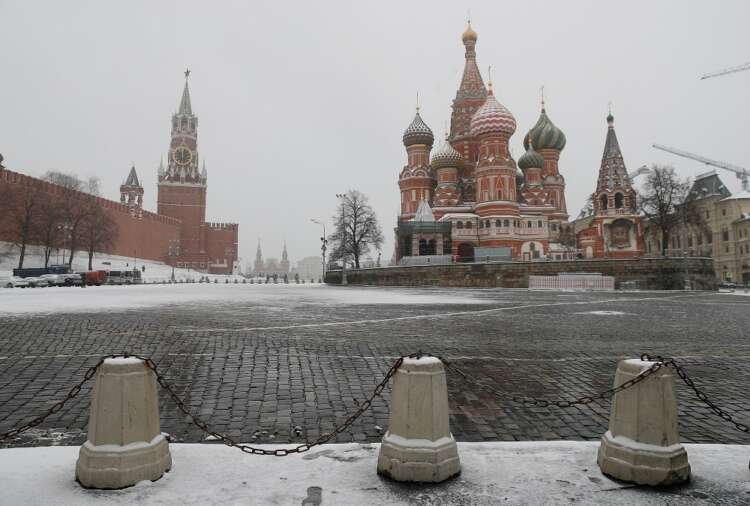
    The image showcases Moscow's Kremlin alongside St. Basil's Cathedral, symbolizing Russia's historic default on international bonds due to sanctions. This visual emphasizes the impact of global financial restrictions on Russia's economy.
    Moscow's Kremlin and St. Basil's Cathedral highlighting Russia's economic struggles amid sanctions - Global Banking & Finance Review
    Why waste money on news and opinion when you can access them for free?

    Take advantage of our newsletter subscription and stay informed on the go!

    Subscribe

    Tags:debt instrumentsfinancial marketsinternational capital

    By Karin Strohecker, Andrea Shalal and Emily Chan

    LONDON (Reuters) -Russia defaulted on its international bonds for the first time in more than a century, the White House said, as sweeping sanctions have effectively cut the country off from the global financial system, rendering its assets untouchable.

    The Kremlin, which has the money to make payments thanks to oil and gas revenues, swiftly rejected the claims, and has accused the West of driving it into an artificial default.

    Earlier, some bondholders said they had not received overdue interest on Monday following the expiry of a key payment deadline on Sunday.

    Russia has struggled to keep up payments on $40 billion of outstanding bonds since its invasion of Ukraine on Feb. 24.

    “This morning’s news around the finding of Russia’s default, for the first time in more than a century, situates just how strong the actions are that the U.S., along with allies and partners have taken, as well as how dramatic the impact has been on Russia’s economy,” the U.S. official said on the sidelines of a G7 summit in Germany.

    Russia’s efforts to avoid what would be its first major default on international bonds since the Bolshevik revolution more than a century ago hit a roadblock in late May when the U.S. Treasury Department’s Office of Foreign Assets Control (OFAC) effectively blocked Moscow from making payments.

    “Since March we thought that a Russian default is probably inevitable, and the question was just when,” Dennis Hranitzky, head of sovereign litigation at law firm Quinn Emanuel, told Reuters ahead of the Sunday deadline.

    “OFAC has intervened to answer that question for us, and the default is now upon us.”

    A formal default would be largely symbolic given Russia cannot borrow internationally at the moment and doesn’t need to thanks to plentiful oil and gas export revenues. But the stigma would probably raise its borrowing costs in future.

    The payments in question are $100 million in interest on two bonds, one denominated in U.S. dollars and another in euros, that Russia was due to pay on May 27. The payments had a grace period of 30 days, which expired on Sunday.

    Russia’s finance ministry said it made the payments to its onshore National Settlement Depository (NSD) in euros and dollars, adding it had fulfilled obligations.

    In a call with reporters, Kremlin spokesperson Dmitry Peskov said the fact that payments had been blocked by Euroclear because of Western sanctions on Russia was “not our problem”.

    Clearing house Euroclear did not respond to a request for comment.

    Some Taiwanese holders of the bonds had not received payments on Monday, sources told Reuters.

    With no exact deadline specified in the prospectus, lawyers say Russia might have until the end of the following business day to pay these bondholders.

    Credit ratings agencies usually formally downgrade a country’s credit rating to reflect default, but this does not apply in case of Russia as most agencies no longer rate the country.

    LEGAL TANGLE

    The legal situation surrounding the bonds looks complex.

    Russia’s bonds have been issued with an unusual variety of terms, and an increasing level of ambiguities for those sold more recently, when Moscow was already facing sanctions over its annexation of Crimea in 2014 and a poisoning incident in Britain in 2018.

    Rodrigo Olivares-Caminal, chair in banking and finance law at Queen Mary University in London, said clarity was needed on what constituted a discharge for Russia on its obligation, or the difference between receiving and recovering payments.

    “All these issues are subject to interpretation by a court of law,” Olivares-Caminal told Reuters.

    In some ways, Russia has been in default already.

    A committee on derivatives has ruled a “credit event” had occurred on some of Russia’s securities, which triggered a payout on some of Russia’s credit default swaps – instruments used by investors to insure against debt default.

    This was triggered by Russia failing to make a $1.9 million payment in accrued interest on a payment that had been due in early April.

    Until the Ukraine invasion, a sovereign default had seemed unthinkable, with Russia having an investment grade rating shortly before that point. A default would also be unusual as Moscow has the funds to service its debt.

    The U.S. Treasury’s OFAC had issued a temporary waiver, known as a general licence 9A, in early March to allow Moscow to keep paying investors. The U.S. let the waiver expire on May 25 as Washington tightened sanctions on Russia, effectively cutting off payments to U.S. investors and entities.

    The lapsed OFAC licence is not Russia’s only obstacle. In early June, the European Union imposed sanctions on the NSD, Russia’s appointed agent for its Eurobonds.

    Moscow has tried in the past few days to find ways of dealing with upcoming payments and avoid a default.

    President Vladimir Putin signed a decree last Wednesday to launch temporary procedures and give the government 10 days to choose banks to handle payments under a new scheme, suggesting Russia will consider its debt obligations fulfilled when it pays bondholders in roubles and onshore in Russia.

    “Russia saying it’s complying with obligations under the terms of the bond is not the whole story,” Zia Ullah, partner and head of corporate crime and investigations at law firm Eversheds Sutherland told Reuters.

    “If you as an investor are not satisfied, for instance, if you know the money is stuck in an escrow account, which effectively would be the practical impact of what Russia is saying, the answer would be, until you discharge the obligation, you have not satisfied the conditions of the bond.”

    (Reporting by Karin Strohecker in London, Andrea Shalal in Elmau and Emily Chan in Taipei and Sujata Rao in London; Editing by David Holmes, Emelia Sithole-Matarise, Simon Cameron-Moore and Jane Merriman)

    Frequently Asked Questions about Russia pushed into historic default by sanctions

    1What is a default?

    A default occurs when a borrower fails to meet the legal obligations or conditions of a loan, such as missing a payment.

    2What are international bonds?

    International bonds are debt securities issued by a borrower in a currency different from that of the investor, often used to raise capital from foreign markets.

    3What are sanctions?

    Sanctions are restrictions imposed by countries or international organizations to influence or punish a nation, often affecting trade and financial transactions.

    4What is a credit rating?

    A credit rating is an assessment of the creditworthiness of a borrower, indicating the likelihood of default on debt obligations.

    5What is a grace period?

    A grace period is a specified time after a payment due date during which a borrower can make a payment without incurring penalties.

    More from Top Stories

    Explore more articles in the Top Stories category

    Image for Lessons From the Ring and the Deal Table: How Boxing Shapes Steven Nigro’s Approach to Banking and Life
    Lessons From the Ring and the Deal Table: How Boxing Shapes Steven Nigro’s Approach to Banking and Life
    Image for Joe Kiani in 2025: Capital, Conviction, and a Focused Return to Innovation
    Joe Kiani in 2025: Capital, Conviction, and a Focused Return to Innovation
    Image for Marco Robinson – CLOSE THE DEAL AND SUDDENLY GROW RICH
    Marco Robinson – CLOSE THE DEAL AND SUDDENLY GROW RICH
    Image for Digital Tracing: Turning a regulatory obligation into a commercial advantage
    Digital Tracing: Turning a regulatory obligation into a commercial advantage
    Image for Exploring the Role of Blockchain and the Bitcoin Price Today in Education
    Exploring the Role of Blockchain and the Bitcoin Price Today in Education
    Image for Inside the World’s First Collection Industry Conglomerate: PCA Global’s Platform Strategy
    Inside the World’s First Collection Industry Conglomerate: PCA Global’s Platform Strategy
    Image for Chase Buchanan Private Wealth Management Highlights Key Autumn 2025 Budget Takeaways for Expats
    Chase Buchanan Private Wealth Management Highlights Key Autumn 2025 Budget Takeaways for Expats
    Image for PayLaju Strengthens Its Position as Malaysia’s Trusted Interest-Free Sharia-Compliant Loan Provider
    PayLaju Strengthens Its Position as Malaysia’s Trusted Interest-Free Sharia-Compliant Loan Provider
    Image for A Notable Update for Employee Health Benefits:
    A Notable Update for Employee Health Benefits:
    Image for Creating Equity Between Walls: How Mohak Chauhan is Using Engineering, Finance, and Community Vision to Reengineer Affordable Housing
    Creating Equity Between Walls: How Mohak Chauhan is Using Engineering, Finance, and Community Vision to Reengineer Affordable Housing
    Image for Upcoming Book on Real Estate Investing: Harvard Grace Capital Founder Stewart Heath’s Puts Lessons in Print
    Upcoming Book on Real Estate Investing: Harvard Grace Capital Founder Stewart Heath’s Puts Lessons in Print
    Image for ELECTIVA MARKS A LANDMARK FIRST YEAR WITH MAJOR SENIOR APPOINTMENTS AND EXPANSION MILESTONES
    ELECTIVA MARKS A LANDMARK FIRST YEAR WITH MAJOR SENIOR APPOINTMENTS AND EXPANSION MILESTONES
    View All Top Stories Posts
    Previous Top Stories PostGoogle faces antitrust complaint by Danish job-search rival
    Next Top Stories Post‘Systemic challenge’ or worse? NATO members wrangle over how to treat China