
Top Stories
Rising German Solar Supply Weighs on Spot Prices
Published by Uma Rajagopal
Posted on August 18, 2022
2 min readLast updated: February 4, 2026
Add as preferred source on Google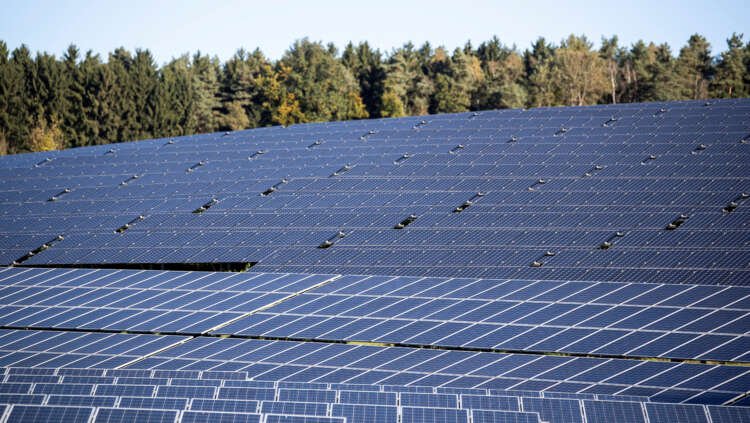
Published by Uma Rajagopal
Posted on August 18, 2022
2 min readLast updated: February 4, 2026
Add as preferred source on GooglePARIS (Reuters) – European spot power prices fell on Thursday as German solar supply is seen rising, while French nuclear availability increased.
PARIS (Reuters) – European spot power prices fell on Thursday as German solar supply is seen rising, while French nuclear availability increased.
German baseload power for delivery on Friday was down 6.2% to 526.50 euros a megawatt-hour (MWh) at 0829 GMT.
The equivalent French price dropped 6% to 522 euros/MWh.
Electricity supply from solar sources in Germany is expected to increase 950 MW to 8.8 gigawatts (GW) on Friday, Refinitiv Eikon data showed.
Daily wind power output in Germany was forecast to fall 1.2 GW day-on-day to 3 GW on Friday, while in France it was expected to climb 1.7 GW to 4 GW, the data showed.
French nuclear availability rose 2.1 percentage points to 48.5% of available capacity as the 1.3 GW Paluel 4 plant returned online following an unplanned outage. [POWER/FR]
The restart of the 900 MW Bugey 3 reactor was moved back three days to Aug. 22.
German procurement portal Ispex said in a monthly newsletter that low Rhine river levels would probably continue into November.
Since the phenomenon is seen as related to climate change, it would have to be factored into any assessments of future supply risks, it said.
Consumption in Germany was seen falling by 1.6 GW to 54.6 GW on Friday, while demand in France it was expected to rise 590 megawatts (MW) to 40.8 GW.
The German year-ahead baseload power contract fell 0.7% to 515 euros/MWh.
The December baseload price in the country reached a contract high earlier of 620 euros/MWh.
The French 2023 baseload contract was untraded, with a bid price of 665 euros/MWh.
European CO2 allowances for December 2022 expiry fell 1% to 94.80 euros a tonne.
Carbon contracts rallied Wednesday as high river water temperatures raised questions around nuclear supply and cooling, low wind generation, and low August auction volumes tightening supply, Greenfact analyst Marcus Ferdinand said.
However, he added the rally was rather short sighted as the potential for industrial demand destruction this winter should have a bearish effect on prices, which could be similar to that seen at the beginning of the war in Ukraine.
(Reporting by Forrest Crellin Additional reporting by Vera Eckert; Editing by Mark Potter)
Solar power is energy derived from the sun's rays, which can be converted into electricity or heat using solar panels and other technologies.
Baseload power refers to the minimum level of demand on an electrical grid over a span of time, typically supplied by reliable sources like nuclear or coal.
CO2 allowances are permits that allow the holder to emit a certain amount of carbon dioxide, used in cap-and-trade systems to limit greenhouse gas emissions.
Nuclear availability refers to the operational status of nuclear power plants, indicating how much of their capacity is online and generating electricity.
Wind power output is the amount of electricity generated by wind turbines, which can vary based on wind conditions and turbine efficiency.
Explore more articles in the Top Stories category











