Search
00
GBAF Logo
trophy
Top StoriesInterviewsBusinessFinanceBankingTechnologyInvestingTradingVideosAwardsMagazinesHeadlinesTrends

Subscribe to our newsletter

Get the latest news and updates from our team.

Global Banking & Finance Review®

Global Banking & Finance Review® - Subscribe to our newsletter

Company

    GBAF Logo
    • About Us
    • Profile
    • Privacy & Cookie Policy
    • Terms of Use
    • Contact Us
    • Advertising
    • Submit Post
    • Latest News
    • Research Reports
    • Press Release
    • Awards▾
      • About the Awards
      • Awards TimeTable
      • Submit Nominations
      • Testimonials
      • Media Room
      • Award Winners
      • FAQ
    • Magazines▾
      • Global Banking & Finance Review Magazine Issue 79
      • Global Banking & Finance Review Magazine Issue 78
      • Global Banking & Finance Review Magazine Issue 77
      • Global Banking & Finance Review Magazine Issue 76
      • Global Banking & Finance Review Magazine Issue 75
      • Global Banking & Finance Review Magazine Issue 73
      • Global Banking & Finance Review Magazine Issue 71
      • Global Banking & Finance Review Magazine Issue 70
      • Global Banking & Finance Review Magazine Issue 69
      • Global Banking & Finance Review Magazine Issue 66
    Top StoriesInterviewsBusinessFinanceBankingTechnologyInvestingTradingVideosAwardsMagazinesHeadlinesTrends

    Global Banking & Finance Review® is a leading financial portal and online magazine offering News, Analysis, Opinion, Reviews, Interviews & Videos from the world of Banking, Finance, Business, Trading, Technology, Investing, Brokerage, Foreign Exchange, Tax & Legal, Islamic Finance, Asset & Wealth Management.
    Copyright © 2010-2026 GBAF Publications Ltd - All Rights Reserved. | Sitemap | Tags | Developed By eCorpIT

    Editorial & Advertiser disclosure

    Global Banking & Finance Review® is an online platform offering news, analysis, and opinion on the latest trends, developments, and innovations in the banking and finance industry worldwide. The platform covers a diverse range of topics, including banking, insurance, investment, wealth management, fintech, and regulatory issues. The website publishes news, press releases, opinion and advertorials on various financial organizations, products and services which are commissioned from various Companies, Organizations, PR agencies, Bloggers etc. These commissioned articles are commercial in nature. This is not to be considered as financial advice and should be considered only for information purposes. It does not reflect the views or opinion of our website and is not to be considered an endorsement or a recommendation. We cannot guarantee the accuracy or applicability of any information provided with respect to your individual or personal circumstances. Please seek Professional advice from a qualified professional before making any financial decisions. We link to various third-party websites, affiliate sales networks, and to our advertising partners websites. When you view or click on certain links available on our articles, our partners may compensate us for displaying the content to you or make a purchase or fill a form. This will not incur any additional charges to you. To make things simpler for you to identity or distinguish advertised or sponsored articles or links, you may consider all articles or links hosted on our site as a commercial article placement. We will not be responsible for any loss you may suffer as a result of any omission or inaccuracy on the website.

    Home > Top Stories > Putin wants ‘unfriendly’ countries to pay for Russian gas in roubles
    Top Stories

    Putin wants ‘unfriendly’ countries to pay for Russian gas in roubles

    Published by Jessica Weisman-Pitts

    Posted on March 23, 2022

    4 min read

    Last updated: January 20, 2026

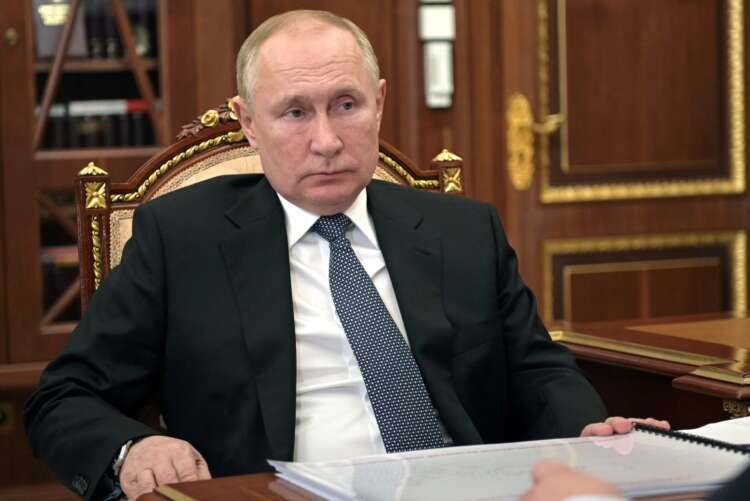
    FILE PHOTO: Russian President Vladimir Putin meets with Novgorod Region Governor Andrei Nikitin in Moscow
    Why waste money on news and opinion when you can access them for free?

    Take advantage of our newsletter subscription and stay informed on the go!

    Subscribe

    By Nina Chestney

    LONDON (Reuters) -Russia will seek payment in roubles for gas sales from “unfriendly” countries, President Vladimir Putin said on Wednesday, sending European gas prices soaring on concerns the move would exacerbate the region’s energy crunch.

    European countries’ dependence on Russian gas to heat their homes and power their economies has been thrown into the spotlight since Moscow sent troops into Ukraine on Feb. 24 and the subsequent imposition of Western sanctions aimed at isolating Russia economically.

    With the financial noose tightening and the European Union split on whether to sanction Russia’s energy sector, Putin hit back with a clear message — if you want our gas, buy our currency.

    “Russia will continue, of course, to supply natural gas in accordance with volumes and prices … fixed in previously concluded contracts,” Putin said at a televised meeting with top government ministers.

    “The changes will only affect the currency of payment, which will be changed to Russian roubles,” he said.

    Russian gas accounts for some 40% of Europe’s total consumption and EU gas imports from Russia have fluctuated between 200 million to 800 million euros ($880 million) a day so far this year. The possibility a change of currency could throw that trade into disarray sent some European wholesale gas prices up to 30% higher on Wednesday.

    The Russian rouble briefly leapt to a three-week high past 95 against the dollar and, despite paring some gains, stayed well below 100 after the shock announcement. The currency is down around 20% since Feb. 24.

    “At face value this appears to be an attempt to prop up the Ruble by compelling gas buyers to buy the previously free-falling currency in order to pay,” Vinicius Romano, senior analyst at consultancy Rystad Energy, said.

    Putin said the government and central bank had one week to come up with a solution on how to move these operations into the Russian currency and that gas giant Gazprom would be ordered to make the corresponding changes to gas contracts.

    With major banks reluctant to trade in Russian assets, some Russian gas buyers in the European Union were not immediately able to clarify how they might pay for gas going forward.

    Several firms, including oil and gas majors Eni, Shell and BP, RWE and Uniper – Germany’s biggest importer of Russian gas – declined to comment.

    Moscow calls its actions in Ukraine a “special military operation” to disarm and “denazify” its neighbour. Ukraine and Western allies call this a baseless pretext that has raised fears of wider conflict in Europe.

    A BREACH OF RULES?

    According to Gazprom, 58% of its sales of natural gas to Europe and other countries as of Jan. 27 were settled in euros. U.S. dollars accounted for about 39% of gross sales and sterling around 3%.

    The European Commission has said it plans to cut EU dependency on Russian gas by two-thirds this year and end its reliance on Russian supplies of the fuel “well before 2030”.

    But unlike the United States and Britain, EU states have not agreed to sanction Russia’s energy sector, given their dependency.

    The Commission, the 27-country EU’s executive, did not immediately respond to request for comment.

    “It is unclear how easy it would be for European clients to switch their payments to roubles given the scale of these purchases,” said Leon Izbicki, associate at consultancy Energy Aspects.

    “However, there are no sanctions in place that would prohibit payments of Russian gas in roubles,” he said, adding that Russia’s central bank could provide additional liquidity to foreign exchange markets that would enable European clients and banks to source the needed amount of roubles on the market.

    However, there are questions over whether Russia’s decision would breach contract rules which were agreed in euros.

    “This would constitute a breach to payment rules included in the current contracts,” said a senior Polish government source, adding that Poland has no intention of signing new contracts with Gazprom after their current long-term agreement expires at the end of this year.

    A spokesperson for Dutch gas supplier Eneco, which buys 15% of its gas from Gazprom’s German subsidiary Wingas GmbH said, it had a long-term contract that was denominated in euros.

    “I can’t imagine we will agree to change the terms of that.”

    Russia drew up a list of “unfriendly” countries, which corresponds to those that imposed sanctions. Among other things, deals with companies and individuals from those countries have to be approved by a government commission.

    The list of countries includes the United States, European Union member states, Britain, Japan, Canada, Norway, Singapore, South Korea, Switzerland and Ukraine.

    Some of these countries, including the United States and Norway, do not purchase Russian gas.

    ($1 = 0.9097 euros)

    (Reporting by Reuters reporters; writing by Nina Chestney; editing by Catherine Evans and Carmel Crimmins)

    More from Top Stories

    Explore more articles in the Top Stories category

    Image for Lessons From the Ring and the Deal Table: How Boxing Shapes Steven Nigro’s Approach to Banking and Life
    Lessons From the Ring and the Deal Table: How Boxing Shapes Steven Nigro’s Approach to Banking and Life
    Image for Joe Kiani in 2025: Capital, Conviction, and a Focused Return to Innovation
    Joe Kiani in 2025: Capital, Conviction, and a Focused Return to Innovation
    Image for Marco Robinson – CLOSE THE DEAL AND SUDDENLY GROW RICH
    Marco Robinson – CLOSE THE DEAL AND SUDDENLY GROW RICH
    Image for Digital Tracing: Turning a regulatory obligation into a commercial advantage
    Digital Tracing: Turning a regulatory obligation into a commercial advantage
    Image for Exploring the Role of Blockchain and the Bitcoin Price Today in Education
    Exploring the Role of Blockchain and the Bitcoin Price Today in Education
    Image for Inside the World’s First Collection Industry Conglomerate: PCA Global’s Platform Strategy
    Inside the World’s First Collection Industry Conglomerate: PCA Global’s Platform Strategy
    Image for Chase Buchanan Private Wealth Management Highlights Key Autumn 2025 Budget Takeaways for Expats
    Chase Buchanan Private Wealth Management Highlights Key Autumn 2025 Budget Takeaways for Expats
    Image for PayLaju Strengthens Its Position as Malaysia’s Trusted Interest-Free Sharia-Compliant Loan Provider
    PayLaju Strengthens Its Position as Malaysia’s Trusted Interest-Free Sharia-Compliant Loan Provider
    Image for A Notable Update for Employee Health Benefits:
    A Notable Update for Employee Health Benefits:
    Image for Creating Equity Between Walls: How Mohak Chauhan is Using Engineering, Finance, and Community Vision to Reengineer Affordable Housing
    Creating Equity Between Walls: How Mohak Chauhan is Using Engineering, Finance, and Community Vision to Reengineer Affordable Housing
    Image for Upcoming Book on Real Estate Investing: Harvard Grace Capital Founder Stewart Heath’s Puts Lessons in Print
    Upcoming Book on Real Estate Investing: Harvard Grace Capital Founder Stewart Heath’s Puts Lessons in Print
    Image for ELECTIVA MARKS A LANDMARK FIRST YEAR WITH MAJOR SENIOR APPOINTMENTS AND EXPANSION MILESTONES
    ELECTIVA MARKS A LANDMARK FIRST YEAR WITH MAJOR SENIOR APPOINTMENTS AND EXPANSION MILESTONES
    View All Top Stories Posts
    Previous Top Stories Postmultilocal underlines storming growth with hiring drive
    Next Top Stories PostNestle to suspend many products in Russia including KitKat