Search
00
GBAF Logo
trophy
Top StoriesInterviewsBusinessFinanceBankingTechnologyInvestingTradingVideosAwardsMagazinesHeadlinesTrends

Subscribe to our newsletter

Get the latest news and updates from our team.

Global Banking & Finance Review®

Global Banking & Finance Review® - Subscribe to our newsletter

Company

    GBAF Logo
    • About Us
    • Profile
    • Privacy & Cookie Policy
    • Terms of Use
    • Contact Us
    • Advertising
    • Submit Post
    • Latest News
    • Research Reports
    • Press Release
    • Awards▾
      • About the Awards
      • Awards TimeTable
      • Submit Nominations
      • Testimonials
      • Media Room
      • Award Winners
      • FAQ
    • Magazines▾
      • Global Banking & Finance Review Magazine Issue 79
      • Global Banking & Finance Review Magazine Issue 78
      • Global Banking & Finance Review Magazine Issue 77
      • Global Banking & Finance Review Magazine Issue 76
      • Global Banking & Finance Review Magazine Issue 75
      • Global Banking & Finance Review Magazine Issue 73
      • Global Banking & Finance Review Magazine Issue 71
      • Global Banking & Finance Review Magazine Issue 70
      • Global Banking & Finance Review Magazine Issue 69
      • Global Banking & Finance Review Magazine Issue 66
    Top StoriesInterviewsBusinessFinanceBankingTechnologyInvestingTradingVideosAwardsMagazinesHeadlinesTrends

    Global Banking & Finance Review® is a leading financial portal and online magazine offering News, Analysis, Opinion, Reviews, Interviews & Videos from the world of Banking, Finance, Business, Trading, Technology, Investing, Brokerage, Foreign Exchange, Tax & Legal, Islamic Finance, Asset & Wealth Management.
    Copyright © 2010-2026 GBAF Publications Ltd - All Rights Reserved. | Sitemap | Tags | Developed By eCorpIT

    Editorial & Advertiser disclosure

    Global Banking & Finance Review® is an online platform offering news, analysis, and opinion on the latest trends, developments, and innovations in the banking and finance industry worldwide. The platform covers a diverse range of topics, including banking, insurance, investment, wealth management, fintech, and regulatory issues. The website publishes news, press releases, opinion and advertorials on various financial organizations, products and services which are commissioned from various Companies, Organizations, PR agencies, Bloggers etc. These commissioned articles are commercial in nature. This is not to be considered as financial advice and should be considered only for information purposes. It does not reflect the views or opinion of our website and is not to be considered an endorsement or a recommendation. We cannot guarantee the accuracy or applicability of any information provided with respect to your individual or personal circumstances. Please seek Professional advice from a qualified professional before making any financial decisions. We link to various third-party websites, affiliate sales networks, and to our advertising partners websites. When you view or click on certain links available on our articles, our partners may compensate us for displaying the content to you or make a purchase or fill a form. This will not incur any additional charges to you. To make things simpler for you to identity or distinguish advertised or sponsored articles or links, you may consider all articles or links hosted on our site as a commercial article placement. We will not be responsible for any loss you may suffer as a result of any omission or inaccuracy on the website.

    Home > Top Stories > Pope apologizes for ‘deplorable evil’ of Canadian indigenous schools
    Top Stories

    Pope apologizes for ‘deplorable evil’ of Canadian indigenous schools

    Published by Jessica Weisman-Pitts

    Posted on July 25, 2022

    4 min read

    Last updated: February 5, 2026

    Pope Francis delivers a heartfelt apology to Canada's indigenous communities in Maskwacis, addressing the Church's role in residential schools and cultural assimilation. This historic moment highlights the ongoing efforts for healing and reconciliation.
    Pope Francis apologizes to Canadian indigenous peoples at Maskwacis - Global Banking & Finance Review
    Why waste money on news and opinion when you can access them for free?

    Take advantage of our newsletter subscription and stay informed on the go!

    Subscribe

    Tags:Compensationfinancial communitysocial development

    By Philip Pullella and Tim Johnson

    MASKWACIS, Alberta (Reuters) -Pope Francis apologized on Monday to Canada’s native people on their land for the Church’s role in schools where indigenous children were abused, calling their forced cultural assimilation a “deplorable evil” and “disastrous error.”

    Speaking near the site of two former schools in Maskwacis, Alberta, Francis apologized for Christian support of the “colonizing mentality” of the times and called for a “serious” investigation of the schools to help survivors and descendants heal.

    “With shame and unambiguously, I humbly beg forgiveness for the evil committed by so many Christians against the indigenous peoples,” said Francis, who arrived and left in a wheelchair due to a fractured knee.

    The address to the First Nations, Metis and Inuit people was the first apology on Canadian soil by the pope as a part of tour to heal deep wounds that rose to the fore after the discovery of unmarked graves at residential schools last year.

    The 85-year-old pope had promised such a tour to indigenous delegations that visited him earlier this year at the Vatican, where he made an initial apology.

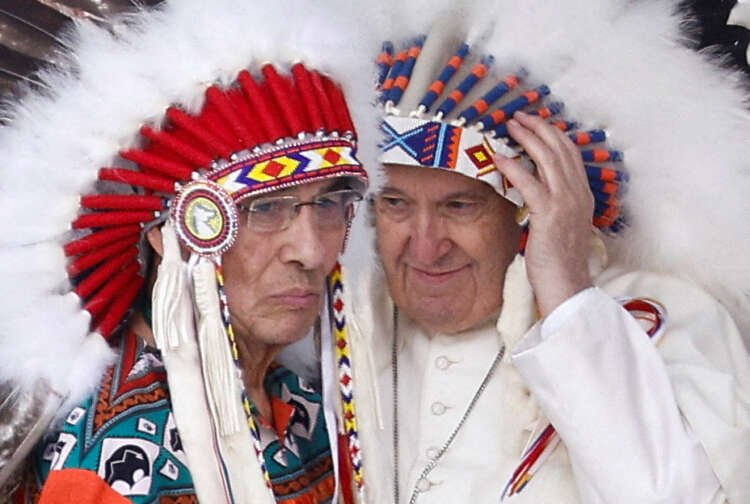
    Indigenous leaders wearing eagle-feather war headdresses greeted the pope as a fellow chief and welcomed him with chanting, beating of drums, dancing and war songs.

    “I am here because the first step of my penitential pilgrimage among you is that of again asking forgiveness, of telling you once more that I am deeply sorry,” he said.

    He was addressing the indigenous groups in the Bear Park Pow-Wow Grounds, part of the the ancestral territory of the Cree, Dene, Blackfoot, Saulteaux and Nakota Sioux people.

    “Sorry for the ways in which, regrettably, many Christians supported the colonizing mentality of the powers that oppressed the indigenous peoples. I am sorry,” he said. “In the face of this deplorable evil, the Church kneels before God and implores his forgiveness for the sins of her children.”

    After the pope spoke, Chief Wilton Littlechild placed a feather headdress on the pontiff’s head. Francis stood from his chair and wore it for a few moments before a clapping crowd.

    An indigenous singer also performed a version of Canada’s national anthem in Cree, with tears pouring down her face. A red banner with names of missing children was carried before the pope, who kissed it.

    Before his address, Francis prayed silently in a field of crosses in the cemetery of a church for indigenous people and passed by a stone memorial to the two residential schools once in the area.

    CULTURAL DESTRUCTION

    Between 1881 and 1996 more than 150,000 indigenous children were separated from their families and brought to residential schools. Many children were starved, beaten for speaking their native languages, and sexually abused in a system that Canada’s Truth and Reconciliation Commission called “cultural genocide.”

    “I ask forgiveness, in particular, for the ways in which many members of the Church and of religious communities cooperated, not least through their indifference, in projects of cultural destruction and forced assimilation promoted by the governments of that time, which culminated in the system of residential schools,” the pope said.

    Most of the schools were run for the government by Roman Catholic religious orders of priests and nuns.

    Last year, the remains of 215 children at a former residential school in British Columbia were discovered. Since then, the suspected remains of hundreds more children have been detected at other former residential schools around the country.

    Many survivors and indigenous leaders say they want more than an apology. They also want financial compensation, the return of artefacts sent to the Vatican by missionaries, support in bringing an alleged abuser now living in France to justice and the release of records held by the religious orders that ran the schools.

    Some also have called for the Catholic Church to renounce 15th-century papal bulls, or edicts, that justified colonial powers taking away indigenous land.

    For Wallace Yellowface, 78, a boarding school survivor from the Pikanni Nation Reserve in southern Alberta, the pope’s message was too little offered too late.

    “It’s late for an apology, and I don’t think it will do me much good,” he said, adding that he was still trying to find out what happened to his sister who attended a residential school.

    Still, many of the indigenous people in the crowd cried openly or applauded each time the pope said he was sorry or condemned policies to wipe out indigenous cultures.

    In January, the Canadian government agreed to pay C$40 billion ($31.5 billion) to compensate First Nations children who were taken from their families.

    The Canadian Conference of Catholic Bishops has promised to raise C$30 million for healing and other initiatives. The fund has raised C$4.6 million so far.

    (Additional reporting by Steve Scherer, Editing by Deepa Babington)

    Frequently Asked Questions about Pope apologizes for ‘deplorable evil’ of Canadian indigenous schools

    1What is cultural genocide?

    Cultural genocide refers to acts aimed at destroying the cultural identity of a group, including the suppression of their language, traditions, and practices.

    2What is the role of the Catholic Church in residential schools?

    The Catholic Church played a significant role in operating residential schools in Canada, where many Indigenous children experienced abuse and cultural assimilation.

    3What is financial compensation for Indigenous peoples?

    Financial compensation refers to monetary payments made to Indigenous peoples as restitution for historical injustices and harms caused by residential schools.

    4What are unmarked graves in the context of residential schools?

    Unmarked graves refer to burial sites of children who died while attending residential schools, often discovered during investigations into the schools' histories.

    More from Top Stories

    Explore more articles in the Top Stories category

    Image for Lessons From the Ring and the Deal Table: How Boxing Shapes Steven Nigro’s Approach to Banking and Life
    Lessons From the Ring and the Deal Table: How Boxing Shapes Steven Nigro’s Approach to Banking and Life
    Image for Joe Kiani in 2025: Capital, Conviction, and a Focused Return to Innovation
    Joe Kiani in 2025: Capital, Conviction, and a Focused Return to Innovation
    Image for Marco Robinson – CLOSE THE DEAL AND SUDDENLY GROW RICH
    Marco Robinson – CLOSE THE DEAL AND SUDDENLY GROW RICH
    Image for Digital Tracing: Turning a regulatory obligation into a commercial advantage
    Digital Tracing: Turning a regulatory obligation into a commercial advantage
    Image for Exploring the Role of Blockchain and the Bitcoin Price Today in Education
    Exploring the Role of Blockchain and the Bitcoin Price Today in Education
    Image for Inside the World’s First Collection Industry Conglomerate: PCA Global’s Platform Strategy
    Inside the World’s First Collection Industry Conglomerate: PCA Global’s Platform Strategy
    Image for Chase Buchanan Private Wealth Management Highlights Key Autumn 2025 Budget Takeaways for Expats
    Chase Buchanan Private Wealth Management Highlights Key Autumn 2025 Budget Takeaways for Expats
    Image for PayLaju Strengthens Its Position as Malaysia’s Trusted Interest-Free Sharia-Compliant Loan Provider
    PayLaju Strengthens Its Position as Malaysia’s Trusted Interest-Free Sharia-Compliant Loan Provider
    Image for A Notable Update for Employee Health Benefits:
    A Notable Update for Employee Health Benefits:
    Image for Creating Equity Between Walls: How Mohak Chauhan is Using Engineering, Finance, and Community Vision to Reengineer Affordable Housing
    Creating Equity Between Walls: How Mohak Chauhan is Using Engineering, Finance, and Community Vision to Reengineer Affordable Housing
    Image for Upcoming Book on Real Estate Investing: Harvard Grace Capital Founder Stewart Heath’s Puts Lessons in Print
    Upcoming Book on Real Estate Investing: Harvard Grace Capital Founder Stewart Heath’s Puts Lessons in Print
    Image for ELECTIVA MARKS A LANDMARK FIRST YEAR WITH MAJOR SENIOR APPOINTMENTS AND EXPANSION MILESTONES
    ELECTIVA MARKS A LANDMARK FIRST YEAR WITH MAJOR SENIOR APPOINTMENTS AND EXPANSION MILESTONES
    View All Top Stories Posts
    Previous Top Stories PostDavid Trimble, Northern Irish hardliner turned consensus-builder dies at 77
    Next Top Stories PostWorld condemns Myanmar junta for ‘cruel’ execution of activists