
Top Stories
Oil Surge Fans Inflation Fears, Dampens Stocks
Published by Wanda Rich
Posted on May 31, 2022
4 min readLast updated: February 6, 2026
Add as preferred source on Google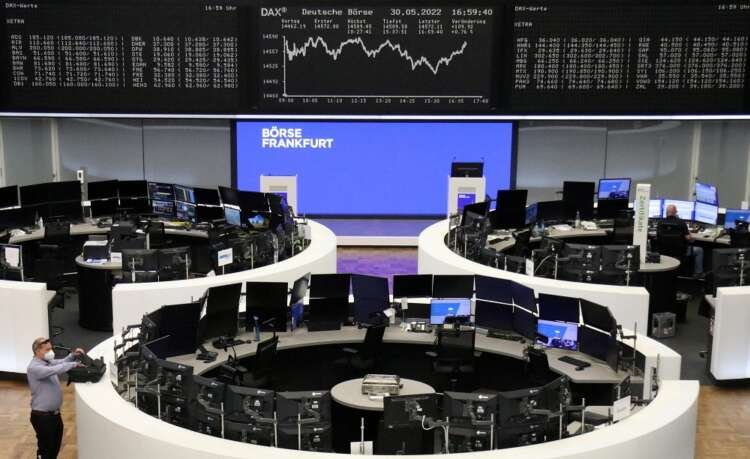
Published by Wanda Rich
Posted on May 31, 2022
4 min readLast updated: February 6, 2026
Add as preferred source on GoogleBy Sujata Rao
LONDON (Reuters) -European shares fell on Tuesday and Wall Street was tipped to start weaker as surging oil prices fanned fears of further acceleration in global inflation that would keep the U.S. Federal Reserve and other central banks raising interest rates.
Markets looked past signs that China’s economic pain might be abating amid easing COVID-19 curbs and focused instead on the inflation outlook. Euro zone inflation hit a record high 8.1% in May, a day after German price growth accelerated to 8.7%. Inflation was last this high during the 1973/74 oil shocks .
Brent crude futures dashed to two-month highs above $123 a barrel and could rise further, analysts warn, citing Europe’s decision to slash Russian oil imports, high U.S. summer demand and the easing of Chinese lockdowns at a time of tight global crude supply.
“It all depends on inflation now,” said Francois Savary, CIO of Prime Partners, a wealth manager in Geneva.
He said stock markets were not out of the woods despite a rebound from mid-month troughs. That rebound was spurred by perceptions that inflation may have peaked and a pullback in Fed rate hike expectations.
“What happens to markets depends on whether we see some normalisation in inflation in the second half of the year,” Savary said.
The German inflation data strengthened the case for an outsized European Central Bank rate hike in July and sent short-dated German yields to the highest in more than a decade.
Highly indebted Italy saw 10-year yields spike more than 7 basis points..
On stock markets, a pan-European equity index slipped 0.3% while German shares lost 0.6%.
Futures for the U.S. S&P 500 slipped 0.45% though Nasdaq e-minis recouped some earlier losses to stand flat.
MSCI’s global stock index is set to end May with a small loss, its first monthly fall this year
Just like in Europe, Treasury yields too were on the rise, after Monday’s U.S. public holiday. Ten-year yields jumped as much as 10 basis points before easing to trade 6 bps higher at 2.81%.
While still 40 bps below their early-May highs, yields have moved away from six-week lows hit recently.
Some of that momentum stems from comments by Fed Governor Christopher Waller who on Monday advocated 50 basis-point rate rises until there was a “substantial” reduction in inflation.
His comments dampened hopes of a rate hike pause in September.
CHINA CURBS EASED
The mood was more cheerful in Asia earlier, when China unveiled policy support details, including cash handouts for hiring graduates and support for internet companies’ offshore listings.
China’s official PMI also showed factory activity declined in May but at a slower pace than in April.
That helped Chinese blue chip shares rise 1.6% while MSCI’s index of Asian shares outside Japan was up 0.7%.
The news from China lifted the Australian dollar although it later turned lower to trade 0.2% down against the U.S. dollar.
“Whether Shanghai could deliver an effective and sustained opening up is key,” Bruce Pang, head of macro and strategy research at China Renaissance Securities Hong Kong, said about the easing of COVID-related measures.
However, with Shanghai residents able to resume driving from Wednesday, oil prices may get another boost, analysts warn.
Such worries and the U.S. Treasury yield bounce lifted the dollar index from one-month lows, allowing it to rise 0.5%. The euro slipped 0.7% against the U.S. currency to $1.0706.
“The dollar has also advanced today on back of higher oil prices…and the risk of a recession is seen as greater in Europe than in the U.S.,” Stuart Cole, chief macro strategist at Equiti Capital, said.
(Reporting by Sujata Rao; Additional reporting by Tom Westbrook and Xie Yu; Editing by Edmund Klamann and Tomasz Janowski)
Inflation is the rate at which the general level of prices for goods and services rises, eroding purchasing power. It is typically measured by the Consumer Price Index (CPI) or Producer Price Index (PPI).
Interest rates are the cost of borrowing money or the return on savings, expressed as a percentage. They are influenced by central banks and can affect economic activity and inflation.
A central bank is a national institution that manages a country's currency, money supply, and interest rates. It also oversees the banking system and implements monetary policy.
A financial market is a marketplace where financial instruments, such as stocks, bonds, and currencies, are traded. It facilitates the exchange of capital and liquidity among participants.
The Eurozone is a group of European Union countries that have adopted the euro as their official currency, allowing for easier trade and economic stability among member states.
Explore more articles in the Top Stories category











