Search
00
GBAF Logo
trophy
Top StoriesInterviewsBusinessFinanceBankingTechnologyInvestingTradingVideosAwardsMagazinesHeadlinesTrends

Subscribe to our newsletter

Get the latest news and updates from our team.

Global Banking and Finance Review

Global Banking & Finance Review

Company

    GBAF Logo
    • About Us
    • Profile
    • Privacy & Cookie Policy
    • Terms of Use
    • Contact Us
    • Advertising
    • Submit Post
    • Latest News
    • Research Reports
    • Press Release
    • Awards▾
      • About the Awards
      • Awards TimeTable
      • Submit Nominations
      • Testimonials
      • Media Room
      • Award Winners
      • FAQ
    • Magazines▾
      • Global Banking & Finance Review Magazine Issue 79
      • Global Banking & Finance Review Magazine Issue 78
      • Global Banking & Finance Review Magazine Issue 77
      • Global Banking & Finance Review Magazine Issue 76
      • Global Banking & Finance Review Magazine Issue 75
      • Global Banking & Finance Review Magazine Issue 73
      • Global Banking & Finance Review Magazine Issue 71
      • Global Banking & Finance Review Magazine Issue 70
      • Global Banking & Finance Review Magazine Issue 69
      • Global Banking & Finance Review Magazine Issue 66
    Top StoriesInterviewsBusinessFinanceBankingTechnologyInvestingTradingVideosAwardsMagazinesHeadlinesTrends

    Global Banking & Finance Review® is a leading financial portal and online magazine offering News, Analysis, Opinion, Reviews, Interviews & Videos from the world of Banking, Finance, Business, Trading, Technology, Investing, Brokerage, Foreign Exchange, Tax & Legal, Islamic Finance, Asset & Wealth Management.
    Copyright © 2010-2025 GBAF Publications Ltd - All Rights Reserved.

    Editorial & Advertiser disclosure

    Global Banking and Finance Review is an online platform offering news, analysis, and opinion on the latest trends, developments, and innovations in the banking and finance industry worldwide. The platform covers a diverse range of topics, including banking, insurance, investment, wealth management, fintech, and regulatory issues. The website publishes news, press releases, opinion and advertorials on various financial organizations, products and services which are commissioned from various Companies, Organizations, PR agencies, Bloggers etc. These commissioned articles are commercial in nature. This is not to be considered as financial advice and should be considered only for information purposes. It does not reflect the views or opinion of our website and is not to be considered an endorsement or a recommendation. We cannot guarantee the accuracy or applicability of any information provided with respect to your individual or personal circumstances. Please seek Professional advice from a qualified professional before making any financial decisions. We link to various third-party websites, affiliate sales networks, and to our advertising partners websites. When you view or click on certain links available on our articles, our partners may compensate us for displaying the content to you or make a purchase or fill a form. This will not incur any additional charges to you. To make things simpler for you to identity or distinguish advertised or sponsored articles or links, you may consider all articles or links hosted on our site as a commercial article placement. We will not be responsible for any loss you may suffer as a result of any omission or inaccuracy on the website.

    Home > Banking > NEW POSITION AVAILABLE: MONEY MULE
    Banking

    NEW POSITION AVAILABLE: MONEY MULE

    NEW POSITION AVAILABLE: MONEY MULE

    Published by Gbaf News

    Posted on January 13, 2018

    Featured image for article about Banking
    • Santander ’fake job ad’ experiment1 convinces one third of Brits2 to apply for a job as a money mule. Only fifteen per cent rightly identified the role as that of a money mule.
    • Of those who fell for the ad, seven per cent said they would still apply for the job even after they were informed it was a role as a money mule.
    • Those aged 18-24 years were most easily duped, while regionally those in Northern Ireland were most likely to fall for the scam.
    • 71 per cent of people are unaware of the term ‘money mule’ but even when given an explanation of what it is over a quarter thought it  may carry no criminal punishment.

    One third (32 per cent) of Britons would apply for a job as a money mule, helping criminals to launder money. That’s the finding of an experiment carried out by Santander to shed light on just how convincing the ‘bogus job ad’ is: a technique which criminals use to lure people looking for work into transferring money connected to criminal activity.

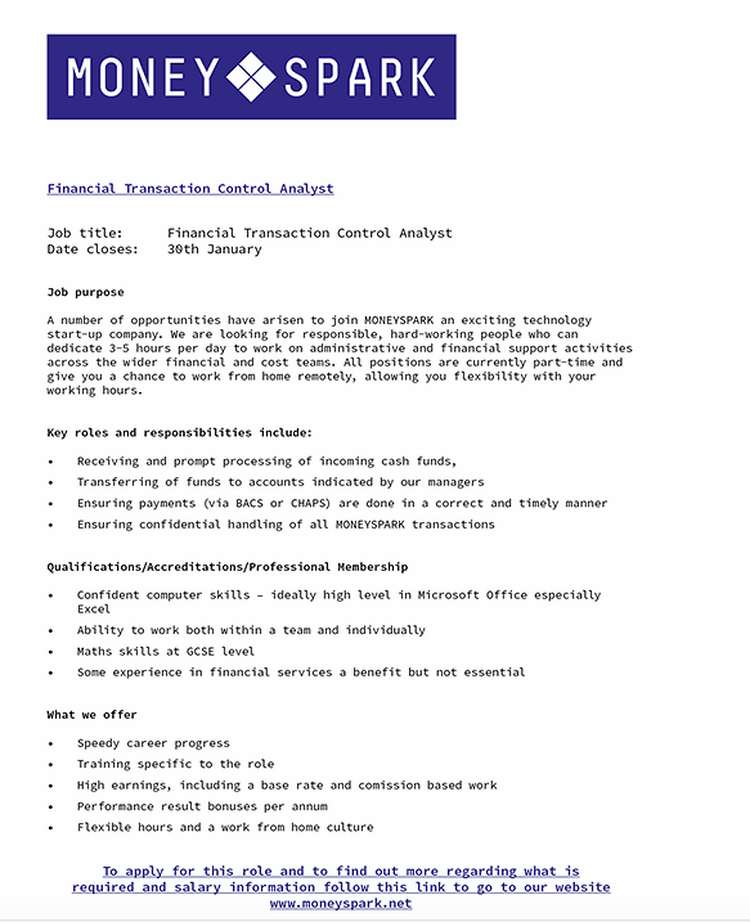
    Santander’s experiment involved presenting 2,000 British adults with a falsified job description to work at a fictitious company called Money Spark as a ‘Financial Transaction Control Analyst’. Details of the role included ‘receiving and processing of incoming cash funds’ and; ‘transferring of funds to accounts indicated by our managers’.

    While some people were suspicious of the description of the role and spotted the tell-tale spelling mistakes and bogus link in the ad, one in three (32 per cent) said they would definitely apply for the job if they were looking for work. What’s more, one in four (27 per cent) said they would leave their current job to join the Money Spark Company. Alarmingly, upon learning the job was a front for criminal activity, seven per cent said they would still accept the job anyway. Only fifteen per cent correctly spotted the role was for a money mule.

    Although 91 per cent of Britons are familiar with the term money laundering, almost three quarters (71 per cent) of those taking part had not heard of the term ‘money mule’. The research also suggests that many Britons are not aware of the true risks associated with becoming a money mule.

    Sixty-nine per cent of the ‘applicants’ in the study did not think that becoming a money mule and partaking in the movement of stolen funds (unwittingly or not) could lead to a jail term in excess of three years (money launderers can face a maximum prison sentence of 14 years). While around a quarter of people thought the punishment would be no more than a fine or a warning.

    This form of criminality is an increasing problem, with the latest official statistics showing that the number of Britons using their bank account for money mule activity has grown by 55 per cent in the past year3. Around four per cent of respondents to Santander’s research believed they, or someone they knew had been approached by a criminal looking to recruit money mules, with this figure doubling to eight per cent for those in the age bracket 18-24 years – that’s around 453,3604 young adults across the UK.

    Chris Ainsley, Head of Fraud Strategy at Santander UK, commented: “Santander is committed to helping consumers protect themselves against scams and fraud. Criminals often target vulnerable people, such as those desperate for a job, and our research illustrates how easily some people can be tricked into falling victim.   

    “We are seeing a rise in the number of fake job ads such as the one used in our experiment and raising awareness of the issue is key to preventing people unwittingly getting involved and ultimately facing life changing consequences for their actions.”

    Other detail from the research revealed that flexible working was the most appealing aspect (80 per cent) to those who were attracted to the job, followed by low working hours (62 per cent) perceived career progression and personal development (44 per cent).

    Those aged 18-24 were the most likely to apply for the job, followed by those in the 25-34 year bracket. Regionally, those based in Northern Ireland came out as the most likely to apply for the job, followed closely by Yorkshire and Humber and West Wales.

    Immediately following the conclusion of the experiment, 72 per cent of those taking part have said they will now be more suspicious and cautious of these types of job descriptions in the future.
    info-2018

    • Santander ’fake job ad’ experiment1 convinces one third of Brits2 to apply for a job as a money mule. Only fifteen per cent rightly identified the role as that of a money mule.
    • Of those who fell for the ad, seven per cent said they would still apply for the job even after they were informed it was a role as a money mule.
    • Those aged 18-24 years were most easily duped, while regionally those in Northern Ireland were most likely to fall for the scam.
    • 71 per cent of people are unaware of the term ‘money mule’ but even when given an explanation of what it is over a quarter thought it  may carry no criminal punishment.

    One third (32 per cent) of Britons would apply for a job as a money mule, helping criminals to launder money. That’s the finding of an experiment carried out by Santander to shed light on just how convincing the ‘bogus job ad’ is: a technique which criminals use to lure people looking for work into transferring money connected to criminal activity.

    Santander’s experiment involved presenting 2,000 British adults with a falsified job description to work at a fictitious company called Money Spark as a ‘Financial Transaction Control Analyst’. Details of the role included ‘receiving and processing of incoming cash funds’ and; ‘transferring of funds to accounts indicated by our managers’.

    While some people were suspicious of the description of the role and spotted the tell-tale spelling mistakes and bogus link in the ad, one in three (32 per cent) said they would definitely apply for the job if they were looking for work. What’s more, one in four (27 per cent) said they would leave their current job to join the Money Spark Company. Alarmingly, upon learning the job was a front for criminal activity, seven per cent said they would still accept the job anyway. Only fifteen per cent correctly spotted the role was for a money mule.

    Although 91 per cent of Britons are familiar with the term money laundering, almost three quarters (71 per cent) of those taking part had not heard of the term ‘money mule’. The research also suggests that many Britons are not aware of the true risks associated with becoming a money mule.

    Sixty-nine per cent of the ‘applicants’ in the study did not think that becoming a money mule and partaking in the movement of stolen funds (unwittingly or not) could lead to a jail term in excess of three years (money launderers can face a maximum prison sentence of 14 years). While around a quarter of people thought the punishment would be no more than a fine or a warning.

    This form of criminality is an increasing problem, with the latest official statistics showing that the number of Britons using their bank account for money mule activity has grown by 55 per cent in the past year3. Around four per cent of respondents to Santander’s research believed they, or someone they knew had been approached by a criminal looking to recruit money mules, with this figure doubling to eight per cent for those in the age bracket 18-24 years – that’s around 453,3604 young adults across the UK.

    Chris Ainsley, Head of Fraud Strategy at Santander UK, commented: “Santander is committed to helping consumers protect themselves against scams and fraud. Criminals often target vulnerable people, such as those desperate for a job, and our research illustrates how easily some people can be tricked into falling victim.   

    “We are seeing a rise in the number of fake job ads such as the one used in our experiment and raising awareness of the issue is key to preventing people unwittingly getting involved and ultimately facing life changing consequences for their actions.”

    Other detail from the research revealed that flexible working was the most appealing aspect (80 per cent) to those who were attracted to the job, followed by low working hours (62 per cent) perceived career progression and personal development (44 per cent).

    Those aged 18-24 were the most likely to apply for the job, followed by those in the 25-34 year bracket. Regionally, those based in Northern Ireland came out as the most likely to apply for the job, followed closely by Yorkshire and Humber and West Wales.

    Immediately following the conclusion of the experiment, 72 per cent of those taking part have said they will now be more suspicious and cautious of these types of job descriptions in the future.

    info-2018

    Related Posts
    DeFi and banking are converging. Here’s what banks can do.
    DeFi and banking are converging. Here’s what banks can do.
    Are Neo Banks Offering Better Metal Debit Cards Than Traditional Banks?
    Are Neo Banks Offering Better Metal Debit Cards Than Traditional Banks?
    Banking at the Intersection: From Nashville to Cannes, A Strategic Call to Action
    Banking at the Intersection: From Nashville to Cannes, A Strategic Call to Action
    Driving Efficiency and Profit Through Customer-Centric Banking
    Driving Efficiency and Profit Through Customer-Centric Banking
    How Ecosystem Partnerships Are Redefining Deposit Products
    How Ecosystem Partnerships Are Redefining Deposit Products
    CIBC Private Banking wins four 2025 Global Banking & Finance Awards
    CIBC Private Banking wins four 2025 Global Banking & Finance Awards
    How Banks Can Put AI to Work Now and Prove ROI in 90 Days
    How Banks Can Put AI to Work Now and Prove ROI in 90 Days
    Top 5 AI quality assurance framework providers for Banks and Financial Services firms.
    Top 5 AI quality assurance framework providers for Banks and Financial Services firms.
    The Unbanked Paradox: How Banking Access Creates Economic Resilience
    The Unbanked Paradox: How Banking Access Creates Economic Resilience
    Hyper-Personalised Banking - Shaping the Future of Finance
    Hyper-Personalised Banking - Shaping the Future of Finance
    The End of Voice Trust: How AI Deepfakes Are Forcing Banks to Rethink Authentication
    The End of Voice Trust: How AI Deepfakes Are Forcing Banks to Rethink Authentication
    Predicting and Preventing Customer Churn in Retail Banking
    Predicting and Preventing Customer Churn in Retail Banking

    Why waste money on news and opinions when you can access them for free?

    Take advantage of our newsletter subscription and stay informed on the go!

    Subscribe

    Previous Banking PostHOW BANKS CAN STOP WORRYING AND LEARN TO LOVE THE API ECONOMY
    Next Banking PostPSD2 GOES LIVE IN EUROPE ON JANUARY 13, MAY SIGNAL PROFOUND CHANGES IN RETAIL BANKING INDUSTRY

    More from Banking

    Explore more articles in the Banking category

    Growth and Impact: Banreservas Leads Dominican Republic Economic Expansion

    Growth and Impact: Banreservas Leads Dominican Republic Economic Expansion

    Turning Insight into Impact: Making AI and Analytics Work in Retail Banking

    Turning Insight into Impact: Making AI and Analytics Work in Retail Banking

    KeyBank Embraces Next-Generation AI Platform to Transform Fraud and Financial Crime Prevention

    KeyBank Embraces Next-Generation AI Platform to Transform Fraud and Financial Crime Prevention

    Understanding Association Banking: Financial Solutions for Community Success

    Understanding Association Banking: Financial Solutions for Community Success

    Applying Symbiosis for advantage in APAC banking

    Applying Symbiosis for advantage in APAC banking

    AmBank Islamic Berhad Earns Triple Recognition for Excellence in Islamic Banking

    AmBank Islamic Berhad Earns Triple Recognition for Excellence in Islamic Banking

    FinTok Strategy: How Banks Are Reaching Gen Z Through Social Media

    FinTok Strategy: How Banks Are Reaching Gen Z Through Social Media

    Rethinking Retail Banking Sustainability: Why the ATM is an Asset in the Sustainable Transition

    Rethinking Retail Banking Sustainability: Why the ATM is an Asset in the Sustainable Transition

    How private banks can survive the neo-broker revolution

    How private banks can survive the neo-broker revolution

    Next-Gen Bank Branches: The Evolution from Transaction Hubs to Experience Centers

    Next-Gen Bank Branches: The Evolution from Transaction Hubs to Experience Centers

    The Banking Talent Crunch: How Financial Institutions Are Competing for Digital-Native Skills

    The Banking Talent Crunch: How Financial Institutions Are Competing for Digital-Native Skills

    Beyond Interest: How Banks Are Reimagining Revenue in the Digital Age

    Beyond Interest: How Banks Are Reimagining Revenue in the Digital Age

    View All Banking Posts