
Top Stories
Multinational Companies Could Be Sitting on a ‘leaseberg’ of Huge Proportions
Published by Gbaf News
Posted on March 1, 2018
8 min readLast updated: January 21, 2026
Add as preferred source on Google
Published by Gbaf News
Posted on March 1, 2018
8 min readLast updated: January 21, 2026
Add as preferred source on GoogleNew lease accounting rules (ASC 842, IFRS 16) will dramatically increase companies’ reported liabilities
The value of operational leases can equal almost two-thirds of the size of the company balance sheet
Large, multinational companies across industry sectors currently rely on a huge variety of operational leases to finance assets, which keep leases and their associated liabilities off balance sheets
The cost of lease commitments that currently don’t sit on the balance sheet can be upwards of 62% of existing balance sheets, according to new analysis by Aptitude Software, a global financial software specialist.
The new lease accounting standards (ASC 842 and IFRS 16) come into force at the start of next year, fundamentally changing how companies account for leases. It can move thousands of leases onto a company’s books and requires CFOs to apply accounting judgment across thousands of leases.
Companies rely on a huge variety of leased assets including premises, land agreements, delivery vehicles, machinery and IT equipment; Aptitude Software’s analysis shows that these operational leases can equal a material percentage of companies’ total asset values.
Ross Chapman, Global Marketing Director, said: “Many investors, CEOs and business managers are on course to hit the unforeseen impacts of new lease accounting rules. The financial effects of the new rules are largely unknown as most companies have yet to implement systems that can deliver control and transparency over lease accounting.”
The following table looks at five leading multinational companies in each sector to calculate an average value of operational lease liabilities against total assets. Examples of the highest recorded lease liability known in each sector have also been highlighted.
| OPERATIONAL LEASE LIABILITIES VERSUS COMPANY NET ASSETS | |||||
| Industry Sector | Average operational lease value as % of total assets (minus goodwill) | Average value of operational leases for observed companies ($B USD) |
Company example | Company example: Operational lease value as % of total assets (minus goodwill) | Company example: value of operational leases
($B USD) |
| Oil & gas | 6% | $10.6 | Statoil | 8% | $8.6 |
| Manufacturing | 6% | $9.8 | CRH | 9% | $2.7 |
| Logistics | 20% | $8.6 | FedEx | 43% | $17.8 |
| Consumer product goods (CPG) | 8% | $1.7 | L’Oréal | 11% | $3.5 |
| Telecommunications | 11% | $20.4 | Deutsche Telekom AG | 13% | $18.6 |
| Financial Services / Banking | 1% | $8.0 | Bank of America | 1% | $13.6 |
| Technology | 4% | $4.1 | IBM | 8% | $6.8 |
| Retail | 31% | $16.2 | Walgreens Boots Alliance | 62% | $31.4 |
Aptitude Software analysis of five well-known companies by industry, Jan 2018
Aptitude Software’s analysis shows that the total value of lease liabilities is only a small part of the issue when it comes to complying with the new standard. A wide variety of leasing arrangements complicate the compliance with new rules including intra-company lease transfers, sub-leasing and embedded options. Furthermore, US (ASC 842) and International (IFRS 16) lease accounting rules are distinctly different, challenging multinational companies to deliver multi-GAAP financial reporting.
Ross E. Chapman, added: “Whilst the new standard is summarized in just over 20 pages, it is deceptively complex. A very high level of judgment and consideration is needed to apply accounting consistently and appropriately across a diverse range of leasing arrangements. Whilst often out of sight, leased assets can be equivalent to an enormous proportion of a company’s value.”
“Some leading multi-nationals have realized that they were on course to hit a ‘leaseberg’ and have mobilized their teams to achieve compliance with new lease accounting capabilities. Many others, unfortunately, have not realized the real-world accounting challenges required to achieve compliance and gain control over the lease liabilities that will need to be managed on their balance sheets.”
The new lease accounting standard fundamentally changes accounting for lease transactions and will move hundreds or thousands of lease contracts onto a company’s books. All leases over $5,000 need to be disclosed. For global companies, leased assets need to be accounted for consistently regardless of where assets are stored. Some companies have reported that the new lease accounting standard will necessitate 66 times more journal entries than were previously required.
Jeremy Suddards, Aptitude Software Chief Revenue Officer, added: “The new leasing standards are an accounting nightmare. A global technology brand recently approached us with over $2 billion of operating leases. Applying the new accounting standard was going to have a huge impact on their business and they needed to understand exactly how new rules would affect their financial position.”
“After a series of mergers and acquisitions, this business has multiple ledgers and numerous different lease management systems. With over 50 entities around the world, the combination of multiple currencies, embedded equipment leases and other complex arrangements made achieving compliance and gaining control of lease accounting a priority.”
Aptitude’s Leaseberg Index combines available data on the value of lease liabilities with sector specific insights to estimate the overall challenge across key industries.
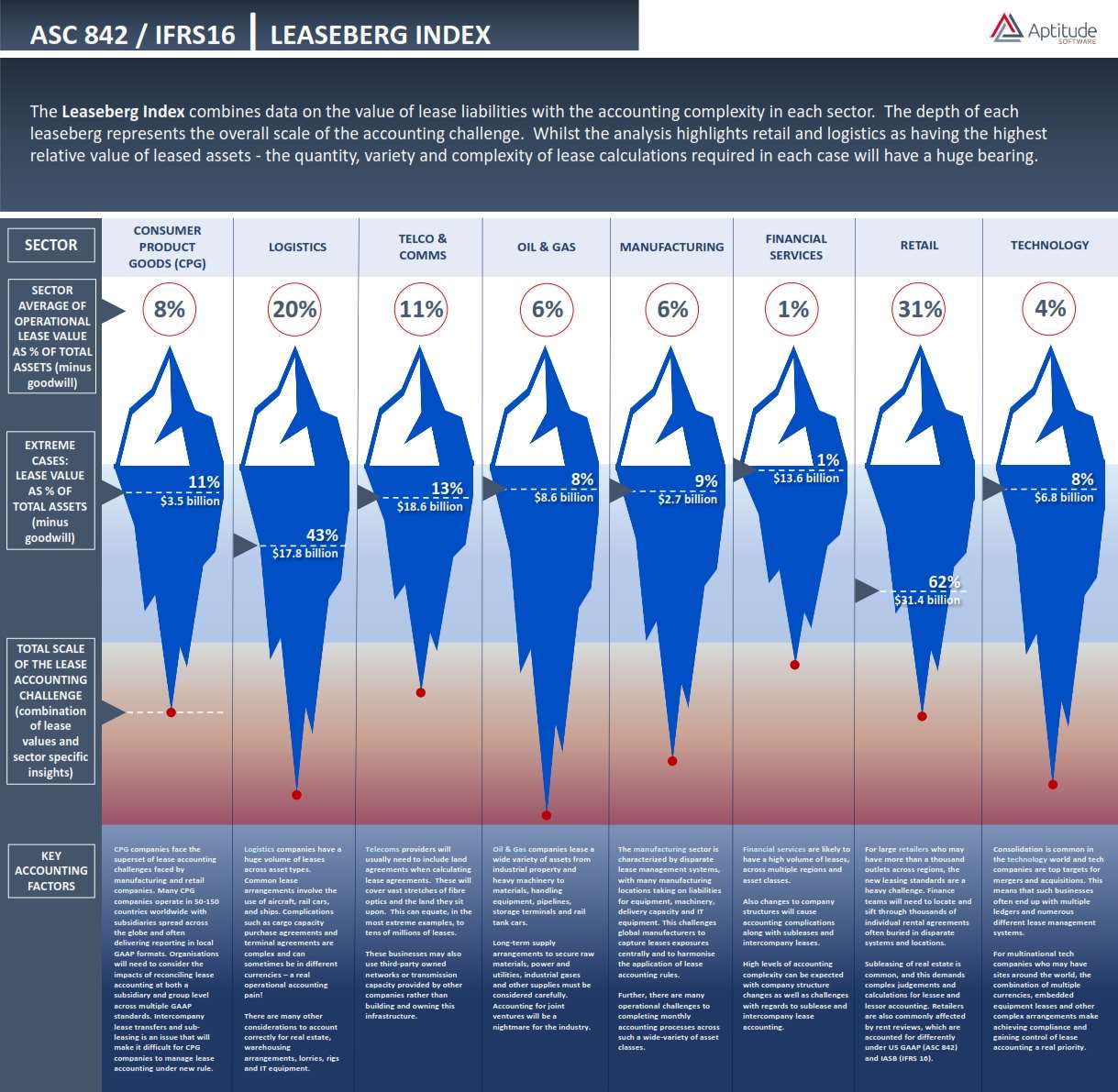
Aptitude Leaseberg infographic
New lease accounting rules (ASC 842, IFRS 16) will dramatically increase companies’ reported liabilities
The value of operational leases can equal almost two-thirds of the size of the company balance sheet
Large, multinational companies across industry sectors currently rely on a huge variety of operational leases to finance assets, which keep leases and their associated liabilities off balance sheets
The cost of lease commitments that currently don’t sit on the balance sheet can be upwards of 62% of existing balance sheets, according to new analysis by Aptitude Software, a global financial software specialist.
The new lease accounting standards (ASC 842 and IFRS 16) come into force at the start of next year, fundamentally changing how companies account for leases. It can move thousands of leases onto a company’s books and requires CFOs to apply accounting judgment across thousands of leases.
Companies rely on a huge variety of leased assets including premises, land agreements, delivery vehicles, machinery and IT equipment; Aptitude Software’s analysis shows that these operational leases can equal a material percentage of companies’ total asset values.
Ross Chapman, Global Marketing Director, said: “Many investors, CEOs and business managers are on course to hit the unforeseen impacts of new lease accounting rules. The financial effects of the new rules are largely unknown as most companies have yet to implement systems that can deliver control and transparency over lease accounting.”
The following table looks at five leading multinational companies in each sector to calculate an average value of operational lease liabilities against total assets. Examples of the highest recorded lease liability known in each sector have also been highlighted.
| OPERATIONAL LEASE LIABILITIES VERSUS COMPANY NET ASSETS | |||||
| Industry Sector | Average operational lease value as % of total assets (minus goodwill) | Average value of operational leases for observed companies ($B USD) | Company example | Company example: Operational lease value as % of total assets (minus goodwill) | Company example: value of operational leases ($B USD) |
| Oil & gas | 6% | $10.6 | Statoil | 8% | $8.6 |
| Manufacturing | 6% | $9.8 | CRH | 9% | $2.7 |
| Logistics | 20% | $8.6 | FedEx | 43% | $17.8 |
| Consumer product goods (CPG) | 8% | $1.7 | L’Oréal | 11% | $3.5 |
| Telecommunications | 11% | $20.4 | Deutsche Telekom AG | 13% | $18.6 |
| Financial Services / Banking | 1% | $8.0 | Bank of America | 1% | $13.6 |
| Technology | 4% | $4.1 | IBM | 8% | $6.8 |
| Retail | 31% | $16.2 | Walgreens Boots Alliance | 62% | $31.4 |
Aptitude Software analysis of five well-known companies by industry, Jan 2018
Aptitude Software’s analysis shows that the total value of lease liabilities is only a small part of the issue when it comes to complying with the new standard. A wide variety of leasing arrangements complicate the compliance with new rules including intra-company lease transfers, sub-leasing and embedded options. Furthermore, US (ASC 842) and International (IFRS 16) lease accounting rules are distinctly different, challenging multinational companies to deliver multi-GAAP financial reporting.
Ross E. Chapman, added: “Whilst the new standard is summarized in just over 20 pages, it is deceptively complex. A very high level of judgment and consideration is needed to apply accounting consistently and appropriately across a diverse range of leasing arrangements. Whilst often out of sight, leased assets can be equivalent to an enormous proportion of a company’s value.”
“Some leading multi-nationals have realized that they were on course to hit a ‘leaseberg’ and have mobilized their teams to achieve compliance with new lease accounting capabilities. Many others, unfortunately, have not realized the real-world accounting challenges required to achieve compliance and gain control over the lease liabilities that will need to be managed on their balance sheets.”
The new lease accounting standard fundamentally changes accounting for lease transactions and will move hundreds or thousands of lease contracts onto a company’s books. All leases over $5,000 need to be disclosed. For global companies, leased assets need to be accounted for consistently regardless of where assets are stored. Some companies have reported that the new lease accounting standard will necessitate 66 times more journal entries than were previously required.
Jeremy Suddards, Aptitude Software Chief Revenue Officer, added: “The new leasing standards are an accounting nightmare. A global technology brand recently approached us with over $2 billion of operating leases. Applying the new accounting standard was going to have a huge impact on their business and they needed to understand exactly how new rules would affect their financial position.”
“After a series of mergers and acquisitions, this business has multiple ledgers and numerous different lease management systems. With over 50 entities around the world, the combination of multiple currencies, embedded equipment leases and other complex arrangements made achieving compliance and gaining control of lease accounting a priority.”
Aptitude’s Leaseberg Index combines available data on the value of lease liabilities with sector specific insights to estimate the overall challenge across key industries.
Aptitude Leaseberg infographic
Explore more articles in the Top Stories category











