Search
00
GBAF Logo
trophy
Top StoriesInterviewsBusinessFinanceBankingTechnologyInvestingTradingVideosAwardsMagazinesHeadlinesTrends

Subscribe to our newsletter

Get the latest news and updates from our team.

Global Banking & Finance Review®

Global Banking & Finance Review® - Subscribe to our newsletter

Company

    GBAF Logo
    • About Us
    • Profile
    • Privacy & Cookie Policy
    • Terms of Use
    • Contact Us
    • Advertising
    • Submit Post
    • Latest News
    • Research Reports
    • Press Release
    • Awards▾
      • About the Awards
      • Awards TimeTable
      • Submit Nominations
      • Testimonials
      • Media Room
      • Award Winners
      • FAQ
    • Magazines▾
      • Global Banking & Finance Review Magazine Issue 79
      • Global Banking & Finance Review Magazine Issue 78
      • Global Banking & Finance Review Magazine Issue 77
      • Global Banking & Finance Review Magazine Issue 76
      • Global Banking & Finance Review Magazine Issue 75
      • Global Banking & Finance Review Magazine Issue 73
      • Global Banking & Finance Review Magazine Issue 71
      • Global Banking & Finance Review Magazine Issue 70
      • Global Banking & Finance Review Magazine Issue 69
      • Global Banking & Finance Review Magazine Issue 66
    Top StoriesInterviewsBusinessFinanceBankingTechnologyInvestingTradingVideosAwardsMagazinesHeadlinesTrends

    Global Banking & Finance Review® is a leading financial portal and online magazine offering News, Analysis, Opinion, Reviews, Interviews & Videos from the world of Banking, Finance, Business, Trading, Technology, Investing, Brokerage, Foreign Exchange, Tax & Legal, Islamic Finance, Asset & Wealth Management.
    Copyright © 2010-2026 GBAF Publications Ltd - All Rights Reserved. | Sitemap | Tags | Developed By eCorpIT

    Editorial & Advertiser disclosure

    Global Banking & Finance Review® is an online platform offering news, analysis, and opinion on the latest trends, developments, and innovations in the banking and finance industry worldwide. The platform covers a diverse range of topics, including banking, insurance, investment, wealth management, fintech, and regulatory issues. The website publishes news, press releases, opinion and advertorials on various financial organizations, products and services which are commissioned from various Companies, Organizations, PR agencies, Bloggers etc. These commissioned articles are commercial in nature. This is not to be considered as financial advice and should be considered only for information purposes. It does not reflect the views or opinion of our website and is not to be considered an endorsement or a recommendation. We cannot guarantee the accuracy or applicability of any information provided with respect to your individual or personal circumstances. Please seek Professional advice from a qualified professional before making any financial decisions. We link to various third-party websites, affiliate sales networks, and to our advertising partners websites. When you view or click on certain links available on our articles, our partners may compensate us for displaying the content to you or make a purchase or fill a form. This will not incur any additional charges to you. To make things simpler for you to identity or distinguish advertised or sponsored articles or links, you may consider all articles or links hosted on our site as a commercial article placement. We will not be responsible for any loss you may suffer as a result of any omission or inaccuracy on the website.

    Home > Top Stories > Luxury sneakers may be a step too far for cash-strapped Gen Z
    Top Stories

    Luxury sneakers may be a step too far for cash-strapped Gen Z

    Published by Uma Rajagopal

    Posted on August 18, 2022

    5 min read

    Last updated: February 4, 2026

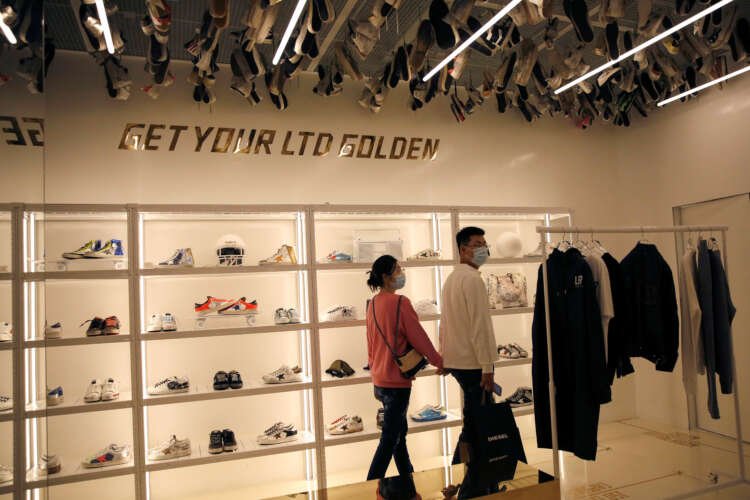
    Customers donning luxury sneakers at Golden Goose in Beijing highlight the rising trend of high-end fashion. This image reflects concerns over Gen Z's purchasing power in the luxury market, as economic factors like youth unemployment and inflation impact spending habits.
    Customers at Golden Goose in Beijing wearing luxury sneakers amid COVID-19 - Global Banking & Finance Review
    Why waste money on news and opinion when you can access them for free?

    Take advantage of our newsletter subscription and stay informed on the go!

    Subscribe

    Tags:retail tradeconsumer perceptionunemployment rates

    By Casey Hall and Mimosa Spencer

    SHANGHAI/PARIS (Reuters) – From $300 bucket hats to $900 sneakers and $700 t-shirts, the high-flying luxury sector is fretting over the appetite among financially stretched Gen Z consumers for such “aspirational” purchases.

    Executives are troubled in particular by a hit to young Chinese shoppers, not only because mainland China has been a major driver of the industry’s growth in recent years, but also because high end consumers in the world’s second-largest economy are a decade younger than the global average of 38.

    Young adults around the world have been “a very strong factor of luxury growth over the past decade,” said Gregory Boutte, chief client and digital officer at Gucci-owner Kering.

    Data this week showed China’s economy slowed unexpectedly, prompting a central bank rate cut, while macroeconomic trends are disproportionately impacting the extra funds that those born between 1996 and 2012 might use to enter the world of luxury.

    Whereas in North America and Europe, inflation and a rising cost-of-living are hitting discretionary incomes of young consumers especially hard, China’s problem is different.

    “In the U.S., inflation is a huge issue, the major focus of a lot of luxury companies … In China, it’s the youth unemployment rate that’s alarming right now,” Kenneth Chow, principal at consultancy Oliver Wyman said.

    Government data for July registers the unemployment rate of China’s urban population aged 16 to 24 at a record 19.9%, exacerbated by the impact of COVID-19 lockdowns and a crackdown on big tech firms that traditionally hired droves of graduates.

    “This might be the first time that a lot of young adults (in China) are facing (such an) economic impact, so it will be a testing ground on how these consumers are going to spend on luxury items going forward,” Chow said.

    “If a recession happens, then I will 100% buy less or maybe even stop buying altogether,” said U.S.-based luxury lifestyle and travel TikToker Jeffrey Huang, 28, who shares his Louis Vuitton shopping trips and hauls with his 150,000 followers.

    A recent Oliver Wyman study showed that some luxury brands are significantly lowering their sales expectations for the Chinese market in response to current conditions, with 80% of executives questioned not expecting a “v-shaped” recovery this year. Oliver Wyman declined to name the brands it surveyed.

    Nevertheless, earnings last month from firms including LVMH and Kering painted a picture of resilience in the face of economic headwinds, with luxury players riding a wave of post-COVID spending by their wealthiest clients.

    And big brands have signaled their intention to grow top end sales of $10,000 handbags and $5,000 coats rather than focus on attracting new entrants onto the bottom rung of the ladder.

    Chanel, Louis Vuitton and Dior have raised prices on high-margin leather goods several times over the past year, with Chanel planning stores dedicated to VIP consumers. nL5N2XG3VO

    “As the prices are rising, I’m becoming more and more cautious because I feel like I did do a good amount of spending in the last year,” said Sara Yogi, a 26-year-old San Francisco, California resident, adding that she may hold off buying a $2,900 Prada bag and one costing $3,200 from Bottega Veneta which are both on her wish list.

    This shift to focus on core luxury consumers also encompasses a cohort of wealthy Gen Z consumers less likely to be impacted by inflation or unemployment.

    But the concern is over would-be buyers who were meant to help Gen Z account for a fifth of all spending in the luxury goods sector globally by 2025.

    And brands such as Burberry have already noted weakness in sales of sneakers and slides, products Gen Z and millennial consumers have traditionally used as their entrée into the world of luxury brands.

    PLAN B FOR GEN Z?

    One way for luxury players to continue to attract Gen Z consumers may be to offer aspirational options at entry-level price points that can be worn often, said Yi Kejie, a 26-year-old marketing content manager.

    Luxury branded mobile phone cases, earrings, hair clips and perfumes are all popular among her Gen Z peers in China, Yi said, adding: “These are items with the lowest threshold for (them) to have that logo, that icon”.

    Some luxury labels, including Balenciaga and Dior, are embracing the metaverse to seed interest with teens and young adults, offering affordable ways for them to kit out their virtual identities on gaming platforms such as Roblox.

    Virtual sneakers from brands like Gucci have already proved wildly popular, with a price point of $17.99.

    Whether in the real or virtual world, entry-level products call for high levels of creative investment.

    “There is this young crowd of consumers that are entering into the market that requires a lot of creativity at more affordable price points,” said Bain partner Claudia D’Arpizio, adding that not all brands are equipped for this.

    There is good news for brands, however.

    If they do find the right offering of entry-level products, or if the economic situation of Gen Z consumers improves, the desire for luxury products remains undimmed.

    “Young people in China are enthusiastic about luxury products,” Yi said. “Lockdowns, or the temporary unemployment rate won’t change their long-term preferences.”

    (Reporting by Casey Hall, Doyinsola Oladipo and Mimosa Spencer; Editing by Alexander Smith)

    Frequently Asked Questions about Luxury sneakers may be a step too far for cash-strapped Gen Z

    1What is luxury spending?

    Luxury spending refers to expenditures on high-end goods and services that are not considered essential, often reflecting a consumer's status and lifestyle.

    2What are aspirational purchases?

    Aspirational purchases are items that consumers buy to reflect a desired lifestyle or status, often beyond their current financial means.

    3What is consumer perception?

    Consumer perception is how individuals view and interpret a brand or product based on their experiences, beliefs, and marketing influences.

    More from Top Stories

    Explore more articles in the Top Stories category

    Image for Lessons From the Ring and the Deal Table: How Boxing Shapes Steven Nigro’s Approach to Banking and Life
    Lessons From the Ring and the Deal Table: How Boxing Shapes Steven Nigro’s Approach to Banking and Life
    Image for Joe Kiani in 2025: Capital, Conviction, and a Focused Return to Innovation
    Joe Kiani in 2025: Capital, Conviction, and a Focused Return to Innovation
    Image for Marco Robinson – CLOSE THE DEAL AND SUDDENLY GROW RICH
    Marco Robinson – CLOSE THE DEAL AND SUDDENLY GROW RICH
    Image for Digital Tracing: Turning a regulatory obligation into a commercial advantage
    Digital Tracing: Turning a regulatory obligation into a commercial advantage
    Image for Exploring the Role of Blockchain and the Bitcoin Price Today in Education
    Exploring the Role of Blockchain and the Bitcoin Price Today in Education
    Image for Inside the World’s First Collection Industry Conglomerate: PCA Global’s Platform Strategy
    Inside the World’s First Collection Industry Conglomerate: PCA Global’s Platform Strategy
    Image for Chase Buchanan Private Wealth Management Highlights Key Autumn 2025 Budget Takeaways for Expats
    Chase Buchanan Private Wealth Management Highlights Key Autumn 2025 Budget Takeaways for Expats
    Image for PayLaju Strengthens Its Position as Malaysia’s Trusted Interest-Free Sharia-Compliant Loan Provider
    PayLaju Strengthens Its Position as Malaysia’s Trusted Interest-Free Sharia-Compliant Loan Provider
    Image for A Notable Update for Employee Health Benefits:
    A Notable Update for Employee Health Benefits:
    Image for Creating Equity Between Walls: How Mohak Chauhan is Using Engineering, Finance, and Community Vision to Reengineer Affordable Housing
    Creating Equity Between Walls: How Mohak Chauhan is Using Engineering, Finance, and Community Vision to Reengineer Affordable Housing
    Image for Upcoming Book on Real Estate Investing: Harvard Grace Capital Founder Stewart Heath’s Puts Lessons in Print
    Upcoming Book on Real Estate Investing: Harvard Grace Capital Founder Stewart Heath’s Puts Lessons in Print
    Image for ELECTIVA MARKS A LANDMARK FIRST YEAR WITH MAJOR SENIOR APPOINTMENTS AND EXPANSION MILESTONES
    ELECTIVA MARKS A LANDMARK FIRST YEAR WITH MAJOR SENIOR APPOINTMENTS AND EXPANSION MILESTONES
    View All Top Stories Posts
    Previous Top Stories PostAdverty and Yazle announce exclusive in-game ad partnership in MENA region
    Next Top Stories PostRising German solar supply weighs on spot prices