
Top Stories
Instant View- British Prime Minister Liz Truss Resigns After 44 Days
Published by Jessica Weisman-Pitts
Posted on October 20, 2022
8 min readLast updated: February 3, 2026
Add as preferred source on Google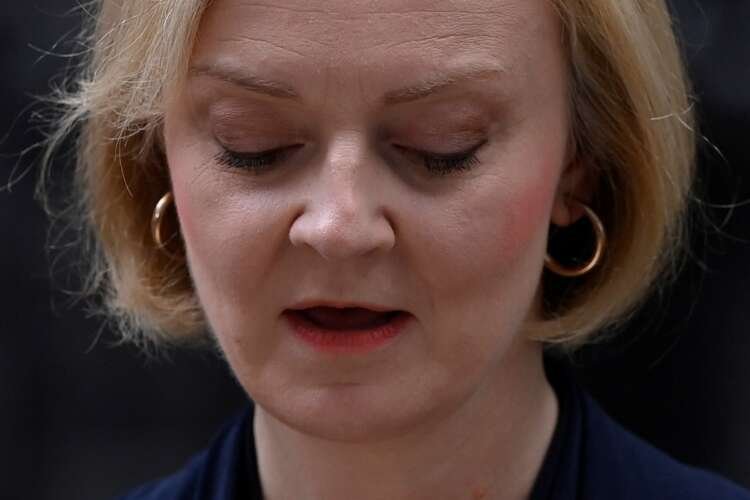
Published by Jessica Weisman-Pitts
Posted on October 20, 2022
8 min readLast updated: February 3, 2026
Add as preferred source on GoogleLiz Truss said on Thursday she would resign just six weeks after she was appointed, making her the shortest serving prime minister in British history.
Liz Truss said on Thursday she would resign just six weeks after she was appointed, making her the shortest serving prime minister in British history.
A leadership contest to choose her successor will be completed by Oct. 28. and follows weeks of turmoil sparked by Truss’ proposed economic programme.
Sterling, which had rallied ahead of Truss’ statement, was last up 0.33% at $1.126, with the pound also rising a little versus the euro.
Britain’s mid cap stocks index briefly jumped 1% as Truss said she would step down and last traded up 0.25%, while UK blue chips turned negative after the resignation.
Long dated gilts fell. Twenty- and 30-year gilt yields, which had fallen as much as 13 basis points (bps) earlier in the day, were down 3-5 bps.
Bond yields move inversely to prices.
Investor bets on the Bank of England hiking interest rates by 100 basis points next month receded to 8% vs 25% earlier in the day.
COMMENTS:
ULRICH LEUCHTMANN, HEAD OF FX RESEARCH, COMMERZBANK, FRANKFURT:
“Of course, Liz Truss resigning is positive news for sterling. However, the problem is that the currency has sustained lasting damage as it has become clear just how ready the Bank of England is to support the country’s finance minister and put its fight against inflation on the back burner.
“Pessimists always suspected as much, and they always think this of any central bank – and we have seen this with the European Central Bank for some time.”
“But now, it has become very visible and very clear that this is the case for the Bank of England, this will inflict permanent damage on the pound and we won’t see a return to levels we have seen at the start of the year.”
JOHN WOOLFITT, DIRECTOR OF TRADING AT ATLANTIC CAPITAL MARKETS, UK:
“What we did see in the market was a big initial and very positive response from the UK economy facing stocks and the likes of house-building stocks, they all had a bit of a jump.”
“But it doesn’t change the farcical behaviour of our politics at the moment. We are going to be up to the third prime minister in two months. Regardless as to what people thought about Truss, having three prime ministers go through the doors in a couple of months is not a good sign.”
ROBERT ALSTER, CHIEF INVESTMENT OFFICER, CLOSE BROTHERS ASSET MANAGEMENT, LONDON:
“The impact on markets of Liz Truss’ resignation over the short term will all depend on the fiscal stance of her successor, who they appoint as Chancellor, and how both these events play out in the mini-budget at the end of the month.
“Markets are looking for a more balanced budget and more political stability for the UK, and sterling is rising in the hope that the new Prime Minister will provide both.”
CHRIS BEAUCHAMP, CHIEF MARKET ANALYST, IG, LONDON:
“An initial bounce in the pound has begun to fade, as the implications of yet another period of uncertainty sink in. But given how quick the change is expected, and with the chancellor likely to stay in place, we should expect market tensions to calm.
“In all likelihood Rishi (Sunak) is ready to step in, and with Hunt in alignment with him we can expect a very different approach, but one more likely to please markets.”
PAUL DALES, CHIEF UK ECONOMIST, CAPITAL ECONOMICS, LONDON:
“Overall, the resignation of Truss is a step that needed to happen for the UK government to move further along the path towards restoring credibility in the eyes of the financial markets.”
“But more needs to be done and the new Prime Minister and their Chancellor have a big task to navigate the economy through the cost of living crisis, cost of borrowing crisis and the cost of credibility crisis. The situation is clearly going to evolve very quickly.”
JEREMY STRETCH, HEAD OF G10 FX STRATEGY, CIBC, LONDON:
“I think the question now is all about the parameters of the leadership campaign and trying to understand the profile of the process.”
“What is going to be the threshold to enter the race, for example, how many supporters they’re going to need and who is prepared to throw their hat into the ring – are going to be the next obvious set of questions the market will be asking.
“That might just be the one factor which will preclude cable rallying substantively above the $1.13-$1.1350 area until there’s a bit of clarity in that regard.”
VIRAJ PATEL, GLOBAL MACRO STRATEGIST, VANDA RESEARCH, LONDON:
“Initially, this is likely to take an uncertainty premium out of the market but it depends who takes over, you need a steady hand at the top.”
“My view hasn’t really changed in that the damage we saw from the mini-budget is already done.”
“I still struggle to see a good play for sterling and there’s probably other ways markets will react. Equities should be bouncing here, rates should be moving a bit lower but sterling will likely trade sideways with no strong conviction because the damage has largely been done.”
GILES COGHLAN, CHIEF MARKET ANALYST, HYCM, LONDON:
“After just 44 days in office, it appears that the markets and a party in open revolt have sealed Liz Truss’s fate.”
“Although Truss was brought into usher in an era of growth and ‘trickle-down economics’, her strong pro-growth policy was poorly timed, sending the UK bond markets into a sharp sell off as her policies fanned the flames of surging inflation.”
“To fend off instability, the Bank of England has even intervened in gilt markets, and it remains to be seen whether the central bank will now hike interest rates more quickly.”
KIT JUCKES, MACRO STRATEGIST, SOCIETE GENERALE, LONDON:
“If you told me you were going to get (Rishi) Sunak, (Penny) Mordaunt and (Jeremy) Hunt as the top three running the country, and one of them as prime minister, then I think the markets might turn around and say: ‘Good, we’ve got a credible team and here we go.’ On the other hand you could go in the other direction.”
“If you’ve got someone who looked like they were going to create stability, and in effect deliver the Hunt fiscal plan, I think this means the peak in (interest) rates will be lower than we’ve got priced in. I still think sterling will go down, not up, because rates won’t go as high as traders expect, but I think you’ve probably already seen the low in cable (sterling/dollar).
KENNETH BROUX, CURRENCY STRATEGIST, SOCIETE GENERALE, LONDON:
“The short timescale of the leadership contest is designed to minimize impact for the pound, but you would not want to be long (sterling) until we know who takes over.
“Then on 31 October, the OBR publishes its forecasts. Ideally a fiscal conservative steadies the ship and the credit outlook.
“But the prospects are not great and with the economy on the cusp of recession, it is going to be difficult still for the pound to rally on its own accord.”
STUART COLE, HEAD MACRO ECONOMIST, EQUITI CAPITAL, LONDON:
“I think it was not unexpected, but the fact they would not even keep her in power until the 31 October fiscal statement shows how desperate they were to get rid of her.
“But who would want the job now? The markets have largely dictated the direction economic policy has to take and will leave a new PM with little room for manoeuvre in that area.”
LEE HARDMAN, CURRENCY ANALYST, MUFG BANK, LONDON:
“The market reaction is just short-term volatility – it was seen as inevitable given the situation she was in. We will be watching closely who the successor will be but we already have a strong policy in place for tightening fiscal policy, so to some extent it doesn’t matter quite so much who would be coming in next.”
“Whoever comes in will probably be seen as a more credible prime minister than Liz Truss – on the margins, markets would probably like to see someone like Rishi Sunak.”
ANTOINE BOUVET, SENIOR RATES STRATEGIST, ING, LONDON:
“I think there is an underlying assumption that this is going to deliver more political stability and hopefully some political support behind the budget measures that have been announced last week.”
“One week is a relatively short period of time, so in that sense it’s positive, shorter period of uncertainty.”
“In terms of valuation gilts have closed a lot of the gap they opened with Bunds and Treasuries, so as much as there is room for further gains, I think we’ve clearly done most of the tightening.”
(Reporting by UK and U.S. markets teams, editing by Sinead Cruise)
A currency is a system of money in general use in a particular country or economic context, serving as a medium of exchange for goods and services.
Interest rates are the amount charged by lenders to borrowers for the use of money, expressed as a percentage of the principal.
Economic growth refers to the increase in the production of goods and services in an economy over a period, typically measured by GDP.
Currency hedging is a financial strategy used to reduce the risk of adverse price movements in an asset, particularly in foreign exchange markets.
Financial markets are marketplaces where trading of securities, commodities, and other financial instruments occurs, facilitating the exchange of capital.
Explore more articles in the Top Stories category











