
Top Stories
Inflation Expectations Still Anchored Even Though Price Hike Longer: Centeno
Published by Jessica Weisman-Pitts
Posted on September 27, 2022
2 min readLast updated: February 4, 2026
Add as preferred source on Google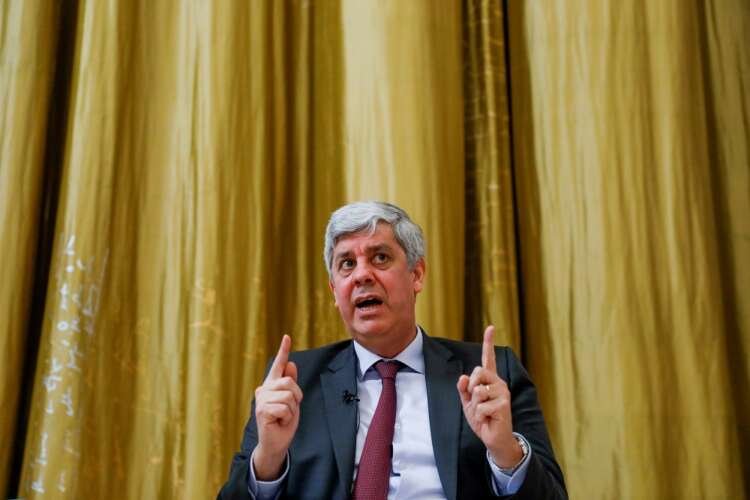
Published by Jessica Weisman-Pitts
Posted on September 27, 2022
2 min readLast updated: February 4, 2026
Add as preferred source on GoogleBy Sergio Goncalves
LISBON (Reuters) -Inflation expectations are anchored to the European Central Bank’s medium-term target even though consumer price rises will be steeper and longer than originally thought, European Central Bank governing council member Mario Centeno said on Tuesday.
“In Europe there is no de-anchored inflation expectations,” Centeno said, adding that “five-year inflation swaps in the euro area are very close to 2%” – the medium term objective for inflation.
He blamed sharp and drawn-out inflation on a “succession of overlapping shocks that have changed the economic context significantly”, impossible to predict one year ago, including Russia’s invasion of Ukraine, which pressured energy and food prices, and supply chain disruptions as a result of China’s zero-COVID policy.
With the bloc’s annual inflation rate running at close to 10%, the ECB has lifted interest rates by a combined 125 basis points over its last two meetings. It is likely to keep on raising rates in the coming months, said Centeno, who is also Portugal’s central bank governor.
Markets have priced in further increases at each of the ECB’s meetings through next spring.
As long as inflation peaks persist, it “won’t be possible to have the desired predictability of monetary policy,” he said. “Therefore, our collective effort, at European level, must be directed to reach the peak of inflation as soon as possible.”
He warned governments against enforcing “pro-cyclical fiscal policies” such as packages to help families and companies to deal with inflation so that the ECB’s monetary and government’s fiscal policies “do not cancel each other out.”
(Reporting by Sergio Goncalvez, writing by Aislinn Laing, editing by Inti Landauro and Frank Jack Daniel)
Inflation is the rate at which the general level of prices for goods and services rises, eroding purchasing power. It is often measured by the Consumer Price Index (CPI) or Producer Price Index (PPI).
Monetary policy is the process by which a central bank manages the supply of money, often targeting interest rates to achieve macroeconomic objectives such as controlling inflation, consumption, growth, and liquidity.
Interest rates are the cost of borrowing money or the return for investing money, expressed as a percentage of the principal. They are influenced by central bank policies and economic conditions.
The European Central Bank (ECB) is the central bank for the eurozone, responsible for monetary policy, maintaining price stability, and overseeing the banking system within the European Union.
Inflation expectations refer to the rate at which people expect prices to rise in the future. These expectations can influence economic behavior, such as spending and saving decisions.
Explore more articles in the Top Stories category











