Search
00
GBAF Logo
trophy
Top StoriesInterviewsBusinessFinanceBankingTechnologyInvestingTradingVideosAwardsMagazinesHeadlinesTrends

Subscribe to our newsletter

Get the latest news and updates from our team.

Global Banking & Finance Review®

Global Banking & Finance Review® - Subscribe to our newsletter

Company

    GBAF Logo
    • About Us
    • Profile
    • Privacy & Cookie Policy
    • Terms of Use
    • Contact Us
    • Advertising
    • Submit Post
    • Latest News
    • Research Reports
    • Press Release
    • Awards▾
      • About the Awards
      • Awards TimeTable
      • Submit Nominations
      • Testimonials
      • Media Room
      • Award Winners
      • FAQ
    • Magazines▾
      • Global Banking & Finance Review Magazine Issue 79
      • Global Banking & Finance Review Magazine Issue 78
      • Global Banking & Finance Review Magazine Issue 77
      • Global Banking & Finance Review Magazine Issue 76
      • Global Banking & Finance Review Magazine Issue 75
      • Global Banking & Finance Review Magazine Issue 73
      • Global Banking & Finance Review Magazine Issue 71
      • Global Banking & Finance Review Magazine Issue 70
      • Global Banking & Finance Review Magazine Issue 69
      • Global Banking & Finance Review Magazine Issue 66
    Top StoriesInterviewsBusinessFinanceBankingTechnologyInvestingTradingVideosAwardsMagazinesHeadlinesTrends

    Global Banking & Finance Review® is a leading financial portal and online magazine offering News, Analysis, Opinion, Reviews, Interviews & Videos from the world of Banking, Finance, Business, Trading, Technology, Investing, Brokerage, Foreign Exchange, Tax & Legal, Islamic Finance, Asset & Wealth Management.
    Copyright © 2010-2026 GBAF Publications Ltd - All Rights Reserved. | Sitemap | Tags | Developed By eCorpIT

    Editorial & Advertiser disclosure

    Global Banking & Finance Review® is an online platform offering news, analysis, and opinion on the latest trends, developments, and innovations in the banking and finance industry worldwide. The platform covers a diverse range of topics, including banking, insurance, investment, wealth management, fintech, and regulatory issues. The website publishes news, press releases, opinion and advertorials on various financial organizations, products and services which are commissioned from various Companies, Organizations, PR agencies, Bloggers etc. These commissioned articles are commercial in nature. This is not to be considered as financial advice and should be considered only for information purposes. It does not reflect the views or opinion of our website and is not to be considered an endorsement or a recommendation. We cannot guarantee the accuracy or applicability of any information provided with respect to your individual or personal circumstances. Please seek Professional advice from a qualified professional before making any financial decisions. We link to various third-party websites, affiliate sales networks, and to our advertising partners websites. When you view or click on certain links available on our articles, our partners may compensate us for displaying the content to you or make a purchase or fill a form. This will not incur any additional charges to you. To make things simpler for you to identity or distinguish advertised or sponsored articles or links, you may consider all articles or links hosted on our site as a commercial article placement. We will not be responsible for any loss you may suffer as a result of any omission or inaccuracy on the website.

    Home > Top Stories > In the ‘Garden of England’, loss-making orchards are cut down
    Top Stories

    In the ‘Garden of England’, loss-making orchards are cut down

    Published by Wanda Rich

    Posted on April 5, 2023

    4 min read

    Last updated: February 1, 2026

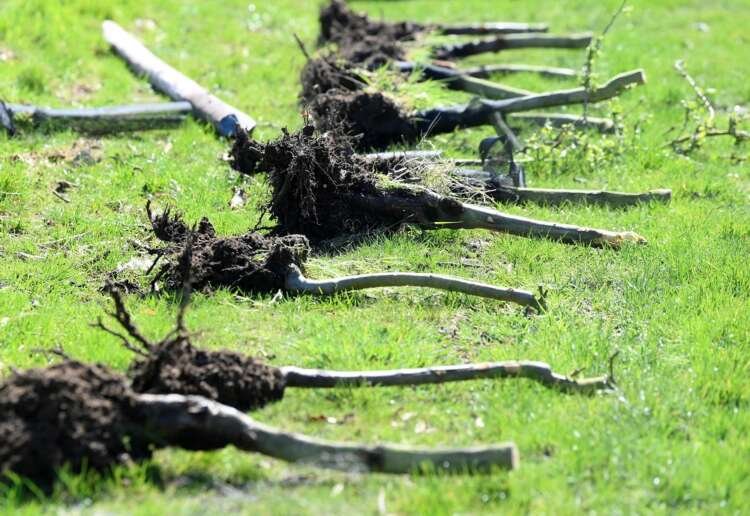
    A field in Kent shows discarded apple tree stumps, highlighting the struggles faced by British fruit farmers like James Smith. This image reflects the challenges of profitability in apple production amid rising costs and labor shortages.
    Discarded apple tree stumps in Kent illustrate the decline of British orchards - Global Banking & Finance Review
    Why waste money on news and opinion when you can access them for free?

    Take advantage of our newsletter subscription and stay informed on the go!

    Subscribe

    Tags:sustainabilityretail tradeBrexitagricultural sectorsUK economy

    By Sarah Young

    LINTON, England (Reuters) – The stumps of dozens of apple trees lie discarded along the side of a field. The fruit that helped give the “Garden of England” its name hundreds of years ago no longer makes money so farmer James Smith is tearing down his orchards.

    Shortages of tomatoes and cucumbers on Britain’s supermarket shelves earlier this year turned the spotlight onto the country’s food producers. For some of them, the ultra-competitive grocery market has gone too far.

    “I don’t really want to get rid of all of my fruit but I simply cannot see a way of overcoming all of the challenges,” Smith said at his farm amid the rolling hills of Kent, southeast England, where his family have grown apples since 1882.

    Turning a profit from selling red apples to supermarkets has been a struggle for years, he said. A more unpredictable climate has been compounded by the lack of labour to pick fruit in the years after Britain left the European Union. The surge in inflation over the last year brought the situation to a head.

    For 2022’s crop to break even, he said he needed supermarkets to pay him 20% more than the previous year for each giant wooden crate of apples. Supermarkets offered 0.8% more.

    It was the final straw after years of losses.

    “If I stop growing fruit I can make money,” he said, explaining his plans to diversify away from apples by turning to livestock, a vineyard and shop.

    Britain’s fruit production has been in decline since 2015, according to government figures, and was down 12% in 2021 from the previous year. The United Kingdom imports about 85% of its fruit needs annually.

    Supermarkets say they need to hold prices down for consumers, who are grappling with a cost of living crisis. Grocery price inflation stood at a record level of 17.5% according to the most recent industry data for March.

    The British Retail Consortium, which represents supermarkets, said they source the majority of their food from the United Kingdom and know they need to pay farmers a sustainable price.

    PROBLEMS FOR THE FUTURE

    “Given the pressure on British farmers at the moment, retailers are paying more for their produce,” BRC’s Director of Food & Sustainability Andrew Opie said.

    But Smith, who over the last decade said he has supplied all the big supermarkets, including most recently Tesco and Aldi, via a partner group, said supermarkets do not pay enough.

    “Retailers are completely committed to making sure we can’t make any sensible profit, not even in the good years,” said Smith, whose title is managing director of Loddington Farm.

    By squeezing domestic producers so hard, he believes retailers are storing up problems for the future.

    If other farmers like him stop producing at scale, Britain will be more reliant on imports and vulnerable to supply shocks.

    For the farmers that stick it out, it will be a battle.

    “Clearly a grower with no margins hasn’t got the profits to invest back in the business,” said Richard Napier, professor in plant and agricultural biosciences at the University of Warwick.

    In Kent, Smith is removing 80% of his orchards. Last year growing apples lost him 150,000 pounds ($186,000), a loss which would have been higher had it not been cushioned by other income streams from his land.

    Last harvest’s Braeburn apples have not been sold. Wooden crates stacked eight high are loaded in a warehouse where they are kept at between 0.5 and 1 degree Celsius to keep them fresh and provide supply whatever the season.

    That means big energy costs. Last October, Smith’s monthly energy cost per kilowatt hour was 450% higher than the previous year. Labour costs were up 15%, while the price he paid for the wires and posts used to structure the orchards rose 15%.

    Watching tree after tree being ripped out of the soil as most of his orchards are cleared, Smith said he had no time to be nostalgic as turning his back on commercial apple production was the best way to ensure his family’s farm survives.

    He’s bought a juicing business for which he will continue to grow a small amount of apples. Pigs and chickens will be brought in to graze on the former orchards and there’s a farm shop selling juice and other produce.

    He’s also planting a vineyard and is growing small amounts of cherries, the fruit which legend has it prompted King Henry VIII to first call Kent the “Garden of England”.

    Under Smith’s plans, the garden lives on, but is producing less food than it once did.

    (Reporting by Sarah Young and Gerhard Mey; Writing by Sarah Young; Editing by Janet Lawrence)

    Frequently Asked Questions about In the ‘Garden of England’, loss-making orchards are cut down

    1What is inflation?

    Inflation is the rate at which the general level of prices for goods and services rises, eroding purchasing power. It is typically measured annually.

    2What is Brexit?

    Brexit refers to the United Kingdom's decision to leave the European Union, which has significant implications for trade, immigration, and economic policies.

    More from Top Stories

    Explore more articles in the Top Stories category

    Image for Lessons From the Ring and the Deal Table: How Boxing Shapes Steven Nigro’s Approach to Banking and Life
    Lessons From the Ring and the Deal Table: How Boxing Shapes Steven Nigro’s Approach to Banking and Life
    Image for Joe Kiani in 2025: Capital, Conviction, and a Focused Return to Innovation
    Joe Kiani in 2025: Capital, Conviction, and a Focused Return to Innovation
    Image for Marco Robinson – CLOSE THE DEAL AND SUDDENLY GROW RICH
    Marco Robinson – CLOSE THE DEAL AND SUDDENLY GROW RICH
    Image for Digital Tracing: Turning a regulatory obligation into a commercial advantage
    Digital Tracing: Turning a regulatory obligation into a commercial advantage
    Image for Exploring the Role of Blockchain and the Bitcoin Price Today in Education
    Exploring the Role of Blockchain and the Bitcoin Price Today in Education
    Image for Inside the World’s First Collection Industry Conglomerate: PCA Global’s Platform Strategy
    Inside the World’s First Collection Industry Conglomerate: PCA Global’s Platform Strategy
    Image for Chase Buchanan Private Wealth Management Highlights Key Autumn 2025 Budget Takeaways for Expats
    Chase Buchanan Private Wealth Management Highlights Key Autumn 2025 Budget Takeaways for Expats
    Image for PayLaju Strengthens Its Position as Malaysia’s Trusted Interest-Free Sharia-Compliant Loan Provider
    PayLaju Strengthens Its Position as Malaysia’s Trusted Interest-Free Sharia-Compliant Loan Provider
    Image for A Notable Update for Employee Health Benefits:
    A Notable Update for Employee Health Benefits:
    Image for Creating Equity Between Walls: How Mohak Chauhan is Using Engineering, Finance, and Community Vision to Reengineer Affordable Housing
    Creating Equity Between Walls: How Mohak Chauhan is Using Engineering, Finance, and Community Vision to Reengineer Affordable Housing
    Image for Upcoming Book on Real Estate Investing: Harvard Grace Capital Founder Stewart Heath’s Puts Lessons in Print
    Upcoming Book on Real Estate Investing: Harvard Grace Capital Founder Stewart Heath’s Puts Lessons in Print
    Image for ELECTIVA MARKS A LANDMARK FIRST YEAR WITH MAJOR SENIOR APPOINTMENTS AND EXPANSION MILESTONES
    ELECTIVA MARKS A LANDMARK FIRST YEAR WITH MAJOR SENIOR APPOINTMENTS AND EXPANSION MILESTONES
    View All Top Stories Posts
    Previous Top Stories PostWTO sees “subpar” 2023 trade growth with multiple risks
    Next Top Stories PostDeutsche Telekom reaches majority stake in T-Mobile U.S. – CEO