Search
00
GBAF Logo
trophy
Top StoriesInterviewsBusinessFinanceBankingTechnologyInvestingTradingVideosAwardsMagazinesHeadlinesTrends

Subscribe to our newsletter

Get the latest news and updates from our team.

Global Banking & Finance Review®

Global Banking & Finance Review® - Subscribe to our newsletter

Company

    GBAF Logo
    • About Us
    • Profile
    • Privacy & Cookie Policy
    • Terms of Use
    • Contact Us
    • Advertising
    • Submit Post
    • Latest News
    • Research Reports
    • Press Release
    • Awards▾
      • About the Awards
      • Awards TimeTable
      • Submit Nominations
      • Testimonials
      • Media Room
      • Award Winners
      • FAQ
    • Magazines▾
      • Global Banking & Finance Review Magazine Issue 79
      • Global Banking & Finance Review Magazine Issue 78
      • Global Banking & Finance Review Magazine Issue 77
      • Global Banking & Finance Review Magazine Issue 76
      • Global Banking & Finance Review Magazine Issue 75
      • Global Banking & Finance Review Magazine Issue 73
      • Global Banking & Finance Review Magazine Issue 71
      • Global Banking & Finance Review Magazine Issue 70
      • Global Banking & Finance Review Magazine Issue 69
      • Global Banking & Finance Review Magazine Issue 66
    Top StoriesInterviewsBusinessFinanceBankingTechnologyInvestingTradingVideosAwardsMagazinesHeadlinesTrends

    Global Banking & Finance Review® is a leading financial portal and online magazine offering News, Analysis, Opinion, Reviews, Interviews & Videos from the world of Banking, Finance, Business, Trading, Technology, Investing, Brokerage, Foreign Exchange, Tax & Legal, Islamic Finance, Asset & Wealth Management.
    Copyright © 2010-2026 GBAF Publications Ltd - All Rights Reserved. | Sitemap | Tags | Developed By eCorpIT

    Editorial & Advertiser disclosure

    Global Banking & Finance Review® is an online platform offering news, analysis, and opinion on the latest trends, developments, and innovations in the banking and finance industry worldwide. The platform covers a diverse range of topics, including banking, insurance, investment, wealth management, fintech, and regulatory issues. The website publishes news, press releases, opinion and advertorials on various financial organizations, products and services which are commissioned from various Companies, Organizations, PR agencies, Bloggers etc. These commissioned articles are commercial in nature. This is not to be considered as financial advice and should be considered only for information purposes. It does not reflect the views or opinion of our website and is not to be considered an endorsement or a recommendation. We cannot guarantee the accuracy or applicability of any information provided with respect to your individual or personal circumstances. Please seek Professional advice from a qualified professional before making any financial decisions. We link to various third-party websites, affiliate sales networks, and to our advertising partners websites. When you view or click on certain links available on our articles, our partners may compensate us for displaying the content to you or make a purchase or fill a form. This will not incur any additional charges to you. To make things simpler for you to identity or distinguish advertised or sponsored articles or links, you may consider all articles or links hosted on our site as a commercial article placement. We will not be responsible for any loss you may suffer as a result of any omission or inaccuracy on the website.

    Home > Top Stories > Hungary price caps could stay in place if war is entrenched, Orban says
    Top Stories

    Hungary price caps could stay in place if war is entrenched, Orban says

    Published by Wanda Rich

    Posted on June 10, 2022

    3 min read

    Last updated: February 6, 2026

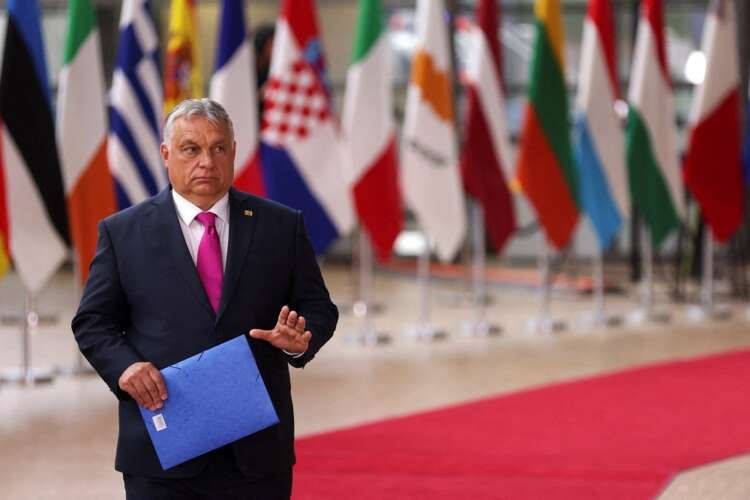
    Hungarian Prime Minister Viktor Orban speaks about the potential extension of fuel price caps in Hungary due to the ongoing Ukraine war, emphasizing the economic impact of the conflict on inflation. This image is relevant to the discussion of price controls and inflationary pressures in Central Europe.
    Hungarian Prime Minister Orban discussing fuel price caps amid Ukraine war - Global Banking & Finance Review
    Why waste money on news and opinion when you can access them for free?

    Take advantage of our newsletter subscription and stay informed on the go!

    Subscribe

    Tags:financial marketsinterest rateseconomic growth

    By Gergely Szakacs

    BUDAPEST (Reuters) – Hungary’s price caps on fuel, some basic foods and energy could stay in place for a longer period if the war in Ukraine is entrenched, sustaining high inflationary pressures, Prime Minister Viktor Orban said on Friday.

    Inflation has been rising sharply across Central Europe since Russia’s invasion of Ukraine amplified already strong price pressures following the coronavirus pandemic, prompting central banks to raise interest rates sharply.

    Orban’s government set a limit on fuel prices in mid-November and followed up with caps on some food staples in February. The measures, which have lopped 5 to 6 percentage points off headline inflation, are due to expire next month.

    “There is a high likelihood that the war becomes protracted and the year 2023 will also be full of uncertainty and sorrow,” Orban told public radio. “The world will be suffering from the war and its economic consequences.”

    Orban said without the measure capping retail fuel prices at 480 forints ($1.29) per litre, market prices for fuel would be around 700 to 900 forints.

    The scope of the fuel price cap was recently narrowed to cars with a Hungarian licence plate, triggering conflict with the European Union, while Hungarian energy group MOL on Thursday called for the gradual phasing out of the measure.

    MOL Chairman and Chief Executive Zsolt Hernadi told local media that phasing out the fuel price cap gradually would be necessary to ensure the long-term safety of supply.

    “It all depends on the war. If there is war, then there is war inflation,” Orban said. “If there is peace, then we can phase out these measures more quickly. If there is war, then we cannot, or can only do so very slowly.”

    Asked about the EU calling on Hungary to suspend discriminatory fuel pricing against vehicles with foreign licence plates or risk being taken to court, Orban said there was no one-size-fits-all solution to the problem.

    “This is an extraordinary situation and we need to do what such situations require,” Orban said. “In times like this it is mandatory to deviate from general regulations.”

    Orban said without the price caps, Hungarian inflation, which accelerated to 10.7% in May, would be running at 15% to 16%.

    He added that a European Union embargo on Russian gas imports would destroy the European economy, already grappling with surging inflation due to higher energy prices.

    ($1 = 371.84 forints)

    (Reporting by Gergely Szakacs; Editing by Toby Chopra)

    Frequently Asked Questions about Hungary price caps could stay in place if war is entrenched, Orban says

    1What is inflation?

    Inflation is the rate at which the general level of prices for goods and services rises, eroding purchasing power.

    2What is the role of the EU in economic policies?

    The EU plays a significant role in shaping economic policies among member states, including regulations on pricing and market competition.

    3What are interest rates?

    Interest rates are the cost of borrowing money, expressed as a percentage of the amount borrowed, typically set by central banks.

    More from Top Stories

    Explore more articles in the Top Stories category

    Image for Lessons From the Ring and the Deal Table: How Boxing Shapes Steven Nigro’s Approach to Banking and Life
    Lessons From the Ring and the Deal Table: How Boxing Shapes Steven Nigro’s Approach to Banking and Life
    Image for Joe Kiani in 2025: Capital, Conviction, and a Focused Return to Innovation
    Joe Kiani in 2025: Capital, Conviction, and a Focused Return to Innovation
    Image for Marco Robinson – CLOSE THE DEAL AND SUDDENLY GROW RICH
    Marco Robinson – CLOSE THE DEAL AND SUDDENLY GROW RICH
    Image for Digital Tracing: Turning a regulatory obligation into a commercial advantage
    Digital Tracing: Turning a regulatory obligation into a commercial advantage
    Image for Exploring the Role of Blockchain and the Bitcoin Price Today in Education
    Exploring the Role of Blockchain and the Bitcoin Price Today in Education
    Image for Inside the World’s First Collection Industry Conglomerate: PCA Global’s Platform Strategy
    Inside the World’s First Collection Industry Conglomerate: PCA Global’s Platform Strategy
    Image for Chase Buchanan Private Wealth Management Highlights Key Autumn 2025 Budget Takeaways for Expats
    Chase Buchanan Private Wealth Management Highlights Key Autumn 2025 Budget Takeaways for Expats
    Image for PayLaju Strengthens Its Position as Malaysia’s Trusted Interest-Free Sharia-Compliant Loan Provider
    PayLaju Strengthens Its Position as Malaysia’s Trusted Interest-Free Sharia-Compliant Loan Provider
    Image for A Notable Update for Employee Health Benefits:
    A Notable Update for Employee Health Benefits:
    Image for Creating Equity Between Walls: How Mohak Chauhan is Using Engineering, Finance, and Community Vision to Reengineer Affordable Housing
    Creating Equity Between Walls: How Mohak Chauhan is Using Engineering, Finance, and Community Vision to Reengineer Affordable Housing
    Image for Upcoming Book on Real Estate Investing: Harvard Grace Capital Founder Stewart Heath’s Puts Lessons in Print
    Upcoming Book on Real Estate Investing: Harvard Grace Capital Founder Stewart Heath’s Puts Lessons in Print
    Image for ELECTIVA MARKS A LANDMARK FIRST YEAR WITH MAJOR SENIOR APPOINTMENTS AND EXPANSION MILESTONES
    ELECTIVA MARKS A LANDMARK FIRST YEAR WITH MAJOR SENIOR APPOINTMENTS AND EXPANSION MILESTONES
    View All Top Stories Posts
    Previous Top Stories PostCzech inflation hits 16%, raising bets of big June rate hike
    Next Top Stories PostRates must rise but ECB will fight fragmentation: policymakers