Search
00
GBAF Logo
trophy
Top StoriesInterviewsBusinessFinanceBankingTechnologyInvestingTradingVideosAwardsMagazinesHeadlinesTrends

Subscribe to our newsletter

Get the latest news and updates from our team.

Global Banking & Finance Review®

Global Banking & Finance Review® - Subscribe to our newsletter

Company

    GBAF Logo
    • About Us
    • Profile
    • Privacy & Cookie Policy
    • Terms of Use
    • Contact Us
    • Advertising
    • Submit Post
    • Latest News
    • Research Reports
    • Press Release
    • Awards▾
      • About the Awards
      • Awards TimeTable
      • Submit Nominations
      • Testimonials
      • Media Room
      • Award Winners
      • FAQ
    • Magazines▾
      • Global Banking & Finance Review Magazine Issue 79
      • Global Banking & Finance Review Magazine Issue 78
      • Global Banking & Finance Review Magazine Issue 77
      • Global Banking & Finance Review Magazine Issue 76
      • Global Banking & Finance Review Magazine Issue 75
      • Global Banking & Finance Review Magazine Issue 73
      • Global Banking & Finance Review Magazine Issue 71
      • Global Banking & Finance Review Magazine Issue 70
      • Global Banking & Finance Review Magazine Issue 69
      • Global Banking & Finance Review Magazine Issue 66
    Top StoriesInterviewsBusinessFinanceBankingTechnologyInvestingTradingVideosAwardsMagazinesHeadlinesTrends

    Global Banking & Finance Review® is a leading financial portal and online magazine offering News, Analysis, Opinion, Reviews, Interviews & Videos from the world of Banking, Finance, Business, Trading, Technology, Investing, Brokerage, Foreign Exchange, Tax & Legal, Islamic Finance, Asset & Wealth Management.
    Copyright © 2010-2026 GBAF Publications Ltd - All Rights Reserved. | Sitemap | Tags | Developed By eCorpIT

    Editorial & Advertiser disclosure

    Global Banking & Finance Review® is an online platform offering news, analysis, and opinion on the latest trends, developments, and innovations in the banking and finance industry worldwide. The platform covers a diverse range of topics, including banking, insurance, investment, wealth management, fintech, and regulatory issues. The website publishes news, press releases, opinion and advertorials on various financial organizations, products and services which are commissioned from various Companies, Organizations, PR agencies, Bloggers etc. These commissioned articles are commercial in nature. This is not to be considered as financial advice and should be considered only for information purposes. It does not reflect the views or opinion of our website and is not to be considered an endorsement or a recommendation. We cannot guarantee the accuracy or applicability of any information provided with respect to your individual or personal circumstances. Please seek Professional advice from a qualified professional before making any financial decisions. We link to various third-party websites, affiliate sales networks, and to our advertising partners websites. When you view or click on certain links available on our articles, our partners may compensate us for displaying the content to you or make a purchase or fill a form. This will not incur any additional charges to you. To make things simpler for you to identity or distinguish advertised or sponsored articles or links, you may consider all articles or links hosted on our site as a commercial article placement. We will not be responsible for any loss you may suffer as a result of any omission or inaccuracy on the website.

    Home > Top Stories > Hungary ends massive rate hikes with one last 125 bps step
    Top Stories

    Hungary ends massive rate hikes with one last 125 bps step

    Published by Jessica Weisman-Pitts

    Posted on September 27, 2022

    3 min read

    Last updated: February 4, 2026

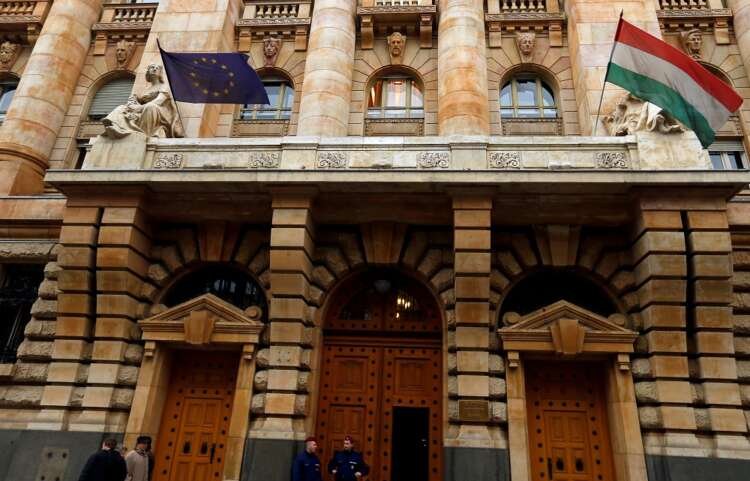
    The image captures the entrance of the National Bank of Hungary in Budapest, reflecting the central bank's decision to end rate hikes after a significant increase. This relates to the recent article on Hungary's monetary policy and inflation management.
    View of the National Bank of Hungary building, symbolizing recent interest rate changes - Global Banking & Finance Review
    Why waste money on news and opinion when you can access them for free?

    Take advantage of our newsletter subscription and stay informed on the go!

    Subscribe

    Tags:interest ratesmonetary policyemerging marketsfinancial stability

    By Gergely Szakacs and Krisztina Than

    BUDAPEST (Reuters) -The National Bank of Hungary raised its base rate by a larger-than-expected 125 basis points to 13% on Tuesday and ended its more than year-long rate hike cycle amid a slowing economy.

    Central European policymakers are seeking to end a strategy of interest rate rises running since last year even as inflationary pressures remain and the world’s major central banks keep pursuing higher rates.

    The NBH has raised its base rate by more than 1,200 bps since June 2021 to the highest level in Central Europe to curb double-digit inflation which is still on the rise.

    “… Interest rate conditions have become sufficiently strict, which ensures the achievement of the inflation target. The Monetary Council has decided to stop the cycle of base rate hikes,” the bank said in a statement.

    The bank said tight monetary conditions would be maintained “over a prolonged period” to ensure that inflation expectations are anchored. While ending its rate hikes, the bank raised its inflation forecasts for this year and next. Average inflation next year is projected at 11.5%-14.0%.

    “Looking ahead, tightening liquidity and further enhancing monetary transmission will be in the NBH’s focus, for which the central bank may decide on additional measures in the future,” the bank added.

    The NBH announced a set of measures in August which are expected to tighten forint liquidity from October. These include raising the required reserve ratio for banks.

    RISKY MOVE?

    The decision to call an end to rate hikes had been on the cards after deputy Governor Barnabas Virag said last week that the NBH could consider ending its rate rise cycle after Tuesday’s meeting.

    The central bank’s move is not without risks as markets are turning against riskier emerging market assets as the U.S. Federal Reserve aggressively hikes rates – boosting the dollar. Hungary’s widening current account deficit on its surging energy imports makes it vulnerable to shifts in global sentiment.

    By 1328 GMT, the forint, central Europe’s worst-performing unit with a 9% loss versus the euro this year alone, firmed to 404.50 per euro from 407.85 just before the rate increase.

    “The continued widening of the current account deficit in Q2 alongside growing concerns about the global economy mean the risks remain very much skewed to a weaker (forint) currency,” analysts at Capital Economics said in a note on Tuesday.

    Governor Gyorgy Matolcsy told a briefing that inflation would start decreasing slowly in the first half of 2023.

    Economists polled by Reuters last week still forecast the base rate rising to 14% by the end of this year.

    (Reporting by Gergely Szakacs and Krisztina Than;Editing by Alison Williams)

    Frequently Asked Questions about Hungary ends massive rate hikes with one last 125 bps step

    1What is a central bank?

    A central bank is a financial institution that manages a country's currency, money supply, and interest rates. It oversees the banking system and implements monetary policy.

    2What is inflation?

    Inflation is the rate at which the general level of prices for goods and services rises, eroding purchasing power. It is typically measured annually.

    3What are basis points?

    Basis points are a unit of measure used in finance to describe the percentage change in value or interest rates. One basis point is equal to 0.01%.

    4What is monetary policy?

    Monetary policy refers to the actions taken by a central bank to control the money supply and interest rates to achieve macroeconomic objectives such as controlling inflation and stabilizing currency.

    5What is a current account deficit?

    A current account deficit occurs when a country spends more on foreign trade than it earns, leading to an outflow of domestic currency to foreign markets.

    More from Top Stories

    Explore more articles in the Top Stories category

    Image for Lessons From the Ring and the Deal Table: How Boxing Shapes Steven Nigro’s Approach to Banking and Life
    Lessons From the Ring and the Deal Table: How Boxing Shapes Steven Nigro’s Approach to Banking and Life
    Image for Joe Kiani in 2025: Capital, Conviction, and a Focused Return to Innovation
    Joe Kiani in 2025: Capital, Conviction, and a Focused Return to Innovation
    Image for Marco Robinson – CLOSE THE DEAL AND SUDDENLY GROW RICH
    Marco Robinson – CLOSE THE DEAL AND SUDDENLY GROW RICH
    Image for Digital Tracing: Turning a regulatory obligation into a commercial advantage
    Digital Tracing: Turning a regulatory obligation into a commercial advantage
    Image for Exploring the Role of Blockchain and the Bitcoin Price Today in Education
    Exploring the Role of Blockchain and the Bitcoin Price Today in Education
    Image for Inside the World’s First Collection Industry Conglomerate: PCA Global’s Platform Strategy
    Inside the World’s First Collection Industry Conglomerate: PCA Global’s Platform Strategy
    Image for Chase Buchanan Private Wealth Management Highlights Key Autumn 2025 Budget Takeaways for Expats
    Chase Buchanan Private Wealth Management Highlights Key Autumn 2025 Budget Takeaways for Expats
    Image for PayLaju Strengthens Its Position as Malaysia’s Trusted Interest-Free Sharia-Compliant Loan Provider
    PayLaju Strengthens Its Position as Malaysia’s Trusted Interest-Free Sharia-Compliant Loan Provider
    Image for A Notable Update for Employee Health Benefits:
    A Notable Update for Employee Health Benefits:
    Image for Creating Equity Between Walls: How Mohak Chauhan is Using Engineering, Finance, and Community Vision to Reengineer Affordable Housing
    Creating Equity Between Walls: How Mohak Chauhan is Using Engineering, Finance, and Community Vision to Reengineer Affordable Housing
    Image for Upcoming Book on Real Estate Investing: Harvard Grace Capital Founder Stewart Heath’s Puts Lessons in Print
    Upcoming Book on Real Estate Investing: Harvard Grace Capital Founder Stewart Heath’s Puts Lessons in Print
    Image for ELECTIVA MARKS A LANDMARK FIRST YEAR WITH MAJOR SENIOR APPOINTMENTS AND EXPANSION MILESTONES
    ELECTIVA MARKS A LANDMARK FIRST YEAR WITH MAJOR SENIOR APPOINTMENTS AND EXPANSION MILESTONES
    View All Top Stories Posts
    Previous Top Stories PostWith flowers and a gun salute, Japan bids farewell to divisive Abe
    Next Top Stories PostJust Eat Takeaway shares leap 10% on forecast of underlying profit