
Top Stories
H&M-backed Project Pilots CO2-capturing Aprons at Stockholm Restaurant
Published by Wanda Rich
Posted on May 20, 2022
3 min readLast updated: February 7, 2026
Add as preferred source on Google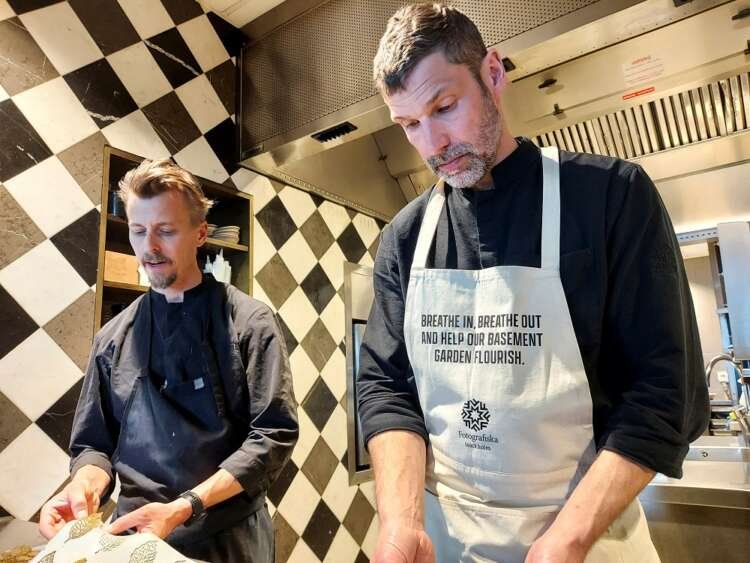
Published by Wanda Rich
Posted on May 20, 2022
3 min readLast updated: February 7, 2026
Add as preferred source on GoogleSTOCKHOLM (Reuters) – A Stockholm restaurant crew is wearing cotton aprons that capture greenhouse gas from the air, in a pilot of a technique developed by H&M-backed researchers as the fashion industry struggles to lower its climate impact.
STOCKHOLM (Reuters) – A Stockholm restaurant crew is wearing cotton aprons that capture greenhouse gas from the air, in a pilot of a technique developed by H&M-backed researchers as the fashion industry struggles to lower its climate impact.
The textile industry has a large carbon footprint, something fashion giants are under increasing pressure to address as shoppers become more aware of the environmental impact of clothes and as global temperatures rise.
The Hong Kong Research Institute of Textiles and Apparel (HKRITA) has developed an amine-containing solution with which to treat cotton – fibre, yarn or fabric – making the cotton pull carbon dioxide gas towards it and capture it, to thereafter stabilise and store it on the surface of the textile.
HKRITA CEO Edwin Keh said in an interview his team had been inspired by techniques used in chimneys of coal-fired power plants to limit emissions.
“Many power plants have to scrub as much carbon dioxide as they can out of the air before the exhaust is released,” Keh told Reuters. “We thought ‘why don’t we try to replicate that chemical process on a cotton fibre”.
A T-shirt is able to absorb about a third of what a tree absorbs per day, Keh said. “The (capturing) capacity isn’t super high but this is quite inexpensive to produce and quite easy, and we think there are a lot of potential applications.”
The aprons in the pilot were produced at a H&M supplier in Indonesia, using the factory’s existing equipment for the treatment, Keh said. “It is a fairly simple chemical process.”
In the pilot the aprons are after use heated to 30-40 degrees Celsius at which temperature they release the CO2 – into a greenhouse where the gas is taken up by plants.
H&M Foundation said the innovation could potentially be a game changer in the reduction of global CO2 emissions.
Projects to develop CO2 absorbing textiles are however at an early stage, and their potential contribution to lessening the environmental impact of the textile industry remains to seen.
Keh said the institute would now develop its technology further, and try to find other uses for it, as well as other ways to use or dispose of the captured CO2.
HKRITA, which is part-financed by the philanthropic arm of Swedish fashion retailer H&M, has developed a number of innovations aimed at making fashion more sustainable. One that has reached industrial scale use is a technique to separate cotton and polyester fibres in blend-textiles.
(Reporting by Anna Ringstrom, Philip O’Connor and David Gregorio)
Carbon capture is a technology that captures carbon dioxide emissions produced from the use of fossil fuels in electricity generation and industrial processes, preventing the gas from entering the atmosphere.
The textile industry involves the production and distribution of fabrics and garments, which includes processes like spinning, weaving, dyeing, and finishing textiles for clothing and other uses.
A pilot project is a small-scale study conducted to test the feasibility, time, cost, risk, and adverse events involved in a specific project or initiative before full-scale implementation.
Greenhouse gases are gases in the Earth's atmosphere that trap heat, such as carbon dioxide, methane, and nitrous oxide, contributing to the greenhouse effect and climate change.
Sustainable fashion refers to clothing that is designed, manufactured, distributed, and used in ways that are environmentally friendly and socially responsible, minimizing harm to the planet and its inhabitants.
Explore more articles in the Top Stories category











