Search
00
GBAF Logo
trophy
Top StoriesInterviewsBusinessFinanceBankingTechnologyInvestingTradingVideosAwardsMagazinesHeadlinesTrends

Subscribe to our newsletter

Get the latest news and updates from our team.

Global Banking & Finance Review®

Global Banking & Finance Review® - Subscribe to our newsletter

Company

    GBAF Logo
    • About Us
    • Profile
    • Privacy & Cookie Policy
    • Terms of Use
    • Contact Us
    • Advertising
    • Submit Post
    • Latest News
    • Research Reports
    • Press Release
    • Awards▾
      • About the Awards
      • Awards TimeTable
      • Submit Nominations
      • Testimonials
      • Media Room
      • Award Winners
      • FAQ
    • Magazines▾
      • Global Banking & Finance Review Magazine Issue 79
      • Global Banking & Finance Review Magazine Issue 78
      • Global Banking & Finance Review Magazine Issue 77
      • Global Banking & Finance Review Magazine Issue 76
      • Global Banking & Finance Review Magazine Issue 75
      • Global Banking & Finance Review Magazine Issue 73
      • Global Banking & Finance Review Magazine Issue 71
      • Global Banking & Finance Review Magazine Issue 70
      • Global Banking & Finance Review Magazine Issue 69
      • Global Banking & Finance Review Magazine Issue 66
    Top StoriesInterviewsBusinessFinanceBankingTechnologyInvestingTradingVideosAwardsMagazinesHeadlinesTrends

    Global Banking & Finance Review® is a leading financial portal and online magazine offering News, Analysis, Opinion, Reviews, Interviews & Videos from the world of Banking, Finance, Business, Trading, Technology, Investing, Brokerage, Foreign Exchange, Tax & Legal, Islamic Finance, Asset & Wealth Management.
    Copyright © 2010-2026 GBAF Publications Ltd - All Rights Reserved. | Sitemap | Tags | Developed By eCorpIT

    Editorial & Advertiser disclosure

    Global Banking & Finance Review® is an online platform offering news, analysis, and opinion on the latest trends, developments, and innovations in the banking and finance industry worldwide. The platform covers a diverse range of topics, including banking, insurance, investment, wealth management, fintech, and regulatory issues. The website publishes news, press releases, opinion and advertorials on various financial organizations, products and services which are commissioned from various Companies, Organizations, PR agencies, Bloggers etc. These commissioned articles are commercial in nature. This is not to be considered as financial advice and should be considered only for information purposes. It does not reflect the views or opinion of our website and is not to be considered an endorsement or a recommendation. We cannot guarantee the accuracy or applicability of any information provided with respect to your individual or personal circumstances. Please seek Professional advice from a qualified professional before making any financial decisions. We link to various third-party websites, affiliate sales networks, and to our advertising partners websites. When you view or click on certain links available on our articles, our partners may compensate us for displaying the content to you or make a purchase or fill a form. This will not incur any additional charges to you. To make things simpler for you to identity or distinguish advertised or sponsored articles or links, you may consider all articles or links hosted on our site as a commercial article placement. We will not be responsible for any loss you may suffer as a result of any omission or inaccuracy on the website.

    Home > Top Stories > German heat pump bonanza test industry’s resilience in Russian gas crunch
    Top Stories

    German heat pump bonanza test industry’s resilience in Russian gas crunch

    Published by Wanda Rich

    Posted on August 18, 2022

    5 min read

    Last updated: February 4, 2026

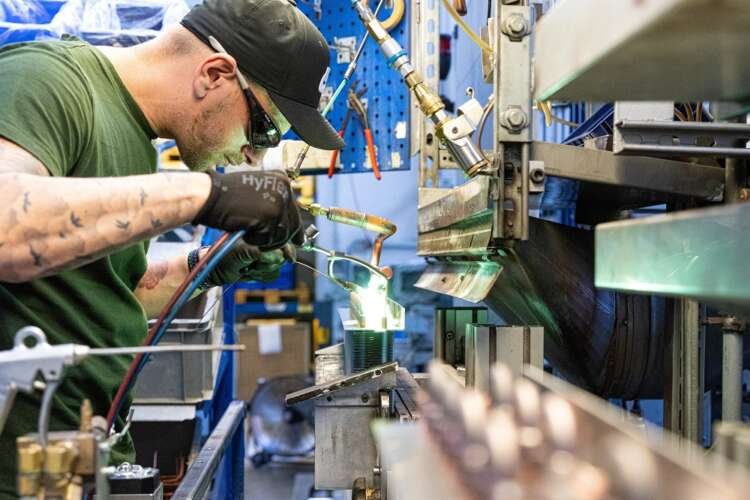
    The image depicts a busy production line at Stiebel Eltron, showcasing workers assembling heat pumps. This highlights Germany's shift to energy-efficient solutions amidst the Russian gas crisis, reflecting the resilience and challenges faced by the industry.
    Heat pump production line at Stiebel Eltron during Germany's energy crisis - Global Banking & Finance Review
    Why waste money on news and opinion when you can access them for free?

    Take advantage of our newsletter subscription and stay informed on the go!

    Subscribe

    Tags:sustainabilityinnovationemployment opportunitieseconomic growth

    By Thomas Escritt

    HOLZMINDEN, Germany (Reuters) – In a way, Stiebel Eltron has never had it so good. The heating manufacturer’s main factory has gone up to working 24 hours a day making the energy-efficient heat pumps that Germany needs to wean itself off Russian gas.

    But it also has never had it so tough, with supply bottlenecks, labour shortages, and surging energy costs making it all but impossible to meet nearly limitless demand.

    “I’ve worked here for 25 years and I’ve never experienced such wildly fluctuating and high material prices,” said Kai Schiefelbein, the company’s chief operating officer.

    Thousands of medium-sized, family-owned companies like Stiebel Eltron, with some 4,000 employees and less than a billion euros in turnover, are the engine room of Germany’s economy, accounting for half its output and some 40 million jobs. Their ability to adapt will be the key test of whether Germany’s prosperity, built on its manufacturing excellence and exports, can survive into the new era ushered in by Moscow’s invasion of Ukraine.

    “Germany built up a business model that relied on cheap Russian gas,” said Economy Minister Robert Habeck earlier this week. “This model has failed and it’s not coming back.”

    Heat pumps, reverse refrigerators that suck heat out of the environment to warm houses and water through the winter using just a quarter of the energy of a gas boiler, are in heavy demand as Germany prepares for a winter with less Russian gas.

    But Stiebel Eltron, like many other “Mittelstand” medium-sized family owned companies, has now found itself short of everything that made up Germany’s winning formula – smoothly functioning global supply chains, skilled labour and cheap energy.

    Supply chains, already stretched by the coronavirus pandemic, have been further frayed by the war in Ukraine, while the cost of raw materials has soared, including that of the copper from which coolant pipes are made, or the silver with which sections are welded together.

    “We’ve bought processors that normally cost 42 cents for 45 euros,” said Schiefelbein, pointing to a tiny component on a half-assembled unit at the company’s main factory in Holzminden, a picturesque town by the Weser river in central Germany.

    The surge in demand is a bonanza for the company, founded in 1924. It sold 50,000 heat pumps last year – a third of the 154,000 sold in Germany – and expects to sell 80,000 this year. Revenues are expected to hit a billion euros, up from 837 million euros last year. But it could have sold 50,000 more if it could keep up with the demand.

    ‘THAT’S THE JOB’

    With solid demand growth, Stiebel Eltron has it easier than many: in the autos sector, life is harder, with many suppliers finding their heavy engineering expertise is less valuable in an age of electric vehicles.

    Earlier this year, auto components supplier Robert Hofmann announced it was cutting up to 70 jobs because of demand shifting away from combustion engine vehicles. Managing Director Oliver Hofmann told broadcaster BR that the company, a 3D printing pioneer, was seeking new markets in aviation and healthcare.

    Many companies are weathering the storm, but the overall picture is grim: an Ifo institute survey of the mood in the Mittelstand showed it hitting its lowest in two years in July, with soaring energy costs a major concern.

    The Nord Stream pipeline from Russia is delivering just 20% of its normal volumes, and many fear Moscow could yet screw the taps completely shut, bringing rationing and further misery to an economy on the brink of recession.

    Schiefelbein has little time for those who predict a gloomy future for Europe’s manufacturing powerhouse, saying the time he spent running a Stiebel Eltron factory in China has given him a “half-Asian” can-do attitude.

    “These are simply the conditions we face,” he said. “And our job, my job especially, is to make sure people keep their jobs and that the company keeps growing.”

    That involves recruiting from abroad where there are staff shortages. Since 2015, the share of people with immigrant background at the company has tripled, according to Rebecca Knauer, the company’s human resources director.

    With time, the company will add new production lines, allowing stretched staff to return to working days only, said Schiefelbein said as he greeted staff streaming out at the end of the dawn shift.

    Most recently, they have recruited Ukrainian refugees, partly through personal networks, with staff who had chosen to host new arrivals recommending them to the company, which sought volunteers among the company’s 2,500 staff in Germany to translate for those whose German is not yet up to it.

    The number of Ukrainians working in Germany is still relatively low: of a million Ukrainians, 84,000 were employed in June, according to the German labour agency. Earlier refugee waves, though, such as the 2015 influx from Syria, eventually led to strong employment growth, with some 400,000 refugees in work by 2019.

    Alyona, whose family remains in the Russian-occupied Zaporizhzhia region of eastern Ukraine, and declined to give her full name to protect them, found her experience as a seamstress had prepared her well for precision welding in central Germany.

    Like many of Germany’s Mittelstand businesses, Stiebel Eltron welcomes recent government moves to make it easier for foreigners to come to Germany to work, but despairs at authorities’ continuing insistence on checking whether foreign education certificates match up with Germany’s intricate vocational qualifications.

    The company is spending 1.4 million euros to link itself up to existing liquid natural gas distribution pipelines to ensure gas will continue to arrive even if Russia completely closes the tap, but it is also investing in new robots that weld using electric induction rather than gas.

    (Reporting by Thomas Escritt; Editing by Tomasz Janowski)

    Frequently Asked Questions about German heat pump bonanza test industry’s resilience in Russian gas crunch

    1What is a heat pump?

    A heat pump is a device that transfers heat from one place to another, often used for heating buildings by extracting heat from the environment, using less energy than traditional heating systems.

    2What is the Mittelstand?

    Mittelstand refers to small and medium-sized enterprises (SMEs) in Germany, which are often family-owned and play a crucial role in the country's economy by driving innovation and employment.

    3What is economic growth?

    Economic growth is an increase in the production of goods and services in an economy over a period, typically measured by the rise in Gross Domestic Product (GDP).

    4What are renewable energy technologies?

    Renewable energy technologies harness energy from natural resources that are replenished, such as solar, wind, and geothermal energy, contributing to sustainable energy solutions.

    More from Top Stories

    Explore more articles in the Top Stories category

    Image for Lessons From the Ring and the Deal Table: How Boxing Shapes Steven Nigro’s Approach to Banking and Life
    Lessons From the Ring and the Deal Table: How Boxing Shapes Steven Nigro’s Approach to Banking and Life
    Image for Joe Kiani in 2025: Capital, Conviction, and a Focused Return to Innovation
    Joe Kiani in 2025: Capital, Conviction, and a Focused Return to Innovation
    Image for Marco Robinson – CLOSE THE DEAL AND SUDDENLY GROW RICH
    Marco Robinson – CLOSE THE DEAL AND SUDDENLY GROW RICH
    Image for Digital Tracing: Turning a regulatory obligation into a commercial advantage
    Digital Tracing: Turning a regulatory obligation into a commercial advantage
    Image for Exploring the Role of Blockchain and the Bitcoin Price Today in Education
    Exploring the Role of Blockchain and the Bitcoin Price Today in Education
    Image for Inside the World’s First Collection Industry Conglomerate: PCA Global’s Platform Strategy
    Inside the World’s First Collection Industry Conglomerate: PCA Global’s Platform Strategy
    Image for Chase Buchanan Private Wealth Management Highlights Key Autumn 2025 Budget Takeaways for Expats
    Chase Buchanan Private Wealth Management Highlights Key Autumn 2025 Budget Takeaways for Expats
    Image for PayLaju Strengthens Its Position as Malaysia’s Trusted Interest-Free Sharia-Compliant Loan Provider
    PayLaju Strengthens Its Position as Malaysia’s Trusted Interest-Free Sharia-Compliant Loan Provider
    Image for A Notable Update for Employee Health Benefits:
    A Notable Update for Employee Health Benefits:
    Image for Creating Equity Between Walls: How Mohak Chauhan is Using Engineering, Finance, and Community Vision to Reengineer Affordable Housing
    Creating Equity Between Walls: How Mohak Chauhan is Using Engineering, Finance, and Community Vision to Reengineer Affordable Housing
    Image for Upcoming Book on Real Estate Investing: Harvard Grace Capital Founder Stewart Heath’s Puts Lessons in Print
    Upcoming Book on Real Estate Investing: Harvard Grace Capital Founder Stewart Heath’s Puts Lessons in Print
    Image for ELECTIVA MARKS A LANDMARK FIRST YEAR WITH MAJOR SENIOR APPOINTMENTS AND EXPANSION MILESTONES
    ELECTIVA MARKS A LANDMARK FIRST YEAR WITH MAJOR SENIOR APPOINTMENTS AND EXPANSION MILESTONES
    View All Top Stories Posts
    Previous Top Stories PostBritain to receive rare LNG cargo from Australia, Oman
    Next Top Stories PostBank of England sets out plans to sell $23 billion corporate bond stockpile