Search
00
GBAF Logo
trophy
Top StoriesInterviewsBusinessFinanceBankingTechnologyInvestingTradingVideosAwardsMagazinesHeadlinesTrends

Subscribe to our newsletter

Get the latest news and updates from our team.

Global Banking & Finance Review®

Global Banking & Finance Review® - Subscribe to our newsletter

Company

    GBAF Logo
    • About Us
    • Profile
    • Privacy & Cookie Policy
    • Terms of Use
    • Contact Us
    • Advertising
    • Submit Post
    • Latest News
    • Research Reports
    • Press Release
    • Awards▾
      • About the Awards
      • Awards TimeTable
      • Submit Nominations
      • Testimonials
      • Media Room
      • Award Winners
      • FAQ
    • Magazines▾
      • Global Banking & Finance Review Magazine Issue 79
      • Global Banking & Finance Review Magazine Issue 78
      • Global Banking & Finance Review Magazine Issue 77
      • Global Banking & Finance Review Magazine Issue 76
      • Global Banking & Finance Review Magazine Issue 75
      • Global Banking & Finance Review Magazine Issue 73
      • Global Banking & Finance Review Magazine Issue 71
      • Global Banking & Finance Review Magazine Issue 70
      • Global Banking & Finance Review Magazine Issue 69
      • Global Banking & Finance Review Magazine Issue 66
    Top StoriesInterviewsBusinessFinanceBankingTechnologyInvestingTradingVideosAwardsMagazinesHeadlinesTrends

    Global Banking & Finance Review® is a leading financial portal and online magazine offering News, Analysis, Opinion, Reviews, Interviews & Videos from the world of Banking, Finance, Business, Trading, Technology, Investing, Brokerage, Foreign Exchange, Tax & Legal, Islamic Finance, Asset & Wealth Management.
    Copyright © 2010-2026 GBAF Publications Ltd - All Rights Reserved. | Sitemap | Tags | Developed By eCorpIT

    Editorial & Advertiser disclosure

    Global Banking & Finance Review® is an online platform offering news, analysis, and opinion on the latest trends, developments, and innovations in the banking and finance industry worldwide. The platform covers a diverse range of topics, including banking, insurance, investment, wealth management, fintech, and regulatory issues. The website publishes news, press releases, opinion and advertorials on various financial organizations, products and services which are commissioned from various Companies, Organizations, PR agencies, Bloggers etc. These commissioned articles are commercial in nature. This is not to be considered as financial advice and should be considered only for information purposes. It does not reflect the views or opinion of our website and is not to be considered an endorsement or a recommendation. We cannot guarantee the accuracy or applicability of any information provided with respect to your individual or personal circumstances. Please seek Professional advice from a qualified professional before making any financial decisions. We link to various third-party websites, affiliate sales networks, and to our advertising partners websites. When you view or click on certain links available on our articles, our partners may compensate us for displaying the content to you or make a purchase or fill a form. This will not incur any additional charges to you. To make things simpler for you to identity or distinguish advertised or sponsored articles or links, you may consider all articles or links hosted on our site as a commercial article placement. We will not be responsible for any loss you may suffer as a result of any omission or inaccuracy on the website.

    Home > Top Stories > G7 finance chiefs agree on Russian oil price cap but level not yet set
    Top Stories

    G7 finance chiefs agree on Russian oil price cap but level not yet set

    Published by Wanda Rich

    Posted on September 2, 2022

    4 min read

    Last updated: February 4, 2026

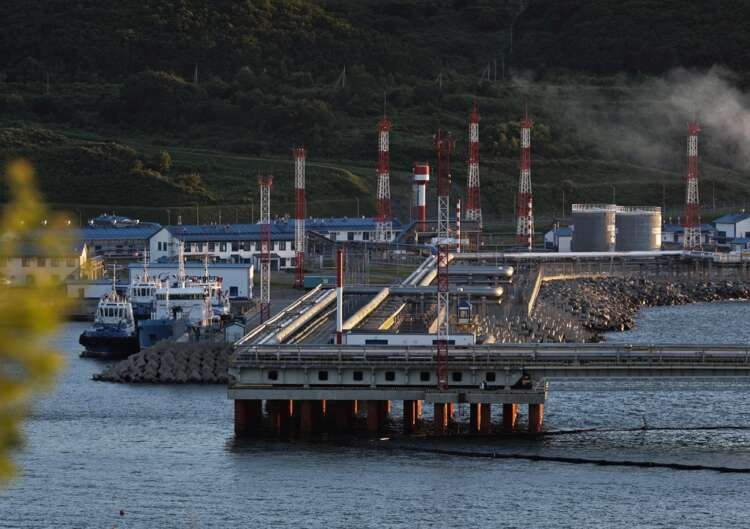
    The image shows the Kozmino oil terminal near Nakhodka, emphasizing the G7's decision to impose a price cap on Russian oil to reduce funding for the Ukraine war while managing global energy prices.
    Oil terminal near Nakhodka highlights G7 discussions on Russian oil price cap - Global Banking & Finance Review
    Why waste money on news and opinion when you can access them for free?

    Take advantage of our newsletter subscription and stay informed on the go!

    Subscribe

    Tags:oil and gasfinancial marketsInternational trade

    By David Lawder and Christian Kraemer

    (Reuters) -Group of Seven finance ministers agreed on Friday to impose a price cap on Russian oil aimed at slashing revenues for Moscow’s war in Ukraine while avoiding price spikes, but Russia said it would halt oil sales to countries imposing it.

    The ministers from the G7 wealthy democracies confirmed their commitment to the plan after a virtual meeting. They said, however, that key details, including the per-barrel level of the price cap would be determined later “based on a range of technical inputs” to be agreed by the coalition of countries implementing it.

    “Today we confirm our joint political intention to finalise and implement a comprehensive prohibition of services which enable maritime transportation of Russian-origin crude oil and petroleum products globally,” the G7 ministers said.

    The provision of Western-dominated maritime transportation services, including insurance and finance, would be allowed only if the Russian oil cargoes are purchased at or below the price level “determined by the broad coalition of countries adhering to and implementing the price cap.”

    A senior U.S. Treasury official told reporters that the coalition would set a specific dollar price limit for Russian crude and two others for petroleum products — not discounts to global market prices — and the price level would be revisited as needed.

    “This price cap on Russian oil exports is designed to reduce Putin’s revenues, closing an important source of funding for the war of aggression,” said German Finance Minister Christian Lindner, the current G7 finance chair. “At the same time, we want to curb rising global energy prices. This will minimize inflation globally.”

    OIL CUT-OFF

    The Kremlin responded to the G7 statement by saying that it would stop selling oil to countries implementing the price cap, saying it would destabilize global oil markets.

    “We simply will not cooperate with them on non-market principles,” Kremlin spokesman Dmitry Peskov told reporters. [nL8N3091TK]

    The Treasury official said Russia would have little choice but to sell oil at reduced prices in line with the cap, because India, China and other countries outside the coalition will still want to buy oil as cheaply as possible and alternative insurance will be considerably more expensive.

    “We got positive signals from other countries, but no firm commitments yet,” a senior G7 source said of efforts to recruit other countries into the coalition. “We wanted to send a signal of unity towards Russia and also countries like China.”

    The G7 announcement had little effect on benchmark crude prices, which rose in anticipation of an OPEC+ discussion of output cuts on Monday amid weaker demand

    The ministers said they would work to finalize the details, through their own domestic processes, aiming to align it with the start of European Union sanctions that will ban Russian oil imports into the bloc starting in December.

    The G7 consists of Britain, Canada, France, Germany, Italy, Japan and the United States.

    Enforcing the cap would rely heavily on denying London-brokered shipping insurance, which covers about 95% of the world’s tanker fleet, and finance to cargoes priced above the cap. But analysts say that alternatives can be found to circumvent the cap and market forces could render it ineffective

    Despite Russia’s falling oil export volumes, its oil export revenue in June increased by $700 million from May due to prices pushed higher by its war in Ukraine, the International Energy Agency said last month.

    The G7 finance ministers’ statement follows up on their leaders’ decision in June to explore the cap, a move Moscow says it will not abide by and can thwart by shipping oil to states not obeying the price ceiling.

    PRICING CONCERNS

    The U.S. Treasury has raised concerns that the EU embargo could set off a scramble for alternative supplies, spiking global crude prices to as much as $140 a barrel, and it has been promoting the price cap since May as a way to keep Russian crude flowing.

    Russian oil prices have risen in anticipation of the EU embargo, with Urals crude trading at an $18-to-$25 per barrel discount to benchmark Brent crude, down from a $30-to-$40 discount earlier this year.

    (Additional reporting by Jan Strupczewski, Matthias Williams, Steve Scherer, William James, Leigh Thomas, Timothy Gardner, Daphne Psaledakis and Rami Ayyub; editng by Raju Gopalakrishnan and Chizu Nomiyama)

    Frequently Asked Questions about G7 finance chiefs agree on Russian oil price cap but level not yet set

    1What are economic sanctions?

    Economic sanctions are restrictive measures imposed by countries to influence or punish a nation, often involving trade restrictions or financial penalties.

    2What is inflation?

    Inflation is the rate at which the general level of prices for goods and services rises, eroding purchasing power.

    3What is crude oil?

    Crude oil is a naturally occurring, unrefined petroleum product composed of hydrocarbon deposits and other organic materials.

    4What is maritime transportation?

    Maritime transportation refers to the movement of goods and passengers by sea, which is crucial for international trade.

    More from Top Stories

    Explore more articles in the Top Stories category

    Image for Lessons From the Ring and the Deal Table: How Boxing Shapes Steven Nigro’s Approach to Banking and Life
    Lessons From the Ring and the Deal Table: How Boxing Shapes Steven Nigro’s Approach to Banking and Life
    Image for Joe Kiani in 2025: Capital, Conviction, and a Focused Return to Innovation
    Joe Kiani in 2025: Capital, Conviction, and a Focused Return to Innovation
    Image for Marco Robinson – CLOSE THE DEAL AND SUDDENLY GROW RICH
    Marco Robinson – CLOSE THE DEAL AND SUDDENLY GROW RICH
    Image for Digital Tracing: Turning a regulatory obligation into a commercial advantage
    Digital Tracing: Turning a regulatory obligation into a commercial advantage
    Image for Exploring the Role of Blockchain and the Bitcoin Price Today in Education
    Exploring the Role of Blockchain and the Bitcoin Price Today in Education
    Image for Inside the World’s First Collection Industry Conglomerate: PCA Global’s Platform Strategy
    Inside the World’s First Collection Industry Conglomerate: PCA Global’s Platform Strategy
    Image for Chase Buchanan Private Wealth Management Highlights Key Autumn 2025 Budget Takeaways for Expats
    Chase Buchanan Private Wealth Management Highlights Key Autumn 2025 Budget Takeaways for Expats
    Image for PayLaju Strengthens Its Position as Malaysia’s Trusted Interest-Free Sharia-Compliant Loan Provider
    PayLaju Strengthens Its Position as Malaysia’s Trusted Interest-Free Sharia-Compliant Loan Provider
    Image for A Notable Update for Employee Health Benefits:
    A Notable Update for Employee Health Benefits:
    Image for Creating Equity Between Walls: How Mohak Chauhan is Using Engineering, Finance, and Community Vision to Reengineer Affordable Housing
    Creating Equity Between Walls: How Mohak Chauhan is Using Engineering, Finance, and Community Vision to Reengineer Affordable Housing
    Image for Upcoming Book on Real Estate Investing: Harvard Grace Capital Founder Stewart Heath’s Puts Lessons in Print
    Upcoming Book on Real Estate Investing: Harvard Grace Capital Founder Stewart Heath’s Puts Lessons in Print
    Image for ELECTIVA MARKS A LANDMARK FIRST YEAR WITH MAJOR SENIOR APPOINTMENTS AND EXPANSION MILESTONES
    ELECTIVA MARKS A LANDMARK FIRST YEAR WITH MAJOR SENIOR APPOINTMENTS AND EXPANSION MILESTONES
    View All Top Stories Posts
    Previous Top Stories PostBritish port workers plan two-week strike from Sept. 19
    Next Top Stories PostStress test backs extending lifespan of two German nuclear plants: sources