
Top Stories
FEATURE-Nigeria’s Women Shopkeepers Forced to Scale Back as Prices Soar
Published by Wanda Rich
Posted on April 12, 2022
5 min readLast updated: February 8, 2026
Add as preferred source on Google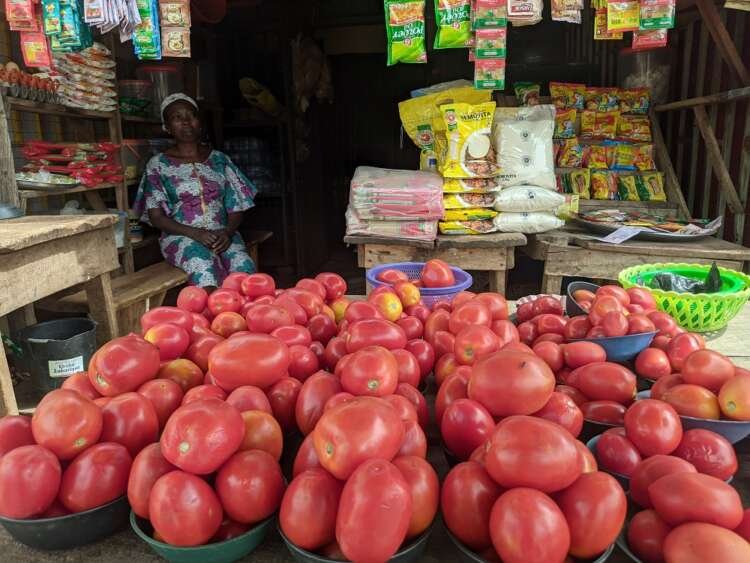
Published by Wanda Rich
Posted on April 12, 2022
5 min readLast updated: February 8, 2026
Add as preferred source on Google• Food, fuel inflation pushes up shopping bills
• Small business owners forced to cut costs as sales fall
• Some take out loans in bid to stay afloat
By Pelumi Salako
ILORIN, Nigeria, April 12 (Thomson Reuters Foundation) – The freezers at Mama Tee’s frozen food shop used to be brimming with chicken, turkey cuts and the fish varieties popular with her mainly student clientele in the city of Ilorin in western Nigeria.
Not so today. Inflation means Mama Tee’s price-conscious customers are tightening their belts, forcing her to drastically reduce her stock and devastating the small business that she relies on to provide for her seven children.
“The market is bad,” she said, asking to be identified only by her nickname, as she sat on a bench outside her store’s blue-painted frontage.
“The price of things has become high especially since September of last year. This year is even worse.”
As Russia’s invasion of Ukraine fuels rising global energy and food prices, small business owners in import-dependent African countries such as Nigeria are feeling the pinch.
Nigeria’s annual inflation accelerated to 15.7% in February, according to the latest official data, causing a major headache for the country’s 41 million micro businesses – about 40% of which are run by women.
Some, like Mama Tee, are taking out loans in a bid to stave off closure.
“It’s easy to take the loan but to repay it has been difficult especially as we’re not making enough profit. Now when visitors tell me they want to visit me at home, I tell them not to come because I cannot afford to entertain them,” she said.
Her problems have been compounded by a strike by Nigerian university lecturers, frequent electricity cuts and fuel shortages in the oil-exporting country.
A few weeks ago, she had to throw out stock worth 60,000 Naira ($144) because of a power outage that lasted more than seven days.
Nearby, shopkeeper Bolanle Adeleke has also seen her profits eroded as buyers stay away – unwilling or unable to pay higher prices for the everyday food items she sells.
“Before things became this expensive, I was usually happy. But these days, people don’t buy as much. My wares are not things I can keep for long, so what I do is to reduce the amount of stocks I buy,” said Adeleke.
“I don’t get any profit at all. I’m only striving to keep the shop alive,” she told the Thomson Reuters Foundation in her shop.
WHEAT PRICES
Nigeria’s neighbours in West Africa are also experiencing inflationary pressures due to a cocktail of factors including COVID-19 supply bottlenecks, depreciating currencies and a heavy reliance on imports, economic analysts said.
The price of wheat has also reached an “all-time high” as a result of the conflict between major exporters Ukraine and Russia, said Deepankar Rustagi, chief executive of Omnibiz, an e-commerce company serving retailers in Nigeria.
“The retailer is going to be squeezed up in this process because what will happen is that the retailer’s margin, which is already very narrow, will be impacted because not all of the price will be passed to the consumer,” he added.
Wheat was Nigeria’s second-biggest import during the fourth quarter of 2021 after petrol, the statistics office said last month.
That is having a particularly big effect on the household budgets of Nigeria’s poorest families.
“Unfortunately, a larger percentage of the poor’s income is spent on food compared to the rich, who spend maybe 20% of theirs on food,” said Tokunbo Afikuyomi, an economist and editor at Stears Business, a Nigerian business publication.
Because most of Nigeria’s food is transported by truck, rising diesel costs have also driven prices higher, he said, adding that many families were struggling to feed themselves adequately.
GARRI AND NO GAS
In Ilorin, self-employed tailor Sakirat Bake said she was worried that her four children were getting thin as the family cuts back on food expenses.
Bake and her husband, who now works as a motorcycle taxi driver, used to be rice traders but were forced to quit after the government cracked down on imports of the grain in 2019 in a bid to boost local production.
“Before, we ate three times daily but now, our eating pattern has become infrequent. Sometimes, we just manage garri,” she said, referring to a cheap dish prepared from cassava flour.
“On the rare occasions when we cook, we forgo meat because we can’t afford it,” she said, standing outside her low-cost apartment building, where the family shares the kitchen and other facilities with fellow tenants.
She has also started cooking with charcoal instead of natural gas due to a sharp rise in the price of the fuel, and was forced to take on a loan to pay her children’s school fees.
“It’s just God taking care of my kids,” she said.
($1 = 415.1500 naira)
(Reporting by Pelumi Salako; Editing by Helen Popper. Please credit the Thomson Reuters Foundation, the charitable arm of Thomson Reuters, that covers the lives of people around the world who struggle to live freely or fairly. Visit http://news.trust.org)
((Helen.Popper@thomsonreuters.com;))
Inflation is the rate at which the general level of prices for goods and services rises, eroding purchasing power. It is usually measured annually.
Micro businesses are small enterprises typically defined as having fewer than 10 employees. They often play a crucial role in local economies.
A loan is a sum of money borrowed from a lender that is expected to be paid back with interest over a specified period.
Food inflation refers to the increase in the prices of food items over time, affecting consumers' purchasing power and overall cost of living.
A small business is a privately owned company that has a small number of employees and relatively low volume of sales. They are vital for economic growth.
Explore more articles in the Top Stories category











