Search
00
GBAF Logo
trophy
Top StoriesInterviewsBusinessFinanceBankingTechnologyInvestingTradingVideosAwardsMagazinesHeadlinesTrends

Subscribe to our newsletter

Get the latest news and updates from our team.

Global Banking & Finance Review®

Global Banking & Finance Review® - Subscribe to our newsletter

Company

    GBAF Logo
    • About Us
    • Profile
    • Privacy & Cookie Policy
    • Terms of Use
    • Contact Us
    • Advertising
    • Submit Post
    • Latest News
    • Research Reports
    • Press Release
    • Awards▾
      • About the Awards
      • Awards TimeTable
      • Submit Nominations
      • Testimonials
      • Media Room
      • Award Winners
      • FAQ
    • Magazines▾
      • Global Banking & Finance Review Magazine Issue 79
      • Global Banking & Finance Review Magazine Issue 78
      • Global Banking & Finance Review Magazine Issue 77
      • Global Banking & Finance Review Magazine Issue 76
      • Global Banking & Finance Review Magazine Issue 75
      • Global Banking & Finance Review Magazine Issue 73
      • Global Banking & Finance Review Magazine Issue 71
      • Global Banking & Finance Review Magazine Issue 70
      • Global Banking & Finance Review Magazine Issue 69
      • Global Banking & Finance Review Magazine Issue 66
    Top StoriesInterviewsBusinessFinanceBankingTechnologyInvestingTradingVideosAwardsMagazinesHeadlinesTrends

    Global Banking & Finance Review® is a leading financial portal and online magazine offering News, Analysis, Opinion, Reviews, Interviews & Videos from the world of Banking, Finance, Business, Trading, Technology, Investing, Brokerage, Foreign Exchange, Tax & Legal, Islamic Finance, Asset & Wealth Management.
    Copyright © 2010-2026 GBAF Publications Ltd - All Rights Reserved. | Sitemap | Tags | Developed By eCorpIT

    Editorial & Advertiser disclosure

    Global Banking & Finance Review® is an online platform offering news, analysis, and opinion on the latest trends, developments, and innovations in the banking and finance industry worldwide. The platform covers a diverse range of topics, including banking, insurance, investment, wealth management, fintech, and regulatory issues. The website publishes news, press releases, opinion and advertorials on various financial organizations, products and services which are commissioned from various Companies, Organizations, PR agencies, Bloggers etc. These commissioned articles are commercial in nature. This is not to be considered as financial advice and should be considered only for information purposes. It does not reflect the views or opinion of our website and is not to be considered an endorsement or a recommendation. We cannot guarantee the accuracy or applicability of any information provided with respect to your individual or personal circumstances. Please seek Professional advice from a qualified professional before making any financial decisions. We link to various third-party websites, affiliate sales networks, and to our advertising partners websites. When you view or click on certain links available on our articles, our partners may compensate us for displaying the content to you or make a purchase or fill a form. This will not incur any additional charges to you. To make things simpler for you to identity or distinguish advertised or sponsored articles or links, you may consider all articles or links hosted on our site as a commercial article placement. We will not be responsible for any loss you may suffer as a result of any omission or inaccuracy on the website.

    Home > Top Stories > Factbox – Why low water levels on the Rhine river hurt Germany’s economy
    Top Stories

    Factbox – Why low water levels on the Rhine river hurt Germany’s economy

    Published by Jessica Weisman-Pitts

    Posted on August 15, 2022

    3 min read

    Last updated: February 4, 2026

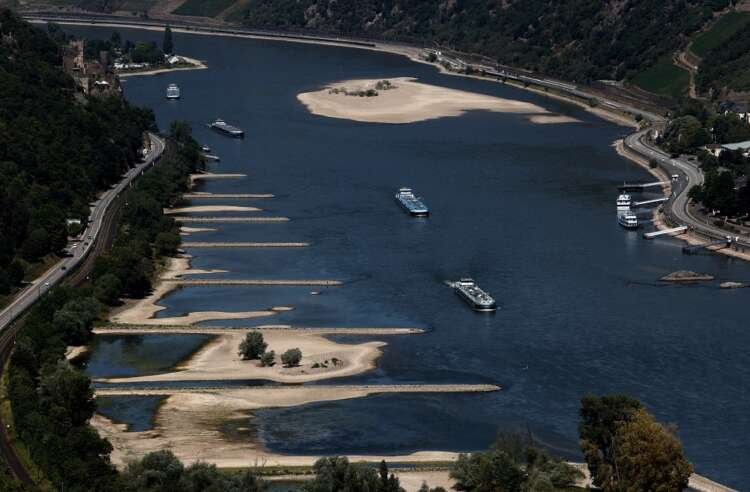
    Image depicting low water levels in the Rhine River, a critical shipping route for Germany's economy. The drought conditions impede vessel navigation, leading to increased freight costs.
    Low water levels in the Rhine River affecting shipping routes - Global Banking & Finance Review
    Why waste money on news and opinion when you can access them for free?

    Take advantage of our newsletter subscription and stay informed on the go!

    Subscribe

    Tags:Transportation SectorGDPeconomic growthlogistics

    Quick Summary

    BERLIN (Reuters) – Water levels on the Rhine river are very low because of unusually hot and dry weather, preventing many vessels from navigating the critical European shipping route fully loaded.

    BERLIN (Reuters) – Water levels on the Rhine river are very low because of unusually hot and dry weather, preventing many vessels from navigating the critical European shipping route fully loaded.

    Here are some facts about why shipping on the Rhine river is important for the economy:

    WHY IS RHINE RIVER SHIPPING IMPORTANT?

    Flowing from the Swiss Alps to the North Sea via German industrial heartlands, the Rhine is a major route for products ranging from grains to chemicals and coal.

    It is an important link between industrial producers and global export terminals in North Sea ports such as Rotterdam and Amsterdam, while canals and other rivers link the Rhine to the Danube, making it possible to ship to the Black Sea as well.

    WHAT HAPPENS WHEN WATER LEVELS ARE LOW?

    When water levels fall, cargo vessels have to sail with reduced load to prevent them running aground.

    Some shippers have said in recent days they were loading about a quarter of the regular amount of freight onto ships.

    This means more ships are needed to move consignments that would normally fit into a single vessel, adding to freight costs. Shipping companies can usually pass on extra costs to cargo owners, who in turn pass on higher costs to customers.

    WHAT IS THE CRITICAL WATER LEVEL?

    There is no specific water level at which shipping stops, and authorities do not close the river. It is up to vessel owners to decide whether they can operate safely.

    The reference waterline level at the chokepoint of Kaub near Koblenz was at 32 centimetres on Monday, down from 42 centimetres on Friday and from 51 centimetres a week ago. Vessels need about 1.5 metres of Kaub reference waterline to sail fully loaded.

    WHAT IS THE IMPACT ON GERMANY’S ECONOMY?

    Shipping bottlenecks are another drag on the German economy, which is already grappling with high inflation, supply chain disruptions and soaring gas prices after Russia’s invasion of Ukraine in February.

    Economists estimate the disruption to Rhine shipping could knock as much as half a percentage point off overall economic growth this year in Europe’s largest economy.

    The low Rhine water levels are expected to increase costs for chemicals companies such as BASF and could lead to production cuts.

    Coal power plants – now back in fashion as an alternative to Russian gas supplies – also face supply shortages with boats unable to take on enough coal. Utility Uniper has warned of output cuts at two of its plants that make up 4% of Germany’s coal-generated electricity capacity.

    WHAT IS BEING DONE TO ALLEVIATE THE SITUATION?

    Companies are shipping more goods by truck or train to make up for the shortfall on the Rhine.

    Germany plans to give the transportation of materials and equipment essential for energy production priority on the country’s rail networks should low water levels on the Rhine fall further, a draft decree showed on Sunday.

    Shipbuilders have also been working on vessel designs that can cope with lower water levels.

    (Compiled by Maria Sheahan; Editing by Edmund Blair)

    Frequently Asked Questions about Factbox – Why low water levels on the Rhine river hurt Germany’s economy

    1What is the Rhine River?

    The Rhine River is a major European waterway that flows from the Swiss Alps to the North Sea, serving as a crucial shipping route for various goods.

    2What are shipping bottlenecks?

    Shipping bottlenecks occur when the flow of goods is disrupted, often due to low water levels or other logistical issues, leading to delays and increased costs.

    3What is a critical water level?

    A critical water level is the minimum depth of water required for vessels to navigate safely without the risk of running aground.

    4What is the economic impact of low water levels?

    Low water levels can hinder shipping operations, leading to increased freight costs and potential reductions in economic growth.

    5What are freight costs?

    Freight costs are the charges incurred for transporting goods, which can increase due to shipping disruptions or logistical challenges.

    More from Top Stories

    Explore more articles in the Top Stories category

    Image for Lessons From the Ring and the Deal Table: How Boxing Shapes Steven Nigro’s Approach to Banking and Life
    Lessons From the Ring and the Deal Table: How Boxing Shapes Steven Nigro’s Approach to Banking and Life
    Image for Joe Kiani in 2025: Capital, Conviction, and a Focused Return to Innovation
    Joe Kiani in 2025: Capital, Conviction, and a Focused Return to Innovation
    Image for Marco Robinson – CLOSE THE DEAL AND SUDDENLY GROW RICH
    Marco Robinson – CLOSE THE DEAL AND SUDDENLY GROW RICH
    Image for Digital Tracing: Turning a regulatory obligation into a commercial advantage
    Digital Tracing: Turning a regulatory obligation into a commercial advantage
    Image for Exploring the Role of Blockchain and the Bitcoin Price Today in Education
    Exploring the Role of Blockchain and the Bitcoin Price Today in Education
    Image for Inside the World’s First Collection Industry Conglomerate: PCA Global’s Platform Strategy
    Inside the World’s First Collection Industry Conglomerate: PCA Global’s Platform Strategy
    Image for Chase Buchanan Private Wealth Management Highlights Key Autumn 2025 Budget Takeaways for Expats
    Chase Buchanan Private Wealth Management Highlights Key Autumn 2025 Budget Takeaways for Expats
    Image for PayLaju Strengthens Its Position as Malaysia’s Trusted Interest-Free Sharia-Compliant Loan Provider
    PayLaju Strengthens Its Position as Malaysia’s Trusted Interest-Free Sharia-Compliant Loan Provider
    Image for A Notable Update for Employee Health Benefits:
    A Notable Update for Employee Health Benefits:
    Image for Creating Equity Between Walls: How Mohak Chauhan is Using Engineering, Finance, and Community Vision to Reengineer Affordable Housing
    Creating Equity Between Walls: How Mohak Chauhan is Using Engineering, Finance, and Community Vision to Reengineer Affordable Housing
    Image for Upcoming Book on Real Estate Investing: Harvard Grace Capital Founder Stewart Heath’s Puts Lessons in Print
    Upcoming Book on Real Estate Investing: Harvard Grace Capital Founder Stewart Heath’s Puts Lessons in Print
    Image for ELECTIVA MARKS A LANDMARK FIRST YEAR WITH MAJOR SENIOR APPOINTMENTS AND EXPANSION MILESTONES
    ELECTIVA MARKS A LANDMARK FIRST YEAR WITH MAJOR SENIOR APPOINTMENTS AND EXPANSION MILESTONES
    View All Top Stories Posts
    Previous Top Stories PostMeal-kit firm HelloFresh still aiming for higher 2022 targets, shares soar
    Next Top Stories PostFTSE 100 up as AstraZeneca gains offset commodity losses