Search
00
GBAF Logo
trophy
Top StoriesInterviewsBusinessFinanceBankingTechnologyInvestingTradingVideosAwardsMagazinesHeadlinesTrends

Subscribe to our newsletter

Get the latest news and updates from our team.

Global Banking & Finance Review®

Global Banking & Finance Review® - Subscribe to our newsletter

Company

    GBAF Logo
    • About Us
    • Profile
    • Privacy & Cookie Policy
    • Terms of Use
    • Contact Us
    • Advertising
    • Submit Post
    • Latest News
    • Research Reports
    • Press Release
    • Awards▾
      • About the Awards
      • Awards TimeTable
      • Submit Nominations
      • Testimonials
      • Media Room
      • Award Winners
      • FAQ
    • Magazines▾
      • Global Banking & Finance Review Magazine Issue 79
      • Global Banking & Finance Review Magazine Issue 78
      • Global Banking & Finance Review Magazine Issue 77
      • Global Banking & Finance Review Magazine Issue 76
      • Global Banking & Finance Review Magazine Issue 75
      • Global Banking & Finance Review Magazine Issue 73
      • Global Banking & Finance Review Magazine Issue 71
      • Global Banking & Finance Review Magazine Issue 70
      • Global Banking & Finance Review Magazine Issue 69
      • Global Banking & Finance Review Magazine Issue 66
    Top StoriesInterviewsBusinessFinanceBankingTechnologyInvestingTradingVideosAwardsMagazinesHeadlinesTrends

    Global Banking & Finance Review® is a leading financial portal and online magazine offering News, Analysis, Opinion, Reviews, Interviews & Videos from the world of Banking, Finance, Business, Trading, Technology, Investing, Brokerage, Foreign Exchange, Tax & Legal, Islamic Finance, Asset & Wealth Management.
    Copyright © 2010-2026 GBAF Publications Ltd - All Rights Reserved. | Sitemap | Tags | Developed By eCorpIT

    Editorial & Advertiser disclosure

    Global Banking & Finance Review® is an online platform offering news, analysis, and opinion on the latest trends, developments, and innovations in the banking and finance industry worldwide. The platform covers a diverse range of topics, including banking, insurance, investment, wealth management, fintech, and regulatory issues. The website publishes news, press releases, opinion and advertorials on various financial organizations, products and services which are commissioned from various Companies, Organizations, PR agencies, Bloggers etc. These commissioned articles are commercial in nature. This is not to be considered as financial advice and should be considered only for information purposes. It does not reflect the views or opinion of our website and is not to be considered an endorsement or a recommendation. We cannot guarantee the accuracy or applicability of any information provided with respect to your individual or personal circumstances. Please seek Professional advice from a qualified professional before making any financial decisions. We link to various third-party websites, affiliate sales networks, and to our advertising partners websites. When you view or click on certain links available on our articles, our partners may compensate us for displaying the content to you or make a purchase or fill a form. This will not incur any additional charges to you. To make things simpler for you to identity or distinguish advertised or sponsored articles or links, you may consider all articles or links hosted on our site as a commercial article placement. We will not be responsible for any loss you may suffer as a result of any omission or inaccuracy on the website.

    Home > Top Stories > Explainer-What you need to know about the April total solar eclipse
    Top Stories

    Explainer-What you need to know about the April total solar eclipse

    Published by Wanda Rich

    Posted on January 26, 2024

    4 min read

    Last updated: January 31, 2026

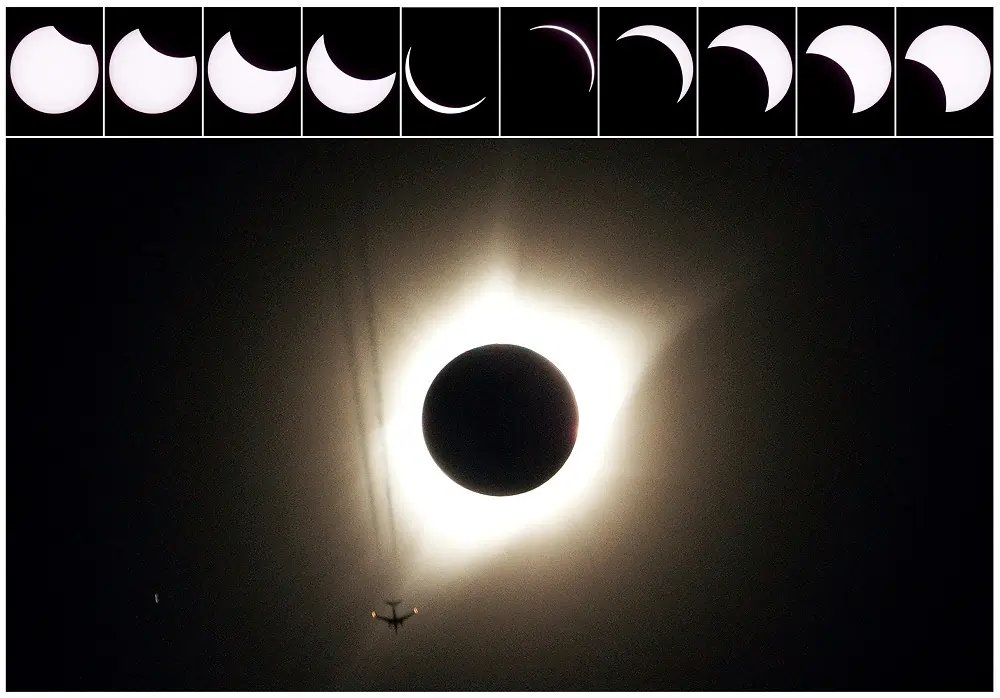
    This image illustrates the total solar eclipse occurring on April 8, 2024, depicting the moon completely covering the sun. It highlights the path of totality across North America, as discussed in the article.
    Total solar eclipse view with the moon covering the sun - Global Banking & Finance Review
    Why waste money on news and opinion when you can access them for free?

    Take advantage of our newsletter subscription and stay informed on the go!

    Subscribe

    Tags:financial communityinvestmentfinancial managementfinancial servicesfinancial sector

    Explainer-What you need to know about the April total solar eclipse

    By Will Dunham

    WASHINGTON (Reuters) – The moon will completely blot out the sun for millions of people in North America along a path crossing from Mexico into the United States and then Canada in a total solar eclipse occurring on April 8.

    Here is an explanation of the solar eclipse and where it will be visible.

    WHAT IS A TOTAL SOLAR ECLIPSE?

    In a total solar eclipse, the moon passes between the sun and Earth, entirely covering the face of the sun along a small path of our planet’s surface. This is called the “path of totality.” The daytime sky turns dark, akin to dusk or dawn, and nocturnal animals have been known to wake up, confused into believing night has arrived.

    In places along the path of totality, people will be able to view the sun’s corona – the star’s outer atmosphere – that typically is not visible because of solar brightness. People observing from outside the path of totality will see a partial eclipse in which the moon obscures most of the sun’s face but not all of it.

    Of course, a cloudy day could spoil the view. After this one, the next total solar eclipse viewable from the contiguous United States will not occur until 2044.

    WHERE WILL IT BE VISIBLE AND WHAT IS ITS PATH?

    According to NASA, the April 8 eclipse will begin over the South Pacific, with its path reaching Mexico’s Pacific coast at around 11:07 a.m. Pacific Time before entering the United States in Texas.

    Its path then takes it through Oklahoma, Arkansas, Missouri, a tiny piece of Tennessee, Illinois, Kentucky, Indiana, Ohio, a tiny piece of Michigan, Pennsylvania, New York, Vermont, New Hampshire and Maine.

    The path then enters Canada in Ontario and journeys through Quebec, New Brunswick, Prince Edward Island and Cape Breton, exiting continental North America on the Atlantic coast of Newfoundland, Canada, at 5:16 p.m. Newfoundland Time. A partial eclipse is due to be visible for people in all 48 contiguous U.S. states.

    HOW DOES THIS DIFFER FROM AN ANNULAR SOLAR ECLIPSE?

    On Oct. 14, 2023, people along a path stretching from the U.S. Pacific Northwest, through Mexico, Central America, Colombia and Brazil witnessed an annular solar eclipse, a slightly different event. An annular solar eclipse occurs when the moon passes between the sun and Earth when the moon is at or near its farthest point from our planet. Thus, it does not completely cover the face of the sun, leaving what looks like a “ring of fire” in the sky.

    HOW DO YOU SAFELY WATCH AN ECLIPSE?

    Experts warn that it is unsafe to look directly at the bright sun without using specialized eye protection designed for solar viewing. Viewing an eclipse through a camera lens, binoculars or telescope without making use of a special-purpose solar filter can cause severe eye injury, according to these experts.

    They advise using safe solar viewing glasses or a safe handheld solar viewer, noting that regular sunglasses are not safe for viewing the sun. The only moment it is considered safe for people to remove eye protection during a total solar eclipse is the brief time when the moon completely blocks the sun’s surface.

    HOW BIG ARE THE EARTH, MOON AND SUN?

    The moon will cover the sun’s face, as visible from Earth, only because the moon – in actuality much smaller than the sun – is so much closer to our planet. The moon’s diameter is 2,159 miles (3,476 km), compared to the sun’s diameter of about 865,000 miles (1.4 million km) and Earth’s diameter of 7,918 miles (12,742 km).

    HOW DO SOLAR ECLIPSES DIFFER FROM LUNAR ECLIPSES?

    Lunar eclipses occur when Earth is positioned between the moon and the sun and our planet’s shadow is cast upon the lunar surface. This leaves the moon looking dim from Earth, sometimes with a reddish color. Lunar eclipses are visible from half of Earth, a much wider area than solar eclipses.

    (Reporting by Will Dunham in Washington, Editing by Rosalba O’Brien)

    Frequently Asked Questions about Explainer-What you need to know about the April total solar eclipse

    1What is a total solar eclipse?

    A total solar eclipse occurs when the moon completely covers the sun, as viewed from Earth, turning day into night along a specific path.

    2What is a partial solar eclipse?

    A partial solar eclipse happens when the moon covers only a part of the sun, allowing some sunlight to reach Earth.

    3What is the corona?

    The corona is the outer atmosphere of the sun, visible during a total solar eclipse when the sun's light is blocked by the moon.

    4What is the path of totality?

    The path of totality is the narrow track on Earth's surface where observers can see a total solar eclipse.

    5What is an annular solar eclipse?

    An annular solar eclipse occurs when the moon is too far from Earth to completely cover the sun, resulting in a 'ring of fire' effect.

    More from Top Stories

    Explore more articles in the Top Stories category

    Image for Lessons From the Ring and the Deal Table: How Boxing Shapes Steven Nigro’s Approach to Banking and Life
    Lessons From the Ring and the Deal Table: How Boxing Shapes Steven Nigro’s Approach to Banking and Life
    Image for Joe Kiani in 2025: Capital, Conviction, and a Focused Return to Innovation
    Joe Kiani in 2025: Capital, Conviction, and a Focused Return to Innovation
    Image for Marco Robinson – CLOSE THE DEAL AND SUDDENLY GROW RICH
    Marco Robinson – CLOSE THE DEAL AND SUDDENLY GROW RICH
    Image for Digital Tracing: Turning a regulatory obligation into a commercial advantage
    Digital Tracing: Turning a regulatory obligation into a commercial advantage
    Image for Exploring the Role of Blockchain and the Bitcoin Price Today in Education
    Exploring the Role of Blockchain and the Bitcoin Price Today in Education
    Image for Inside the World’s First Collection Industry Conglomerate: PCA Global’s Platform Strategy
    Inside the World’s First Collection Industry Conglomerate: PCA Global’s Platform Strategy
    Image for Chase Buchanan Private Wealth Management Highlights Key Autumn 2025 Budget Takeaways for Expats
    Chase Buchanan Private Wealth Management Highlights Key Autumn 2025 Budget Takeaways for Expats
    Image for PayLaju Strengthens Its Position as Malaysia’s Trusted Interest-Free Sharia-Compliant Loan Provider
    PayLaju Strengthens Its Position as Malaysia’s Trusted Interest-Free Sharia-Compliant Loan Provider
    Image for A Notable Update for Employee Health Benefits:
    A Notable Update for Employee Health Benefits:
    Image for Creating Equity Between Walls: How Mohak Chauhan is Using Engineering, Finance, and Community Vision to Reengineer Affordable Housing
    Creating Equity Between Walls: How Mohak Chauhan is Using Engineering, Finance, and Community Vision to Reengineer Affordable Housing
    Image for Upcoming Book on Real Estate Investing: Harvard Grace Capital Founder Stewart Heath’s Puts Lessons in Print
    Upcoming Book on Real Estate Investing: Harvard Grace Capital Founder Stewart Heath’s Puts Lessons in Print
    Image for ELECTIVA MARKS A LANDMARK FIRST YEAR WITH MAJOR SENIOR APPOINTMENTS AND EXPANSION MILESTONES
    ELECTIVA MARKS A LANDMARK FIRST YEAR WITH MAJOR SENIOR APPOINTMENTS AND EXPANSION MILESTONES
    View All Top Stories Posts
    Previous Top Stories PostEuro zone inflation falling quicker than thought, data show
    Next Top Stories PostKing Charles admitted to London hospital for prostate treatment