Search
00
GBAF Logo
trophy
Top StoriesInterviewsBusinessFinanceBankingTechnologyInvestingTradingVideosAwardsMagazinesHeadlinesTrends

Subscribe to our newsletter

Get the latest news and updates from our team.

Global Banking & Finance Review®

Global Banking & Finance Review® - Subscribe to our newsletter

Company

    GBAF Logo
    • About Us
    • Profile
    • Privacy & Cookie Policy
    • Terms of Use
    • Contact Us
    • Advertising
    • Submit Post
    • Latest News
    • Research Reports
    • Press Release
    • Awards▾
      • About the Awards
      • Awards TimeTable
      • Submit Nominations
      • Testimonials
      • Media Room
      • Award Winners
      • FAQ
    • Magazines▾
      • Global Banking & Finance Review Magazine Issue 79
      • Global Banking & Finance Review Magazine Issue 78
      • Global Banking & Finance Review Magazine Issue 77
      • Global Banking & Finance Review Magazine Issue 76
      • Global Banking & Finance Review Magazine Issue 75
      • Global Banking & Finance Review Magazine Issue 73
      • Global Banking & Finance Review Magazine Issue 71
      • Global Banking & Finance Review Magazine Issue 70
      • Global Banking & Finance Review Magazine Issue 69
      • Global Banking & Finance Review Magazine Issue 66
    Top StoriesInterviewsBusinessFinanceBankingTechnologyInvestingTradingVideosAwardsMagazinesHeadlinesTrends

    Global Banking & Finance Review® is a leading financial portal and online magazine offering News, Analysis, Opinion, Reviews, Interviews & Videos from the world of Banking, Finance, Business, Trading, Technology, Investing, Brokerage, Foreign Exchange, Tax & Legal, Islamic Finance, Asset & Wealth Management.
    Copyright © 2010-2026 GBAF Publications Ltd - All Rights Reserved. | Sitemap | Tags | Developed By eCorpIT

    Editorial & Advertiser disclosure

    Global Banking & Finance Review® is an online platform offering news, analysis, and opinion on the latest trends, developments, and innovations in the banking and finance industry worldwide. The platform covers a diverse range of topics, including banking, insurance, investment, wealth management, fintech, and regulatory issues. The website publishes news, press releases, opinion and advertorials on various financial organizations, products and services which are commissioned from various Companies, Organizations, PR agencies, Bloggers etc. These commissioned articles are commercial in nature. This is not to be considered as financial advice and should be considered only for information purposes. It does not reflect the views or opinion of our website and is not to be considered an endorsement or a recommendation. We cannot guarantee the accuracy or applicability of any information provided with respect to your individual or personal circumstances. Please seek Professional advice from a qualified professional before making any financial decisions. We link to various third-party websites, affiliate sales networks, and to our advertising partners websites. When you view or click on certain links available on our articles, our partners may compensate us for displaying the content to you or make a purchase or fill a form. This will not incur any additional charges to you. To make things simpler for you to identity or distinguish advertised or sponsored articles or links, you may consider all articles or links hosted on our site as a commercial article placement. We will not be responsible for any loss you may suffer as a result of any omission or inaccuracy on the website.

    Home > Top Stories > Explainer-What are the consequences of the yen’s fall to a 24-year low?
    Top Stories

    Explainer-What are the consequences of the yen’s fall to a 24-year low?

    Published by Wanda Rich

    Posted on June 13, 2022

    5 min read

    Last updated: February 6, 2026

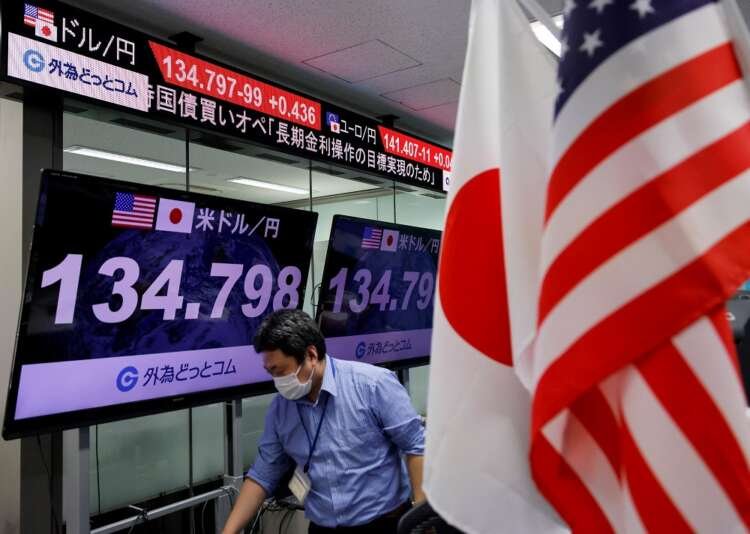
    A financial professional observes a monitor displaying the Japanese yen's fall against the US dollar, reflecting the economic implications discussed in the article about Japan's currency decline.
    Employee monitors Japanese yen exchange rate against the US dollar in Tokyo - Global Banking & Finance Review
    Why waste money on news and opinion when you can access them for free?

    Take advantage of our newsletter subscription and stay informed on the go!

    Subscribe

    Tags:foreign currencyfinancial marketseconomic growthinterest ratescurrency hedging

    By Saikat Chatterjee

    LONDON (Reuters) – The Japanese yen fell past the psychological 135 line to levels against the U.S. dollar last seen in October 1998.

    The scale of the move has repercussions for the domestic economy as yen-based import prices are surging at a record annual pace, heaping pressure on household balance sheets.

    The Bank of Japan and the Japanese government on Friday gave a rare joint statement that they may intervene if weakness persists.

    So far the fallout from the weakening yen has been minimal for broader financial markets, but that could change if the sell-off accelerates.

    Below are key questions about what a sliding yen means for Japan’s economy and international markets:

    WHY IS THE YEN WEAK?

    The yen, the third most-traded currency globally, fell as low as 135.22 yen after starting 2022 at 115. With the dollar up more than 16% so far this year, the yen is on track for its biggest annual drop since 2013.

    The weakness primarily stems from widening interest rate differentials between Japan and elsewhere.

    While the rest of the world, led by the U.S. Federal Reserve, is raising rates aggressively to tame soaring inflation, the BOJ has doubled down on its easy policy stance.

    The gap between Japanese 10-year government bond yields and those in the United States is 293 basis points — a near 3-1/2-year high — while the gap with German yields is at 8-year highs.

    WILL AUTHORITIES INTERVENE?

    They certainly say they might.

    On Friday, Japan’s government and central bank said they were concerned by the recent sharp falls, the strongest warning to date that Tokyo could intervene.

    The yen quickly bounced away from its two-decade lows, but not everyone is convinced actual intervention is likely.

    Given the economy’s reliance on exports, Japan has historically focused on arresting sharp yen rises and taken a hands-off approach to yen weakness, which is more difficult because yen-buying requires Japan to draw on limited foreign reserves.

    The last time Japan intervened to support its currency was 1998, when the Asian financial crisis triggered rapid capital outflows from the region. Before that, Tokyo intervened to counter yen falls in 1991-1992.

    Currency intervention is costly and could easily fail given the difficulty of influencing the yen’s value in global foreign exchange markets.

    WHAT CAN STOP THE DECLINE?

    A marked improvement in growth prospects as the country reopens its borders post-COVID and higher inflation could alter the BOJ’s dovish stance.

    Japan’s core consumer prices in April were 2.1% higher than a year earlier, exceeding the BOJ’s 2% inflation target for the first time in seven years.

    “The yen’s fall could stop if the BOJ changes tack and becomes hawkish,” said Francesca Fornasari, head of currency solutions at Insight Investments.

    Any sign that rates outside of Japan are peaking might also prompt a relief rally. There are no signs of that yet though, with U.S. rates set to peak at 3.5% in mid-2023, according to futures markets.

    DOES A WEAKER YEN BOOST THE ECONOMY?

    The yen has weakened back towards recent 7-year lows versus the Chinese yuan and is hitting new multi-year lows against the Korean won and the Taiwanese dollar, which should provide some relief for Japan’s widening trade deficit.

    Some like John Vail, chief global strategist at Nikko Asset Management, say currency weakness is crucial for Japan’s economy to maintain its competitiveness as a secure source of supply-chain diversification.

    The yen’s decline also boosts the attractiveness of its stock market among foreign investors who consider it undervalued versus European and U.S. markets. Japanese stocks have outperformed rivals in 2022, although they are still down as investors globally dump riskier assets.

    WHAT DOES IT MEAN FOR FX MARKETS?

    The yen has long been the currency of choice for investors undertaking so-called carry trades, which involve borrowing in a low-yielding currency like the yen to invest in higher yielding currencies like U.S. or Canadian dollars.

    A strategy borrowing in yen and investing in an equal basket of U.S., Australian and Canadian dollars would have yielded more than 13% so far in 2022, according to Refinitiv data.

    But the speed of the yen’s drop and questions about policymaker intervention is fuelling unease among investors, especially with short bets against the yen near six-month highs.

    Further volatility and weakness could undermine its appeal as a funding currency.

    WHAT ABOUT DOMESTIC INVESTORS?

    The yen’s weakness puts Japanese investors in a bind.

    Yields are high and rising, which makes foreign bonds much more attractive. But that also means the cost of FX hedging is climbing.

    So Japanese investors can often only capture the higher yields if they buy foreign bonds unhedged.

    But with the yen at such depressed levels it is difficult for investors to stomach such currency risk, such as the yen appreciating. Even a modest move back to 115-120, where we were 4 months ago, would eat up years worth of yield advantage.

    (Reporting by Saikat Chatterjee and Sujata Rao; Editing by Tommy Wilkes, Kirsten Donovan)

    Frequently Asked Questions about Explainer-What are the consequences of the yen’s fall to a 24-year low?

    1What are interest rates?

    Interest rates are the cost of borrowing money, expressed as a percentage of the total loan amount. They can influence economic activity by affecting consumer spending and investment.

    2What is inflation?

    Inflation is the rate at which the general level of prices for goods and services rises, eroding purchasing power. It is typically measured by the Consumer Price Index (CPI).

    3What is a trade deficit?

    A trade deficit occurs when a country's imports exceed its exports, indicating that it is buying more from other countries than it is selling to them.

    More from Top Stories

    Explore more articles in the Top Stories category

    Image for Lessons From the Ring and the Deal Table: How Boxing Shapes Steven Nigro’s Approach to Banking and Life
    Lessons From the Ring and the Deal Table: How Boxing Shapes Steven Nigro’s Approach to Banking and Life
    Image for Joe Kiani in 2025: Capital, Conviction, and a Focused Return to Innovation
    Joe Kiani in 2025: Capital, Conviction, and a Focused Return to Innovation
    Image for Marco Robinson – CLOSE THE DEAL AND SUDDENLY GROW RICH
    Marco Robinson – CLOSE THE DEAL AND SUDDENLY GROW RICH
    Image for Digital Tracing: Turning a regulatory obligation into a commercial advantage
    Digital Tracing: Turning a regulatory obligation into a commercial advantage
    Image for Exploring the Role of Blockchain and the Bitcoin Price Today in Education
    Exploring the Role of Blockchain and the Bitcoin Price Today in Education
    Image for Inside the World’s First Collection Industry Conglomerate: PCA Global’s Platform Strategy
    Inside the World’s First Collection Industry Conglomerate: PCA Global’s Platform Strategy
    Image for Chase Buchanan Private Wealth Management Highlights Key Autumn 2025 Budget Takeaways for Expats
    Chase Buchanan Private Wealth Management Highlights Key Autumn 2025 Budget Takeaways for Expats
    Image for PayLaju Strengthens Its Position as Malaysia’s Trusted Interest-Free Sharia-Compliant Loan Provider
    PayLaju Strengthens Its Position as Malaysia’s Trusted Interest-Free Sharia-Compliant Loan Provider
    Image for A Notable Update for Employee Health Benefits:
    A Notable Update for Employee Health Benefits:
    Image for Creating Equity Between Walls: How Mohak Chauhan is Using Engineering, Finance, and Community Vision to Reengineer Affordable Housing
    Creating Equity Between Walls: How Mohak Chauhan is Using Engineering, Finance, and Community Vision to Reengineer Affordable Housing
    Image for Upcoming Book on Real Estate Investing: Harvard Grace Capital Founder Stewart Heath’s Puts Lessons in Print
    Upcoming Book on Real Estate Investing: Harvard Grace Capital Founder Stewart Heath’s Puts Lessons in Print
    Image for ELECTIVA MARKS A LANDMARK FIRST YEAR WITH MAJOR SENIOR APPOINTMENTS AND EXPANSION MILESTONES
    ELECTIVA MARKS A LANDMARK FIRST YEAR WITH MAJOR SENIOR APPOINTMENTS AND EXPANSION MILESTONES
    View All Top Stories Posts
    Previous Top Stories PostUK slowdown fears mount as GDP unexpectedly shrinks in April
    Next Top Stories PostSurprise British GDP drop, EU tensions add to sterling woes