Search
00
GBAF Logo
trophy
Top StoriesInterviewsBusinessFinanceBankingTechnologyInvestingTradingVideosAwardsMagazinesHeadlinesTrends

Subscribe to our newsletter

Get the latest news and updates from our team.

Global Banking & Finance Review®

Global Banking & Finance Review® - Subscribe to our newsletter

Company

    GBAF Logo
    • About Us
    • Profile
    • Privacy & Cookie Policy
    • Terms of Use
    • Contact Us
    • Advertising
    • Submit Post
    • Latest News
    • Research Reports
    • Press Release
    • Awards▾
      • About the Awards
      • Awards TimeTable
      • Submit Nominations
      • Testimonials
      • Media Room
      • Award Winners
      • FAQ
    • Magazines▾
      • Global Banking & Finance Review Magazine Issue 79
      • Global Banking & Finance Review Magazine Issue 78
      • Global Banking & Finance Review Magazine Issue 77
      • Global Banking & Finance Review Magazine Issue 76
      • Global Banking & Finance Review Magazine Issue 75
      • Global Banking & Finance Review Magazine Issue 73
      • Global Banking & Finance Review Magazine Issue 71
      • Global Banking & Finance Review Magazine Issue 70
      • Global Banking & Finance Review Magazine Issue 69
      • Global Banking & Finance Review Magazine Issue 66
    Top StoriesInterviewsBusinessFinanceBankingTechnologyInvestingTradingVideosAwardsMagazinesHeadlinesTrends

    Global Banking & Finance Review® is a leading financial portal and online magazine offering News, Analysis, Opinion, Reviews, Interviews & Videos from the world of Banking, Finance, Business, Trading, Technology, Investing, Brokerage, Foreign Exchange, Tax & Legal, Islamic Finance, Asset & Wealth Management.
    Copyright © 2010-2026 GBAF Publications Ltd - All Rights Reserved. | Sitemap | Tags | Developed By eCorpIT

    Editorial & Advertiser disclosure

    Global Banking & Finance Review® is an online platform offering news, analysis, and opinion on the latest trends, developments, and innovations in the banking and finance industry worldwide. The platform covers a diverse range of topics, including banking, insurance, investment, wealth management, fintech, and regulatory issues. The website publishes news, press releases, opinion and advertorials on various financial organizations, products and services which are commissioned from various Companies, Organizations, PR agencies, Bloggers etc. These commissioned articles are commercial in nature. This is not to be considered as financial advice and should be considered only for information purposes. It does not reflect the views or opinion of our website and is not to be considered an endorsement or a recommendation. We cannot guarantee the accuracy or applicability of any information provided with respect to your individual or personal circumstances. Please seek Professional advice from a qualified professional before making any financial decisions. We link to various third-party websites, affiliate sales networks, and to our advertising partners websites. When you view or click on certain links available on our articles, our partners may compensate us for displaying the content to you or make a purchase or fill a form. This will not incur any additional charges to you. To make things simpler for you to identity or distinguish advertised or sponsored articles or links, you may consider all articles or links hosted on our site as a commercial article placement. We will not be responsible for any loss you may suffer as a result of any omission or inaccuracy on the website.

    Home > Top Stories > Explainer-How Germany’s hydrogen economy could transform energy use
    Top Stories

    Explainer-How Germany’s hydrogen economy could transform energy use

    Published by Jessica Weisman-Pitts

    Posted on July 25, 2024

    4 min read

    Last updated: January 29, 2026

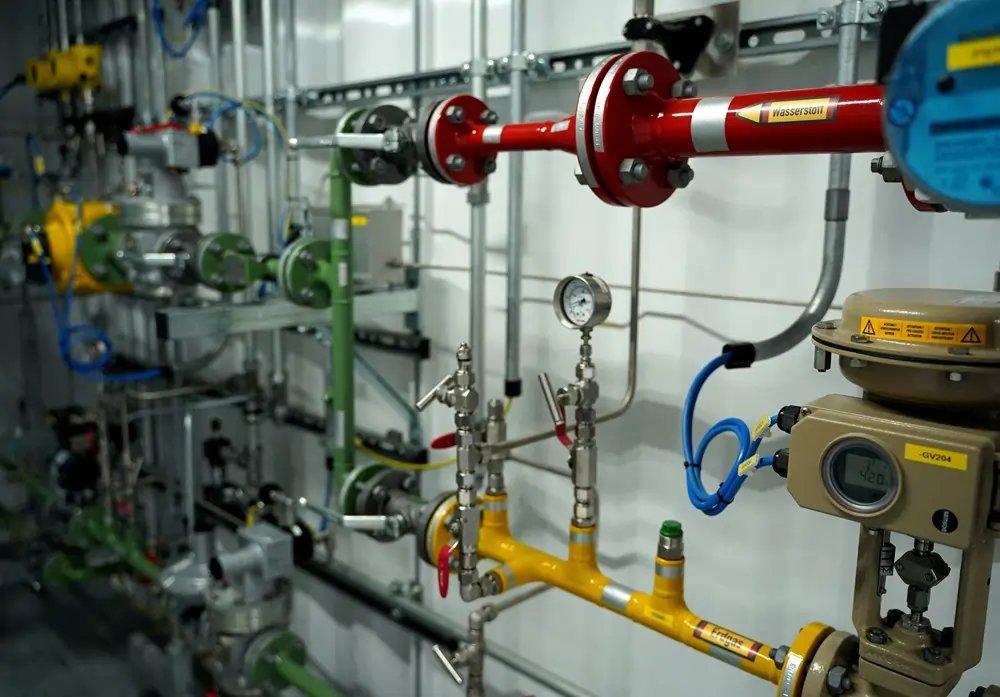
    An overview of Germany's infrastructure developments for green hydrogen, illustrating the country's commitment to transforming energy use through clean hydrogen production and pipeline systems.
    Infrastructure for Germany's hydrogen economy transformation - Global Banking & Finance Review
    Why waste money on news and opinion when you can access them for free?

    Take advantage of our newsletter subscription and stay informed on the go!

    Subscribe

    Tags:sustainabilityrenewable energyinvestment

    By Vera Eckert

    FRANKFURT (Reuters) – German utility EnBW this week pledged 1 billion euros ($1.08 billion) to build pipelines to carry clean hydrogen as part of a plan for a nationwide grid that will start commercial operations by 2032.

    Germany is betting on green hydrogen, produced through electrolysis driven by wind and solar power, as an alternative to fossil fuels.

    For some, it is a gamble, for others a world-leading example.

    The following outlines the progress so far.

    WHY IS GERMANY CENTRAL TO EU HYDROGEN PLANS?

    Germany is spearheading the European Union’s shift towards cleaner energy because it is the bloc’s biggest economy and exporter, with a reliance on industry for a third of its gross national product.

    Advocates of the fuel say it will enable German products, such as cars or steel, to compete more effectively as pressure mounts from some consumers and investors for goods with greatly reduced carbon footprints.

    The energy transition in Germany became urgent after its supplies of relatively inexpensive gas from Russia ended following the Ukraine war.

    The country’s research and development has produced many patents for hydrogen over the last decade.

    WHAT ARE THE WIDER USES?

    The transport grid is just one element in a strategy that spans 10 gigawatts (GW) of domestic production capacity and an import strategy that will draw on supplies from elsewhere in Europe and overseas.

    New gas-to-power generation plants that can switch to hydrogen will be put to tender by the end of 2024 or early next year.

    Industry players in steelmaking and chemicals have plans to replace coal- and gas-based hydrogen with green hydrogen and utilities are adding electrolysis and import facilities to their investment portfolios.

    WHO ARE THE PROTAGONISTS?

    Some of the biggest players are steelmakers Thyssenkrupp, Salzgitter and ArcelorMittal, which plan to invest billions of euros in decarbonising steel production, betting on hydrogen’s availability.

    Utilities are also among the leaders.

    RWE plans 2 GW of electrolysis and 3 GW of hydrogen ready gas-to-power capacity by the end of 2030. Of its total investments of 55 billion euros by that date, 25% are for hydrogen, batteries and flexible power production.

    Uniper has a deal with Salzgitter to provide it with hydrogen from an ammonia cracker at Wilhelmshaven.

    WHAT ARE THE COSTS FOR CONSUMERS AND TAXPAYERS?

    The total cost for the hydrogen network, including 9,666 kilometers of pipelines, is estimated at around 19.7 billion euros.

    Including that and adding electrolysis plants and renewable capacity to feed electrolysers and storage, PwC gave a total of 65-80 billion euros of costs up to 2030 in calculations provided for Reuters.

    Much of the money will have to come from utility companies’ balance sheets, from network usage fees borne by consumers, and from tax revenues as private financiers have so far proved reluctant.

    “The business case for German hydrogen projects is not easy. The banks are asking for customers and secure returns,” said Dirk Niemeier, a director and Lead for Clean Hydrogen and Alternative Fuels at PwC in Germany. “If there is no prospect, investments cannot be made.”

    WHY THE RELIANCE ON IMPORTS?

    Germany, with a lack of its own fossil reserves, has traditionally been an energy importer and has already a network of partners.

    For hydrogen, it can draw on existing trade relationships with Britain, Norway and the Netherlands and is building new alliances with southern Europe and North Africa, as well as Australia, Canada and Chile.

    McKinsey made data available to Reuters showing that hydrogen production costs in Germany could be $10 a kilogram in 2030, higher than the cost of $3-8/kg for imports as countries with cheap renewable power and low labour costs can make green hydrogen relatively cheaply.

    Grey hydrogen made from gas of which Germany uses some 42 TWh each year, costs around $3/kg, indices show.

    WHAT ARE OTHER COUNTRIES DOING?

    Britain, Denmark and Norway are expected to supply Germany with green or blue hydrogen. The latter is produced using natural gas in a process where the CO2 released in production is captured and stored.

    Italy, Spain and the Netherlands have elaborate strategies for their own and neighbouring markets.

    The U.S. is investing billions of dollars and so is China.

    ($1 = 0.9219 euros)

    (Reporting by Vera Eckert, additional reporting by Tom Sims, editing by Barbara Lewis)

    Frequently Asked Questions about Explainer-How Germany’s hydrogen economy could transform energy use

    1What is green hydrogen?

    Green hydrogen is produced through electrolysis using renewable energy sources like wind and solar power, making it a clean alternative to fossil fuels.

    2What are pipelines in the context of hydrogen?

    Pipelines for hydrogen are infrastructure designed to transport hydrogen gas from production sites to consumers, facilitating its use in various industries.

    3What is electrolysis?

    Electrolysis is a chemical process that uses electricity to split water into hydrogen and oxygen, a method used to produce green hydrogen.

    4What is the significance of hydrogen in energy transition?

    Hydrogen plays a crucial role in the energy transition by providing a cleaner alternative to fossil fuels, helping to reduce carbon emissions.

    5What are the costs associated with hydrogen production?

    The costs for hydrogen production and infrastructure are significant, estimated at tens of billions of euros, which will be funded through various means including utility companies and taxes.

    Previous Top Stories PostGlobal investors scramble to dodge US election curveballs
    Next Top Stories PostGerman, French companies less hopeful over economic recovery
    More from Top Stories

    Explore more articles in the Top Stories category

    Image for Lessons From the Ring and the Deal Table: How Boxing Shapes Steven Nigro’s Approach to Banking and Life
    Lessons From the Ring and the Deal Table: How Boxing Shapes Steven Nigro’s Approach to Banking and Life
    Image for Joe Kiani in 2025: Capital, Conviction, and a Focused Return to Innovation
    Joe Kiani in 2025: Capital, Conviction, and a Focused Return to Innovation
    Image for Marco Robinson – CLOSE THE DEAL AND SUDDENLY GROW RICH
    Marco Robinson – CLOSE THE DEAL AND SUDDENLY GROW RICH
    Image for Digital Tracing: Turning a regulatory obligation into a commercial advantage
    Digital Tracing: Turning a regulatory obligation into a commercial advantage
    Image for Exploring the Role of Blockchain and the Bitcoin Price Today in Education
    Exploring the Role of Blockchain and the Bitcoin Price Today in Education
    Image for Inside the World’s First Collection Industry Conglomerate: PCA Global’s Platform Strategy
    Inside the World’s First Collection Industry Conglomerate: PCA Global’s Platform Strategy
    Image for Chase Buchanan Private Wealth Management Highlights Key Autumn 2025 Budget Takeaways for Expats
    Chase Buchanan Private Wealth Management Highlights Key Autumn 2025 Budget Takeaways for Expats
    Image for PayLaju Strengthens Its Position as Malaysia’s Trusted Interest-Free Sharia-Compliant Loan Provider
    PayLaju Strengthens Its Position as Malaysia’s Trusted Interest-Free Sharia-Compliant Loan Provider
    Image for A Notable Update for Employee Health Benefits:
    A Notable Update for Employee Health Benefits:
    Image for Creating Equity Between Walls: How Mohak Chauhan is Using Engineering, Finance, and Community Vision to Reengineer Affordable Housing
    Creating Equity Between Walls: How Mohak Chauhan is Using Engineering, Finance, and Community Vision to Reengineer Affordable Housing
    Image for Upcoming Book on Real Estate Investing: Harvard Grace Capital Founder Stewart Heath’s Puts Lessons in Print
    Upcoming Book on Real Estate Investing: Harvard Grace Capital Founder Stewart Heath’s Puts Lessons in Print
    Image for ELECTIVA MARKS A LANDMARK FIRST YEAR WITH MAJOR SENIOR APPOINTMENTS AND EXPANSION MILESTONES
    ELECTIVA MARKS A LANDMARK FIRST YEAR WITH MAJOR SENIOR APPOINTMENTS AND EXPANSION MILESTONES
    View All Top Stories Posts