Search
00
GBAF Logo
trophy
Top StoriesInterviewsBusinessFinanceBankingTechnologyInvestingTradingVideosAwardsMagazinesHeadlinesTrends

Subscribe to our newsletter

Get the latest news and updates from our team.

Global Banking & Finance Review®

Global Banking & Finance Review® - Subscribe to our newsletter

Company

    GBAF Logo
    • About Us
    • Profile
    • Privacy & Cookie Policy
    • Terms of Use
    • Contact Us
    • Advertising
    • Submit Post
    • Latest News
    • Research Reports
    • Press Release
    • Awards▾
      • About the Awards
      • Awards TimeTable
      • Submit Nominations
      • Testimonials
      • Media Room
      • Award Winners
      • FAQ
    • Magazines▾
      • Global Banking & Finance Review Magazine Issue 79
      • Global Banking & Finance Review Magazine Issue 78
      • Global Banking & Finance Review Magazine Issue 77
      • Global Banking & Finance Review Magazine Issue 76
      • Global Banking & Finance Review Magazine Issue 75
      • Global Banking & Finance Review Magazine Issue 73
      • Global Banking & Finance Review Magazine Issue 71
      • Global Banking & Finance Review Magazine Issue 70
      • Global Banking & Finance Review Magazine Issue 69
      • Global Banking & Finance Review Magazine Issue 66
    Top StoriesInterviewsBusinessFinanceBankingTechnologyInvestingTradingVideosAwardsMagazinesHeadlinesTrends

    Global Banking & Finance Review® is a leading financial portal and online magazine offering News, Analysis, Opinion, Reviews, Interviews & Videos from the world of Banking, Finance, Business, Trading, Technology, Investing, Brokerage, Foreign Exchange, Tax & Legal, Islamic Finance, Asset & Wealth Management.
    Copyright © 2010-2026 GBAF Publications Ltd - All Rights Reserved. | Sitemap | Tags | Developed By eCorpIT

    Editorial & Advertiser disclosure

    Global Banking & Finance Review® is an online platform offering news, analysis, and opinion on the latest trends, developments, and innovations in the banking and finance industry worldwide. The platform covers a diverse range of topics, including banking, insurance, investment, wealth management, fintech, and regulatory issues. The website publishes news, press releases, opinion and advertorials on various financial organizations, products and services which are commissioned from various Companies, Organizations, PR agencies, Bloggers etc. These commissioned articles are commercial in nature. This is not to be considered as financial advice and should be considered only for information purposes. It does not reflect the views or opinion of our website and is not to be considered an endorsement or a recommendation. We cannot guarantee the accuracy or applicability of any information provided with respect to your individual or personal circumstances. Please seek Professional advice from a qualified professional before making any financial decisions. We link to various third-party websites, affiliate sales networks, and to our advertising partners websites. When you view or click on certain links available on our articles, our partners may compensate us for displaying the content to you or make a purchase or fill a form. This will not incur any additional charges to you. To make things simpler for you to identity or distinguish advertised or sponsored articles or links, you may consider all articles or links hosted on our site as a commercial article placement. We will not be responsible for any loss you may suffer as a result of any omission or inaccuracy on the website.

    Home > Top Stories > Exclusive: Tesla supplier Panasonic eyes 20% jump in battery density by 2030
    Top Stories

    Exclusive: Tesla supplier Panasonic eyes 20% jump in battery density by 2030

    Published by Wanda Rich

    Posted on July 13, 2022

    4 min read

    Last updated: February 5, 2026

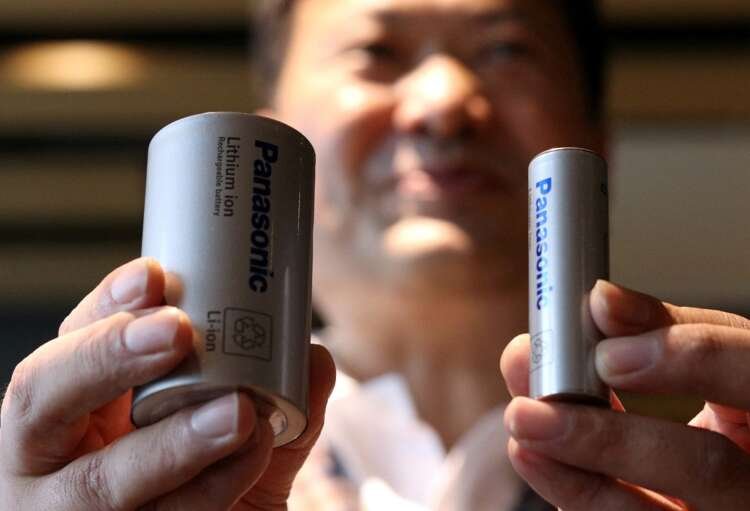
    Kazuo Tadanobu, CEO of Panasonic's Energy Company, holds a prototype of the advanced 4680 battery cell. This innovation is pivotal for enhancing Tesla's electric vehicle range and efficiency, aligning with Panasonic's goal of a 20% increase in battery density by 2030.
    Kazuo Tadanobu of Panasonic showcases 4680 battery prototype, crucial for Tesla EVs - Global Banking & Finance Review
    Why waste money on news and opinion when you can access them for free?

    Take advantage of our newsletter subscription and stay informed on the go!

    Subscribe

    Tags:innovationtechnologysustainabilityinvestment

    By Norihiko Shirouzu

    (Reuters) – Panasonic Energy Co, a major Tesla supplier, is working on new technology to increase battery energy density by a fifth by 2030, the Japanese company’s chief technology officer told Reuters.

    That gain, if achieved, could boost the driving range of a Model Y, for example, by over 100 km (62 miles) with the same size battery pack. Alternatively, it could allow manufacturers to create roomier and possibly lighter electric vehicles (EVs) while keeping driving range unchanged.

    As more automakers roll out EV models, investors are looking for evidence that Tesla and established battery suppliers like Panasonic can keep their lead in the industry. The battery system is the most expensive element of an EV and improved performance and lower costs are seen as key to sustaining gains in global sales.

    Panasonic Energy, a core Panasonic Holdings unit, plans to achieve those gains by using a new mix of additives to allow individual cells to run at a higher voltage without damaging the batteries’ performance, Shoichiro Watanabe said in an interview.

    “The race among battery makers has been to come up with more potent and effective additives,” he said.

    His comments outline for the first time the company’s behind-the-scenes work in improving battery efficiency beyond the most cutting-edge battery technology Panasonic has made available for Tesla today.

    A 20% boost in energy density – essentially the battery’s ability to store energy in a given volume – would likely translate to an energy density of 900 watt-hours per litre (wh/l) for Panasonic’s most advanced cell compared to 750 wh/l today.

    Watanabe said Panasonic planned to achieve that gain over several years but did not say when it would begin to roll out the new chemistry.

    A new larger-format 4680 battery, already being produced by Tesla, is expected to lower production costs and improve range compared to the current-generation 2170 battery, the automaker has said.

    A Panasonic spokeswoman declined to comment on whether the company’s new battery technology would be incorporated into the 4680 or the 2170 or both.

    Tesla did not respond to requests for comment.

    LESS DEGRADATION

    Panasonic, Tesla’s first battery supplier, plans to start mass-producing 4680 batteries in Japan during the financial year starting April 2023 and is reviewing sites for production in the United States. Tesla plans to use 4680 batteries to power new Texas-built Model Y cars.

    Panasonic has developed a way to slow a battery’s degradation at a higher voltage that includes the use of new, more potent additives to the battery’s electrolyte, said Watanabe who is also Panasonic Energy’s executive vice president.

    Higher voltages allow for increased ability to store energy but even small increases have also tended to drive outsized declines in battery performance.

    “Improving energy density by 20% is entirely possible” if Panasonic can deliver on the improvements described, Shirley Meng, a professor at the University of Chicago and chief scientist for the U.S. Argonne National Laboratory’s center for battery science. “I am optimistic about this goal as the research has shown promising data on all those areas.”

    The Argonne National Laboratory works with a number of battery manufacturers. Panasonic’s rivals, which include CATL, LG Energy Solution, Samsung SDI, are also working on technologies that promise to deliver batteries that charge faster, run longer and cost less.

    Panasonic’s current battery cell for Tesla uses a voltage of 4.2 volts, and Watanabe said a boost to 4.3 or 4.4 volts was possible with a new mix of additives to the electrolyte, the chemical soup that separates the negative and positive charged electrodes.

    “If we can get that to 4.5 or 4.6 volts, I think the whole world view in terms of what’s possible for EVs would change,” Watanabe said.

    Panasonic has also developed ways to prevent what engineers call “microcracking,” small cracks that develop in the positive electrode when a battery is charged and discharged, shortening its useful life. One protective measure includes use of so-called “single-crystal materials” for the battery’s positive electrode, he said.

    In addition, Panasonic is working to replace more of the graphite used in battery’s negative electrodes with silicon-based materials to improve that part of the cell, although the trade-off there is the higher cost of silicon, Watanabe said.

    “It’s difficult to balance, but raising the energy density of batteries requires raising the potential of both electrodes,” he said.

    (Reporting by Norihiko Shirouzu in Beijing; Additional reporting by Paul Lienert in Detroit; Editing by Kevin Krolicki and Edwina Gibbs)

    Frequently Asked Questions about Exclusive: Tesla supplier Panasonic eyes 20% jump in battery density by 2030

    1What is battery energy density?

    Battery energy density refers to the amount of energy a battery can store relative to its volume, typically measured in watt-hours per liter (wh/l). Higher energy density allows for longer driving ranges in electric vehicles.

    2What are electric vehicles (EVs)?

    Electric vehicles (EVs) are cars powered by electric motors instead of internal combustion engines. They use rechargeable batteries to store energy and are known for being more environmentally friendly.

    3What is an electric vehicle's driving range?

    An electric vehicle's driving range is the distance it can travel on a single charge of its battery. This range can be affected by battery capacity, vehicle weight, and driving conditions.

    4What are battery additives?

    Battery additives are chemical substances added to battery materials to enhance performance, such as increasing energy density or reducing degradation. They play a crucial role in improving battery efficiency.

    More from Top Stories

    Explore more articles in the Top Stories category

    Image for Lessons From the Ring and the Deal Table: How Boxing Shapes Steven Nigro’s Approach to Banking and Life
    Lessons From the Ring and the Deal Table: How Boxing Shapes Steven Nigro’s Approach to Banking and Life
    Image for Joe Kiani in 2025: Capital, Conviction, and a Focused Return to Innovation
    Joe Kiani in 2025: Capital, Conviction, and a Focused Return to Innovation
    Image for Marco Robinson – CLOSE THE DEAL AND SUDDENLY GROW RICH
    Marco Robinson – CLOSE THE DEAL AND SUDDENLY GROW RICH
    Image for Digital Tracing: Turning a regulatory obligation into a commercial advantage
    Digital Tracing: Turning a regulatory obligation into a commercial advantage
    Image for Exploring the Role of Blockchain and the Bitcoin Price Today in Education
    Exploring the Role of Blockchain and the Bitcoin Price Today in Education
    Image for Inside the World’s First Collection Industry Conglomerate: PCA Global’s Platform Strategy
    Inside the World’s First Collection Industry Conglomerate: PCA Global’s Platform Strategy
    Image for Chase Buchanan Private Wealth Management Highlights Key Autumn 2025 Budget Takeaways for Expats
    Chase Buchanan Private Wealth Management Highlights Key Autumn 2025 Budget Takeaways for Expats
    Image for PayLaju Strengthens Its Position as Malaysia’s Trusted Interest-Free Sharia-Compliant Loan Provider
    PayLaju Strengthens Its Position as Malaysia’s Trusted Interest-Free Sharia-Compliant Loan Provider
    Image for A Notable Update for Employee Health Benefits:
    A Notable Update for Employee Health Benefits:
    Image for Creating Equity Between Walls: How Mohak Chauhan is Using Engineering, Finance, and Community Vision to Reengineer Affordable Housing
    Creating Equity Between Walls: How Mohak Chauhan is Using Engineering, Finance, and Community Vision to Reengineer Affordable Housing
    Image for Upcoming Book on Real Estate Investing: Harvard Grace Capital Founder Stewart Heath’s Puts Lessons in Print
    Upcoming Book on Real Estate Investing: Harvard Grace Capital Founder Stewart Heath’s Puts Lessons in Print
    Image for ELECTIVA MARKS A LANDMARK FIRST YEAR WITH MAJOR SENIOR APPOINTMENTS AND EXPANSION MILESTONES
    ELECTIVA MARKS A LANDMARK FIRST YEAR WITH MAJOR SENIOR APPOINTMENTS AND EXPANSION MILESTONES
    View All Top Stories Posts
    Previous Top Stories PostEuropean shares slip ahead of U.S. inflation; investors focus on euro
    Next Top Stories PostPageGroup profit swells as employers fast-track hiring