Search
00
GBAF Logo
trophy
Top StoriesInterviewsBusinessFinanceBankingTechnologyInvestingTradingVideosAwardsMagazinesHeadlinesTrends

Subscribe to our newsletter

Get the latest news and updates from our team.

Global Banking & Finance Review®

Global Banking & Finance Review® - Subscribe to our newsletter

Company

    GBAF Logo
    • About Us
    • Profile
    • Privacy & Cookie Policy
    • Terms of Use
    • Contact Us
    • Advertising
    • Submit Post
    • Latest News
    • Research Reports
    • Press Release
    • Awards▾
      • About the Awards
      • Awards TimeTable
      • Submit Nominations
      • Testimonials
      • Media Room
      • Award Winners
      • FAQ
    • Magazines▾
      • Global Banking & Finance Review Magazine Issue 79
      • Global Banking & Finance Review Magazine Issue 78
      • Global Banking & Finance Review Magazine Issue 77
      • Global Banking & Finance Review Magazine Issue 76
      • Global Banking & Finance Review Magazine Issue 75
      • Global Banking & Finance Review Magazine Issue 73
      • Global Banking & Finance Review Magazine Issue 71
      • Global Banking & Finance Review Magazine Issue 70
      • Global Banking & Finance Review Magazine Issue 69
      • Global Banking & Finance Review Magazine Issue 66
    Top StoriesInterviewsBusinessFinanceBankingTechnologyInvestingTradingVideosAwardsMagazinesHeadlinesTrends

    Global Banking & Finance Review® is a leading financial portal and online magazine offering News, Analysis, Opinion, Reviews, Interviews & Videos from the world of Banking, Finance, Business, Trading, Technology, Investing, Brokerage, Foreign Exchange, Tax & Legal, Islamic Finance, Asset & Wealth Management.
    Copyright © 2010-2026 GBAF Publications Ltd - All Rights Reserved. | Sitemap | Tags | Developed By eCorpIT

    Editorial & Advertiser disclosure

    Global Banking & Finance Review® is an online platform offering news, analysis, and opinion on the latest trends, developments, and innovations in the banking and finance industry worldwide. The platform covers a diverse range of topics, including banking, insurance, investment, wealth management, fintech, and regulatory issues. The website publishes news, press releases, opinion and advertorials on various financial organizations, products and services which are commissioned from various Companies, Organizations, PR agencies, Bloggers etc. These commissioned articles are commercial in nature. This is not to be considered as financial advice and should be considered only for information purposes. It does not reflect the views or opinion of our website and is not to be considered an endorsement or a recommendation. We cannot guarantee the accuracy or applicability of any information provided with respect to your individual or personal circumstances. Please seek Professional advice from a qualified professional before making any financial decisions. We link to various third-party websites, affiliate sales networks, and to our advertising partners websites. When you view or click on certain links available on our articles, our partners may compensate us for displaying the content to you or make a purchase or fill a form. This will not incur any additional charges to you. To make things simpler for you to identity or distinguish advertised or sponsored articles or links, you may consider all articles or links hosted on our site as a commercial article placement. We will not be responsible for any loss you may suffer as a result of any omission or inaccuracy on the website.

    Home > Top Stories > Exclusive-Germany’s refinery dilemma tests Russian oil ban resolve
    Top Stories

    Exclusive-Germany’s refinery dilemma tests Russian oil ban resolve

    Published by Jessica Weisman-Pitts

    Posted on June 14, 2022

    5 min read

    Last updated: February 6, 2026

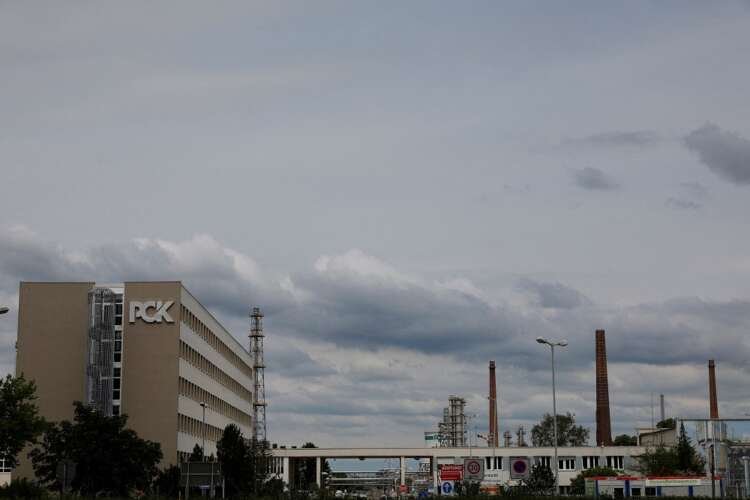
    The image showcases the PCK refinery in Schwedt, Germany, a focal point in the country's efforts to manage its Russian oil imports. This refinery supplies 90% of Berlin's fuel and is central to discussions on energy security amidst the ongoing geopolitical tensions.
    Germany's Schwedt refinery, key to energy supply, facing Russian ownership dilemma - Global Banking & Finance Review
    Why waste money on news and opinion when you can access them for free?

    Take advantage of our newsletter subscription and stay informed on the go!

    Subscribe

    Tags:oil and gasEuropean economiesInternational tradefinancial markets

    Quick Summary

    By Ron Bousso, Marek Strzelecki, Christoph Steitz and Markus Wacket

    By Ron Bousso, Marek Strzelecki, Christoph Steitz and Markus Wacket

    BERLIN (Reuters) – Germany is struggling to find a way to wrest control of a Russian-owned refinery that supplies most of Berlin’s fuel, four people close to the matter said, fearing retaliation by Moscow if the site is nationalised and as Western firms hesitate to step in.

    The PCK refinery in Schwedt, majority-owned by Russian oil giant Rosneft, is testing Germany’s resolve to eliminate imports of oil from Russia by the end of the year under fresh European sanctions to punish Moscow for its invasion of Ukraine.

    The landlocked refinery is the source of 90% of Berlin’s fuel and has received all its crude from Russia via the Druzhba pipeline since the plant was built in the 1960s.

    One solution considered by Germany has been to temporarily hand control of the refinery’s day-to-day operations to British oil major Shell, which owns a 37.5% stake in Schwedt, according to government and company sources.

    Shell, which saw Germany block the sale of its stake in Schwedt to Rosneft last year, is willing to step in as an interim operator, two of the people said, including a company source. But it is neither interested in taking over a larger stake nor being a permanent operator, they said.

    Officials have also sounded out the idea of handing operations to Polish refinery PKN Orlen which could play a key role in efforts to reroute the refinery’s crude supplies away from Russia.

    PKN Orlen and Shell declined to comment. Rosneft, PCK and the Polish government did not immediately reply to requests for comment.

    A spokesperson for Germany’s Economy Ministry, which is in charge of energy, said: “We are working flat out to find a solution. We know the problem and are working on it.”

    Poland insists that Rosneft must be ousted from Schwedt, Germany’s fourth-largest refinery, before a potential deal including state-controlled PKN, the people said.

    Rosneft, meantime, has so far refused to engage with Germany to discuss a sale of its 54.17% stake in Schwedt or any other solutions that could resolve the situation, the people said.

    Italy’s Eni holds the remaining 8.33% and last month confirmed it was in the process of selling it.

    “It’s not trivial to solve this,” German Economy Minister Robert Habeck said on Monday with regard to Schwedt, adding a working group had been set up to discuss its prospects.

    Berlin has the option of taking control of Schwedt from Rosneft or even expropriating the firm, which it can do through energy security legislation recently updated to facilitate nationalisation.

    Expropriation could spark retaliatory steps by Moscow, and the biggest fear in Germany would be that Russia cuts natural gas supplies, the people said. Europe has yet to draw up plans for how to cut dependency on Russian gas.

    (Graphic: https://graphics.reuters.com/UKRAINE-CRISIS/GERMANY-OIL/myvmnqokmpr/chart_eikon.jpg)

    (Graphic: https://fingfx.thomsonreuters.com/gfx/ce/gkplgqkmbvb/Druzhba.png)

    Any alternative crude supply would be costly, putting further pressure on German consumers as Europe’s biggest economy struggles with recessionary risks.

    The EU plans to impose an embargo on 90% of Russian crude oil imports by the year end. The plan excludes landlocked Hungary, Slovakia and the Czech Republic whose refineries get all their feedstock through the Druzhba pipeline from Russia.

    Germany and Poland are gradually increasing crude supplies to Schwedt and the neighbouring TotalEnergies-owned Leuna refinery via other, smaller pipelines from the Baltic ports of Rostock and Gdansk.

    Poland has offered to allocate spare capacity at its oil terminal in Gdansk and could ship sea-borne crude oil via its pipelines from the port to the two German refineries, on the condition Rosneft is removed as an owner of Schwedt.

    The Gdansk terminal has room to receive as much as 36 million tonnes per year, leaving 9 million tonnes on top of the needs of Polish refiners that could be used for Germany.

    Potential cooperation would include coordination of supplies and the types of crude in the pipeline system that feeds Poland’s top refinery in Plock before turning west towards Germany, so that the product yields and refining margins can be maximized.

    While the alternative pipeline supplies, from Norway, the Middle East, the United States and West Africa, are expected to rise in the coming months, they cannot meet the two refineries’ full capacity of a combined 24 million tonnes of oil per year.

    To plug the gap, one measure of last resort that is being considered includes the potential hiring of dozens of tanker trucks to deliver the crude oil from the two ports, two industry sources said.

    For now, Schwedt and Leuna are enjoying unprecedented profit margins.

    The Russian Urals crude delivered via the Druzhba pipeline is priced according to a formula calculating the grade’s average monthly price. Based on a Reuters calculation, that priced the oil at around $35 a barrel below the Brent benchmark.

    While most other European refineries that are no longer buying Russian crude have seen record profits from converting crude oil into gasoline, diesel and jet fuel, the two German refineries’ margins were given a further huge boost by the cheaper crude.

    The margin for Leuna and Schwedt is estimated to be at around $50 to $70 a barrel, according to several industry sources and analysts.

    That translates into a daily profit of between $12 million to $16.8 million per day for each refinery, roughly $8.5 million per day more than a similar sized northwest European refinery which does not process Russian oil.

    (Reporting by Ron Bousso and Shadia Nasralla in London, Marek Strzelecki in Warsaw, Christoph Steitz in Frankfurt, Stephen Jewkes in Milan and Markus Wacket, Andreas Rinke and Christian Kraemer in Berlin; editing by David Evans)

    Frequently Asked Questions about Exclusive-Germany’s refinery dilemma tests Russian oil ban resolve

    1What is a refinery?

    A refinery is an industrial facility that processes crude oil into usable products such as gasoline, diesel, and other petrochemicals.

    2What is energy security?

    Energy security refers to the uninterrupted availability of energy sources at an affordable price, ensuring a stable supply for consumers and industries.

    3What is crude oil?

    Crude oil is a naturally occurring, unrefined petroleum product composed of hydrocarbon deposits and other organic materials, used as a primary energy source.

    4What is the Druzhba pipeline?

    The Druzhba pipeline is one of the world's longest oil pipelines, transporting crude oil from Russia to various countries in Europe.

    More from Top Stories

    Explore more articles in the Top Stories category

    Image for Lessons From the Ring and the Deal Table: How Boxing Shapes Steven Nigro’s Approach to Banking and Life
    Lessons From the Ring and the Deal Table: How Boxing Shapes Steven Nigro’s Approach to Banking and Life
    Image for Joe Kiani in 2025: Capital, Conviction, and a Focused Return to Innovation
    Joe Kiani in 2025: Capital, Conviction, and a Focused Return to Innovation
    Image for Marco Robinson – CLOSE THE DEAL AND SUDDENLY GROW RICH
    Marco Robinson – CLOSE THE DEAL AND SUDDENLY GROW RICH
    Image for Digital Tracing: Turning a regulatory obligation into a commercial advantage
    Digital Tracing: Turning a regulatory obligation into a commercial advantage
    Image for Exploring the Role of Blockchain and the Bitcoin Price Today in Education
    Exploring the Role of Blockchain and the Bitcoin Price Today in Education
    Image for Inside the World’s First Collection Industry Conglomerate: PCA Global’s Platform Strategy
    Inside the World’s First Collection Industry Conglomerate: PCA Global’s Platform Strategy
    Image for Chase Buchanan Private Wealth Management Highlights Key Autumn 2025 Budget Takeaways for Expats
    Chase Buchanan Private Wealth Management Highlights Key Autumn 2025 Budget Takeaways for Expats
    Image for PayLaju Strengthens Its Position as Malaysia’s Trusted Interest-Free Sharia-Compliant Loan Provider
    PayLaju Strengthens Its Position as Malaysia’s Trusted Interest-Free Sharia-Compliant Loan Provider
    Image for A Notable Update for Employee Health Benefits:
    A Notable Update for Employee Health Benefits:
    Image for Creating Equity Between Walls: How Mohak Chauhan is Using Engineering, Finance, and Community Vision to Reengineer Affordable Housing
    Creating Equity Between Walls: How Mohak Chauhan is Using Engineering, Finance, and Community Vision to Reengineer Affordable Housing
    Image for Upcoming Book on Real Estate Investing: Harvard Grace Capital Founder Stewart Heath’s Puts Lessons in Print
    Upcoming Book on Real Estate Investing: Harvard Grace Capital Founder Stewart Heath’s Puts Lessons in Print
    Image for ELECTIVA MARKS A LANDMARK FIRST YEAR WITH MAJOR SENIOR APPOINTMENTS AND EXPANSION MILESTONES
    ELECTIVA MARKS A LANDMARK FIRST YEAR WITH MAJOR SENIOR APPOINTMENTS AND EXPANSION MILESTONES
    View All Top Stories Posts
    Previous Top Stories PostGerman finance minister praises Greek reforms, says must continue
    Next Top Stories PostIn hottest city on Earth, mothers bear brunt of climate change