
Top Stories
European Shares Fall as Sap Drags, Investors Await U.S. Data, ECB
Published by Jessica Weisman-Pitts
Posted on September 12, 2023
3 min readLast updated: January 31, 2026
Add as preferred source on Google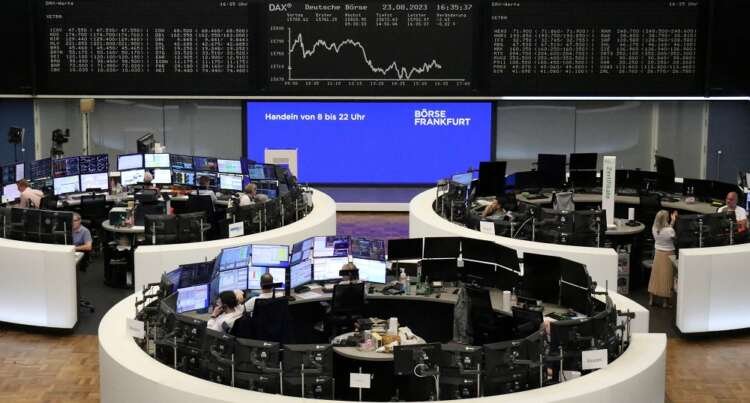
Published by Jessica Weisman-Pitts
Posted on September 12, 2023
3 min readLast updated: January 31, 2026
Add as preferred source on GoogleBy Bansari Mayur Kamdar and Shashwat Chauhan
(Reuters) -European shares fell on Tuesday, dragged down by German software maker SAP following a weak forecast from U.S. tech firm Oracle, while investors turned cautious ahead of U.S. inflation data and the European Central Bank’s rate decision later this week.
The pan-European STOXX 600 index dipped 0.2%, with basic resources losing 0.5% as prices of most base metals fell on a stronger dollar. [MET/L]
Germany’s DAX lost 0.5% with SAP down 1.8% after its U.S. peer Oracle projected current-quarter revenue below Wall Street targets as tough economic conditions pressured cloud spending by businesses.
Britain’s FTSE 100 was an outlier, rising 0.4%, supported by a softer pound after data showed the labour market weakened even as wage growth stayed strong in July, painting an unclear picture ahead of the Bank of England’s interest rate decision next week.
“The good news is that real pay growth is picking up, providing some relief for working households after 19 months of annual contraction … the bad news is that inflation pressures are still with us,” said Elizabeth Martins, senior economist at HSBC.
“Whatever the reason, rising unemployment and falling employment will raise questions about the theory of labour hoarding, on which much of the remaining optimism for the UK economy is resting.”
Spain’s national consumer prices rose 2.6% in the year through August, while a survey from the ZEW economic research institute showed German investor sentiment unexpectedly improved in September.
Money market traders slowly increased their bets of another interest rate hike by the ECB heading into the central bank’s monetary policy decision on Thursday. [GVD/EUR]
Traders have priced in a 50% chance the ECB will hike rates by 25 basis points to 4% on Thursday.
Investors are also awaiting U.S. inflation data on Wednesday which could help shape expectations around global interest rates peaking.
Among individual movers, Airbus eased 2.4% after engine supplier Pratt & Whitney warned about a rare manufacturing flaw that could ground hundreds of Airbus jets at any one time in coming years.
Associated British Foods jumped 5.3% after the Primark owner raised its full-year profit outlook for the second time in four months, underpinned by strong trading at its fast-fashion clothing and food operations.
Ireland-based Smurfit Kappa tanked 10.2% after the company agreed to combine with WestRock, to create one of the world’s largest paper and packaging producers worth nearly $20 billion.
HelloFresh jumped 8.2% after J.P. Morgan added the German meal-kit maker’s stock to its analyst focus list (AFL) and positive catalyst watch.
(Reporting by Bansari Mayur Kamdar and Shashwat Chauhan in Bengaluru; Editing by Sherry Jacob-Phillips, Rashmi Aich and Emelia Sithole-Matarise)
Inflation is the rate at which the general level of prices for goods and services rises, eroding purchasing power. Central banks attempt to limit inflation to keep the economy running smoothly.
A central bank is a financial institution that manages a country's currency, money supply, and interest rates. It oversees the banking system and implements monetary policy.
A stock index is a measurement of the performance of a group of stocks, representing a particular market or sector. Examples include the DAX and FTSE 100.
Monetary policy is the process by which a central bank controls the supply of money, often targeting an inflation rate or interest rate to ensure price stability and trust in the currency.
Explore more articles in the Top Stories category











