Search
00
GBAF Logo
trophy
Top StoriesInterviewsBusinessFinanceBankingTechnologyInvestingTradingVideosAwardsMagazinesHeadlinesTrends

Subscribe to our newsletter

Get the latest news and updates from our team.

Global Banking & Finance Review®

Global Banking & Finance Review® - Subscribe to our newsletter

Company

    GBAF Logo
    • About Us
    • Profile
    • Privacy & Cookie Policy
    • Terms of Use
    • Contact Us
    • Advertising
    • Submit Post
    • Latest News
    • Research Reports
    • Press Release
    • Awards▾
      • About the Awards
      • Awards TimeTable
      • Submit Nominations
      • Testimonials
      • Media Room
      • Award Winners
      • FAQ
    • Magazines▾
      • Global Banking & Finance Review Magazine Issue 79
      • Global Banking & Finance Review Magazine Issue 78
      • Global Banking & Finance Review Magazine Issue 77
      • Global Banking & Finance Review Magazine Issue 76
      • Global Banking & Finance Review Magazine Issue 75
      • Global Banking & Finance Review Magazine Issue 73
      • Global Banking & Finance Review Magazine Issue 71
      • Global Banking & Finance Review Magazine Issue 70
      • Global Banking & Finance Review Magazine Issue 69
      • Global Banking & Finance Review Magazine Issue 66
    Top StoriesInterviewsBusinessFinanceBankingTechnologyInvestingTradingVideosAwardsMagazinesHeadlinesTrends

    Global Banking & Finance Review® is a leading financial portal and online magazine offering News, Analysis, Opinion, Reviews, Interviews & Videos from the world of Banking, Finance, Business, Trading, Technology, Investing, Brokerage, Foreign Exchange, Tax & Legal, Islamic Finance, Asset & Wealth Management.
    Copyright © 2010-2026 GBAF Publications Ltd - All Rights Reserved. | Sitemap | Tags | Developed By eCorpIT

    Editorial & Advertiser disclosure

    Global Banking & Finance Review® is an online platform offering news, analysis, and opinion on the latest trends, developments, and innovations in the banking and finance industry worldwide. The platform covers a diverse range of topics, including banking, insurance, investment, wealth management, fintech, and regulatory issues. The website publishes news, press releases, opinion and advertorials on various financial organizations, products and services which are commissioned from various Companies, Organizations, PR agencies, Bloggers etc. These commissioned articles are commercial in nature. This is not to be considered as financial advice and should be considered only for information purposes. It does not reflect the views or opinion of our website and is not to be considered an endorsement or a recommendation. We cannot guarantee the accuracy or applicability of any information provided with respect to your individual or personal circumstances. Please seek Professional advice from a qualified professional before making any financial decisions. We link to various third-party websites, affiliate sales networks, and to our advertising partners websites. When you view or click on certain links available on our articles, our partners may compensate us for displaying the content to you or make a purchase or fill a form. This will not incur any additional charges to you. To make things simpler for you to identity or distinguish advertised or sponsored articles or links, you may consider all articles or links hosted on our site as a commercial article placement. We will not be responsible for any loss you may suffer as a result of any omission or inaccuracy on the website.

    Home > Top Stories > EU regulator backs two Omicron-adapted COVID boosters
    Top Stories

    EU regulator backs two Omicron-adapted COVID boosters

    Published by Uma Rajagopal

    Posted on September 2, 2022

    4 min read

    Last updated: February 4, 2026

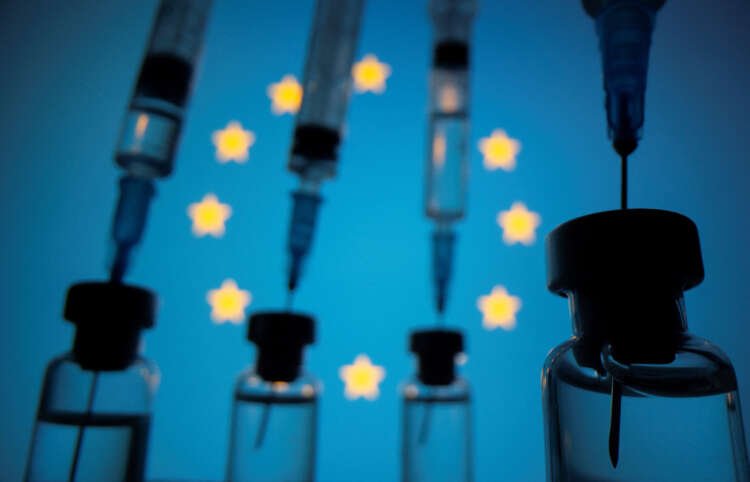
    Illustration of COVID-19 vaccine vials and syringes in front of the EU flag, highlighting the EU's support for Omicron-adapted boosters by Pfizer and Moderna.
    Vials and syringes in front of the EU flag, representing COVID-19 vaccine boosters - Global Banking & Finance Review
    Why waste money on news and opinion when you can access them for free?

    Take advantage of our newsletter subscription and stay informed on the go!

    Subscribe

    Tags:Public HealthEuropean Commission

    By Natalie Grover and Ludwig Burger

    (Reuters) -The European Union’s drug regulator on Thursday backed two separate COVID-19 vaccine boosters updated to target the Omicron variant, ahead of an anticipated rise in infections this winter.

    Developed by Moderna and the team of Pfizer and BioNTech, the new so-called bivalent shots combat the BA.1 version of Omicron and the original virus first detected in China.

    The European Medicines Agency (EMA) recommendation is to authorise the vaccines for people aged 12 and above who have received at least primary vaccination against COVID. The final go-ahead will be subject to European Commission approval, which is expected to come in shortly.

    The companies are expected to start supplying their Omicron-adapted vaccines within days of EU approval, European member of parliament (MEP) Peter Liese said on Wednesday.

    Britain in August became the first country to clear the Moderna bivalent shot. Switzerland and Australia quickly followed suit.

    Pfizer’s retooled booster targeting the currently dominant BA.4/BA.5 variants has already been submitted for EU review, while Moderna’s submission for a similar shot is imminent.

    The EMA is also expected to offer its opinion on BA.4/5 adapted vaccines in the coming weeks, European Commissioner for Health and Food Safety Stella Kyriakides said in a statement on Thursday.

    While existing coronavirus vaccines continue to provide good protection against hospitalisation and death, their effectiveness has taken a hit as the virus has evolved.

    EU officials signalled in recent months they were open to initially using shots targeting the older BA.1 variant, given those specifically targeting newer Omicron offshoots BA.4/5 are further behind in development.

    In contrast, the U.S. Food and Drug Administration (FDA) insisted it was only interested in vaccines targeting BA.4 and BA.5. On Wednesday, Pfizer-BioNTech and Moderna secured U.S. approval for those shots.

    Given BA.1 emerged first, data from human trials testing the adapted vaccines from sets of developers has been submitted to EU regulators. For the BA.4/5 adapted vaccines, submissions to U.S. regulators are based on lab and animal data.

    Using animal and lab data to solicit regulatory approval for retooled vaccines is not without precedent – it is done regularly for flu vaccines that are revamped each year to combat new variants.

    CONTRACTS, RISKS

    In 2021, Pfizer and BioNTech entered an EU supply agreement for up to 1.8 billion doses of their COVID vaccines. Moderna also signed a contract last year for up to 300 million doses with the Commisson, which was expanded this July to cover 15 million more doses.

    Under each contract, companies can switch to supplying the adapted shots as soon as they are cleared by regulators.

    With many European countries already saddled with leftover vaccines, only a fraction of these contracts have been fulfilled so far: 336 million doses of the Pfizer-BioNTech vaccine have been delivered, while Moderna has provided 179 million doses, according to EU data.

    In a statement on Wednesday, MEP Liese said Moderna would provide the EU with 70 million vaccine doses in the first two months post approval, and eight to 11 million should be available as early as the first week of September.

    Up to 29 million doses of the vaccine made by Pfizer-BioNTech are expected to be delivered to Germany alone in September, he added.

    In recent months, European countries had been encouraged to roll out second boosters of the established original vaccines, mainly for the vulnerable and elderly, following a rise in infections over the summer as protection waned due to the domination of BA.4/BA.5.

    Public health experts continue to say vaccines – whether older or updated – are a key component to limiting severe disease and death due to COVID.

    But uptake of the updated vaccines could be limited, as people have become less worried about the disease, thanks in large part to the success of first generation of shots.

    “The challenge is, of course, that people feel the pandemic is mainly over,” Liese told Reuters ahead of the EMA decision on Thursday.

    (Reporting by Natalie Grover and Ludwig Burger; additional reporting by Francesco GuarascioEditing by Josephine Mason, Jason Neely, Frances Kerry and Andrew Heavens)

    Frequently Asked Questions about EU regulator backs two Omicron-adapted COVID boosters

    1What is a bivalent vaccine?

    A bivalent vaccine is designed to provide immunity against two different strains of a virus. In this case, the new COVID-19 boosters target both the original virus and the Omicron variant.

    2What is the European Medicines Agency (EMA)?

    The European Medicines Agency (EMA) is a regulatory body in the European Union responsible for the scientific evaluation, supervision, and safety monitoring of medicines, including vaccines.

    3What is the role of the European Commission in vaccine approval?

    The European Commission is responsible for making the final decision on the authorization of vaccines in the EU, following recommendations from the EMA.

    4What are Omicron variants BA.4 and BA.5?

    BA.4 and BA.5 are subvariants of the Omicron strain of the COVID-19 virus, which have shown to be more transmissible than earlier variants.

    More from Top Stories

    Explore more articles in the Top Stories category

    Image for Lessons From the Ring and the Deal Table: How Boxing Shapes Steven Nigro’s Approach to Banking and Life
    Lessons From the Ring and the Deal Table: How Boxing Shapes Steven Nigro’s Approach to Banking and Life
    Image for Joe Kiani in 2025: Capital, Conviction, and a Focused Return to Innovation
    Joe Kiani in 2025: Capital, Conviction, and a Focused Return to Innovation
    Image for Marco Robinson – CLOSE THE DEAL AND SUDDENLY GROW RICH
    Marco Robinson – CLOSE THE DEAL AND SUDDENLY GROW RICH
    Image for Digital Tracing: Turning a regulatory obligation into a commercial advantage
    Digital Tracing: Turning a regulatory obligation into a commercial advantage
    Image for Exploring the Role of Blockchain and the Bitcoin Price Today in Education
    Exploring the Role of Blockchain and the Bitcoin Price Today in Education
    Image for Inside the World’s First Collection Industry Conglomerate: PCA Global’s Platform Strategy
    Inside the World’s First Collection Industry Conglomerate: PCA Global’s Platform Strategy
    Image for Chase Buchanan Private Wealth Management Highlights Key Autumn 2025 Budget Takeaways for Expats
    Chase Buchanan Private Wealth Management Highlights Key Autumn 2025 Budget Takeaways for Expats
    Image for PayLaju Strengthens Its Position as Malaysia’s Trusted Interest-Free Sharia-Compliant Loan Provider
    PayLaju Strengthens Its Position as Malaysia’s Trusted Interest-Free Sharia-Compliant Loan Provider
    Image for A Notable Update for Employee Health Benefits:
    A Notable Update for Employee Health Benefits:
    Image for Creating Equity Between Walls: How Mohak Chauhan is Using Engineering, Finance, and Community Vision to Reengineer Affordable Housing
    Creating Equity Between Walls: How Mohak Chauhan is Using Engineering, Finance, and Community Vision to Reengineer Affordable Housing
    Image for Upcoming Book on Real Estate Investing: Harvard Grace Capital Founder Stewart Heath’s Puts Lessons in Print
    Upcoming Book on Real Estate Investing: Harvard Grace Capital Founder Stewart Heath’s Puts Lessons in Print
    Image for ELECTIVA MARKS A LANDMARK FIRST YEAR WITH MAJOR SENIOR APPOINTMENTS AND EXPANSION MILESTONES
    ELECTIVA MARKS A LANDMARK FIRST YEAR WITH MAJOR SENIOR APPOINTMENTS AND EXPANSION MILESTONES
    View All Top Stories Posts
    Previous Top Stories PostSterling slides below $1.15 for first time since 2020
    Next Top Stories PostHigh inflation is bad for UK productivity – BoE’s Mann