
Top Stories
ECB’s Centeno Says Rate Cycle Likely Completed, Inflation Retreating
Published by Uma Rajagopal
Posted on October 4, 2023
2 min readLast updated: January 31, 2026
Add as preferred source on Google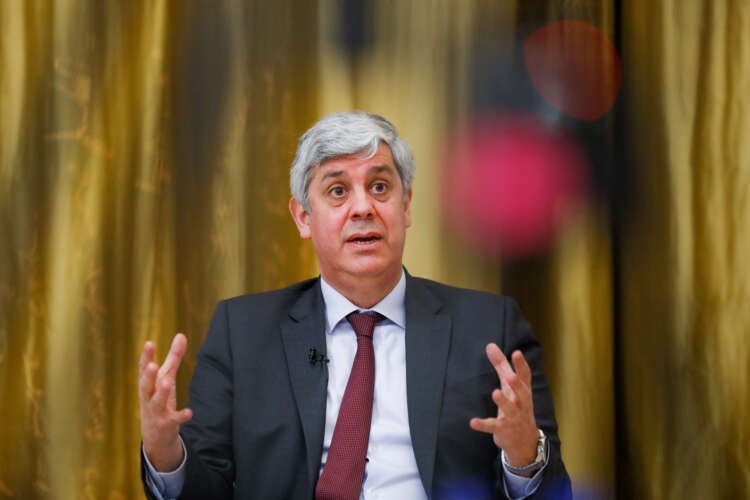
Published by Uma Rajagopal
Posted on October 4, 2023
2 min readLast updated: January 31, 2026
Add as preferred source on GoogleLISBON (Reuters) -The cycle of interest rate hikes by the European Central Bank has likely come to an end as inflation across the
LISBON (Reuters) -The cycle of interest rate hikes by the European Central Bank has likely come to an end as inflation across the euro zone is retreating faster then it rose, ECB Governing Council member Mario Centeno said on Wednesday.
“We can expect that the rate cycle has been completed by now, and with present conditions,” he told reporters in Lisbon.
He said the ECB’s September decision “brought the necessary predictability of monetary policy, by explicitly mentioning that the current level of interest rates is compatible with the convergence of inflation in the medium term towards the objective” of 2%.
The ECB has raised rates at each of its past ten meetings but signalled a pause for October, fuelling a debate among policymakers over whether the monetary authority was done hiking rates or if further tightening was on the table.
Centeno warned that even as the ECB’s nominal interest rates could now remain stable due to declining inflation, real interest rates that directly impact companies, households and economies were still expected to increase, requiring “some caution with decisions in the near future”.
“The transmission of monetary policy is delayed in time, takes time to happen and does not impact all countries in the same way at the same time,” Centeno added.
(Reporting by Sergio Goncalves, edititng by Andrei Khalip, Bernadette Baum and Sharon Singleton)
q1
Monetary policy refers to the actions taken by a central bank to manage the money supply and interest rates to achieve macroeconomic objectives such as controlling inflation, consumption, growth, and liquidity.
The European Central Bank (ECB) is the central bank for the euro and is responsible for monetary policy within the Eurozone, aiming to maintain price stability and oversee the banking system.
Interest rates are the cost of borrowing money or the return on savings, expressed as a percentage of the principal amount. They are influenced by central bank policies and economic conditions.
Inflation is the rate at which the general level of prices for goods and services rises, eroding purchasing power. It is typically measured by the Consumer Price Index (CPI).
A central bank is a national institution that manages a country’s currency, money supply, and interest rates. It also oversees the banking system and implements monetary policy.
Explore more articles in the Top Stories category











