
Top Stories
ECB Sees Sequence of Moves to Lift Rates Into Positive Territory: Lane
Published by Wanda Rich
Posted on May 5, 2022
2 min readLast updated: February 7, 2026
Add as preferred source on Google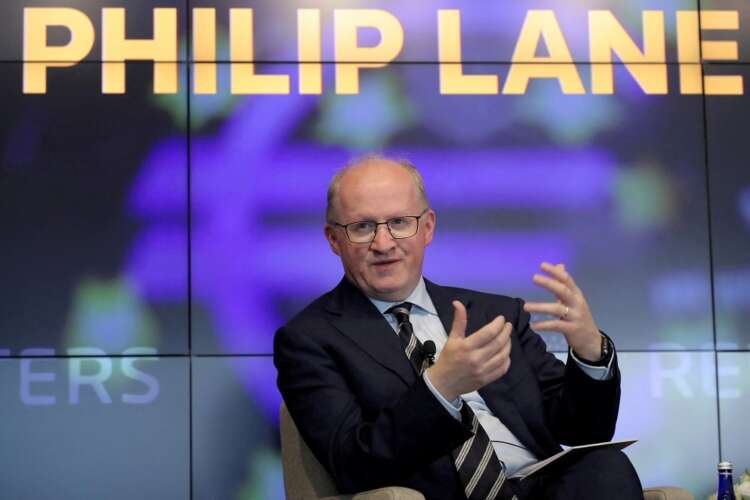
Published by Wanda Rich
Posted on May 5, 2022
2 min readLast updated: February 7, 2026
Add as preferred source on GoogleFRANKFURT (Reuters) -The European Central Bank is preparing for a sequence of rate hikes that will put its benchmark rate in positive territory, but the path it takes is more important than the exact date of the first move,
FRANKFURT (Reuters) -The European Central Bank is preparing for a sequence of rate hikes that will put its benchmark rate in positive territory, but the path it takes is more important than the exact date of the first move, ECB chief economist Philip Lane said on Thursday.
With inflation soaring to a record high 7.5% last month, policymakers have advocated a quicker exit from stimulus and several, including board member Isabel Schnabel, have made the case for a move as soon as July.
“I think it’s clear that at some point we’re going to be moving rates, not just once, but over time, in a sequence,” Lane told the Bruegel think tank. “When exactly will that start?… It should not be seen as the most important issue.”
Lane argued that the overall path of policy normalisation is more relevant as is the definition of the neutral rate, a level where the bank is neither stimulating nor holding back the economy.
“Minus 0.5% (deposit rate) is not in line with the 2% inflation target,” Lane said. “If we believe that inflation is going to be stable around 2%, minus 0.5 is not consistent, zero is not consistent. We know normalisation will be more than that.”
But he also made the case for gradual moves, especially since wage growth, a necessary condition for durable inflation, is still relatively muted, pointing to inflation settling at around the ECB’s 2% target, instead of overshooting it.
The latest wage deals in the euro zone show employers and unions believe the current spike in inflation will prove temporary, Lane added.
“The front-loaded nature of recent wage settlements (with 2022 increases larger than 2023 increases) suggests that wage-setters understand that there is a temporary component to the currently high inflation rate,” Lane said.
He noted wage agreements concluded since the start of this year pointed to wage growth of around 3 per cent in 2022 and 2.5 per cent in 2023.
(Reporting By Francesco Canepa and Balazs Koranyi; Editing by Andrew Heavens)
The European Central Bank (ECB) is the central bank for the euro and administers monetary policy within the Eurozone, aiming to maintain price stability and oversee the banking system.
Inflation is the rate at which the general level of prices for goods and services rises, eroding purchasing power. It is often measured by the Consumer Price Index (CPI).
Monetary policy refers to the actions taken by a central bank to manage the money supply and interest rates to achieve macroeconomic objectives such as controlling inflation and stabilizing currency.
A benchmark interest rate is a standard interest rate used by banks to set rates for loans and savings. It influences economic activity by affecting borrowing and spending.
A deposit rate is the interest rate paid by banks to deposit account holders. It reflects the cost of borrowing money from depositors and can influence overall savings rates.
Explore more articles in the Top Stories category











