Search
00
GBAF Logo
trophy
Top StoriesInterviewsBusinessFinanceBankingTechnologyInvestingTradingVideosAwardsMagazinesHeadlinesTrends

Subscribe to our newsletter

Get the latest news and updates from our team.

Global Banking and Finance Review

Global Banking and Finance Review - Subscribe to our newsletter

Company

    GBAF Logo
    • About Us
    • Profile
    • Privacy & Cookie Policy
    • Terms of Use
    • Contact Us
    • Advertising
    • Submit Post
    • Latest News
    • Research Reports
    • Press Release
    • Awards▾
      • About the Awards
      • Awards TimeTable
      • Submit Nominations
      • Testimonials
      • Media Room
      • Award Winners
      • FAQ
    • Magazines▾
      • Global Banking & Finance Review Magazine Issue 79
      • Global Banking & Finance Review Magazine Issue 78
      • Global Banking & Finance Review Magazine Issue 77
      • Global Banking & Finance Review Magazine Issue 76
      • Global Banking & Finance Review Magazine Issue 75
      • Global Banking & Finance Review Magazine Issue 73
      • Global Banking & Finance Review Magazine Issue 71
      • Global Banking & Finance Review Magazine Issue 70
      • Global Banking & Finance Review Magazine Issue 69
      • Global Banking & Finance Review Magazine Issue 66
    Top StoriesInterviewsBusinessFinanceBankingTechnologyInvestingTradingVideosAwardsMagazinesHeadlinesTrends

    Global Banking & Finance Review® is a leading financial portal and online magazine offering News, Analysis, Opinion, Reviews, Interviews & Videos from the world of Banking, Finance, Business, Trading, Technology, Investing, Brokerage, Foreign Exchange, Tax & Legal, Islamic Finance, Asset & Wealth Management.
    Copyright © 2010-2026 GBAF Publications Ltd - All Rights Reserved. | Sitemap | Tags | Developed By eCorpIT

    Editorial & Advertiser disclosure

    Global Banking and Finance Review is an online platform offering news, analysis, and opinion on the latest trends, developments, and innovations in the banking and finance industry worldwide. The platform covers a diverse range of topics, including banking, insurance, investment, wealth management, fintech, and regulatory issues. The website publishes news, press releases, opinion and advertorials on various financial organizations, products and services which are commissioned from various Companies, Organizations, PR agencies, Bloggers etc. These commissioned articles are commercial in nature. This is not to be considered as financial advice and should be considered only for information purposes. It does not reflect the views or opinion of our website and is not to be considered an endorsement or a recommendation. We cannot guarantee the accuracy or applicability of any information provided with respect to your individual or personal circumstances. Please seek Professional advice from a qualified professional before making any financial decisions. We link to various third-party websites, affiliate sales networks, and to our advertising partners websites. When you view or click on certain links available on our articles, our partners may compensate us for displaying the content to you or make a purchase or fill a form. This will not incur any additional charges to you. To make things simpler for you to identity or distinguish advertised or sponsored articles or links, you may consider all articles or links hosted on our site as a commercial article placement. We will not be responsible for any loss you may suffer as a result of any omission or inaccuracy on the website.

    Home > Banking > ECB raises interest rates again, cuts bank subsidies
    Banking

    ECB raises interest rates again, cuts bank subsidies

    Published by Jessica Weisman-Pitts

    Posted on October 27, 2022

    5 min read

    Last updated: February 3, 2026

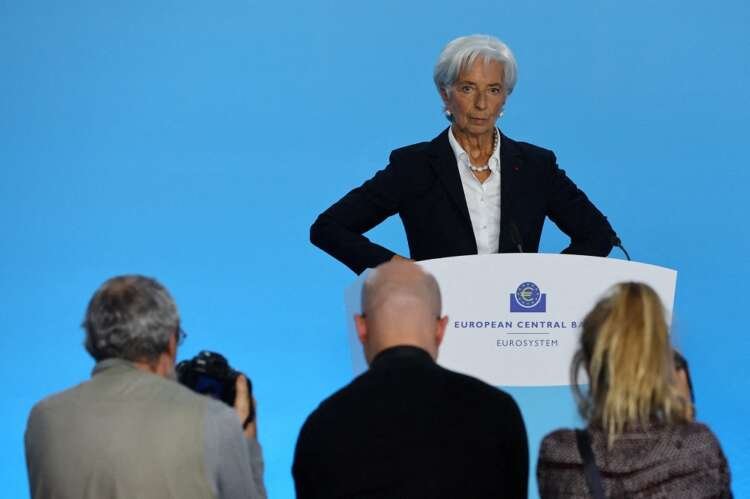
    Christine Lagarde, President of the European Central Bank, addresses the media in Frankfurt regarding the recent interest rate hikes and policy changes aimed at combating inflation in the eurozone.
    ECB President Christine Lagarde speaks at a news conference on interest rate hikes - Global Banking & Finance Review
    Why waste money on news and opinion when you can access them for free?

    Take advantage of our newsletter subscription and stay informed on the go!

    Subscribe

    Tags:monetary policyinterest ratesEuropean Central Bankfinancial markets

    By Balazs Koranyi and Francesco Canepa

    FRANKFURT (Reuters) – The European Central Bank raised interest rates again on Thursday and announced it was changing the terms of its ultra-cheap loans to commercial banks in a bid to shrink its bloated balance sheet and fight off a historic surge in inflation.

    Worried that rapid price growth is becoming entrenched, the ECB is raising borrowing costs at the fastest pace on record, with further hikes almost certain as unwinding a decade’s worth of stimulus will take it well into next year and beyond.

    The central bank for the 19 countries that use the euro raised its deposit rate by a further 75 basis points to 1.5% – the highest rate since 2009. Until as recently as July, ECB rates had been in negative territory for eight years.

    “The Governing Council took today’s decision, and expects to raise interest rates further, to ensure the timely return of inflation to its 2% medium-term inflation target,” the ECB said in a statement.

    The euro dropped and European government bond yields slid after the announcement, which was in line with market expectations.

    At a news conference, ECB President Christine Lagarde noted that while the Ukraine war and other global uncertainties meant the euro area economy faced a number of risks to the downside, inflation risks were skewed upwards.

    “Incoming wage data and recent wage agreements indicate that the growth of wages may be picking up,” she said of the possible emergence of future wage-price spirals, stressing the bank was monitoring expectations about long-term inflation.

    Markets expect the pace of the hikes to slow somewhat, with the deposit rate hitting 2% in December, then peaking at around 3% some time in 2023, although the unusually volatile outlook makes this timeline prone to changes.

    Asked about concerns expressed by some euro zone governments that the ECB’s rate hikes could throw the region into recession, Lagarde said the ECB had a mandate to fight inflation and urged governments to carefully target any support for citizens through the energy crisis so as not to make inflation worse.

    “Everyone has to do their job. Our job is price stability,” she said. “We have to do what we have to do. A central bank has to focus on its mandate.”

    The ECB offered no hints for now about plans to start winding down its bond holdings, after hoovering up trillions of euros of debt issued by euro zone governments since 2015.

    GRAPHIC – ECB hikes policy rate by another 75bps

    https://graphics.reuters.com/GLOBAL-CENTRALBANKS/xmvjkgndjpr/chart.png

    BALANCE SHEET

    With euro zone inflation hitting 9.9%, the ECB also took the first step toward shrinking its 8.8 trillion euro balance sheet, a move that is likely to raise borrowing costs further and may act as a sort of disguised rate hike.

    In a move which may be fought commercial banks, it curbed the subsidy it provides to such lenders through 2.1 trillion euros worth of ultra-cheap three-year loans called Targeted Longer-Term Refinancing Operations, or TLTROs.

    “In view of the unexpected and extraordinary rise in inflation, it (TLTRO) needs to be recalibrated to ensure that it is consistent with the broader monetary policy normalisation process and to reinforce the transmission of policy rate increases to bank lending conditions,” the ECB said.

    It said the interest rate on TLTRO operations will in future be indexed to the average applicable key ECB interest rates, which will encourage early repayment of the loans.

    “Making the terms of TLTRO loans to banks more expensive signals a preference to start shrinking this part of the balance sheet more quickly, especially as the cost of paying interest on bank reserves increases,” said Charles Seville, Senior Director, Fitch Ratings.

    The ECB said further pricing details would be made available at 1345 GMT. In another change, the ECB also said that minimum reserves would be remunerated at the deposit rate, rather than the main rate, which is 50 basis point higher.

    GRAPHIC – The race to raise rates

    https://graphics.reuters.com/GLOBAL-MARKETS/byvrloqyove/chart.png

    Having borrowed at zero or even negative rates at a time when the ECB’s main worry was persistently low inflation, banks can now simply park TLTRO cash with the ECB and enjoy a risk-free return that rises with each deposit rate hike.

    This is politically contentious in itself, but an abundance of liquidity is also keeping money market rates depressed and preventing the ECB’s rate hikes from being fully passed through via the banks to businesses and households.

    The biggest chunk of TLTRO loans, worth around 1.5 trillion euros, expire next June. Thursday’s changes may encourage banks to repay them as soon as December, shrinking the ECB’s balance sheet in the process.

    The bank confirmed its guidance on reinvestments of bonds maturing in its bond buying schemes, confounding some expectations for a small change that would hint at a wind down of the Asset Purchase Programme next year.

    (Editing by Hugh Lawson and Catherine Evans)

    Frequently Asked Questions about ECB raises interest rates again, cuts bank subsidies

    1What is the European Central Bank?

    The European Central Bank (ECB) is the central bank for the eurozone, responsible for monetary policy and maintaining price stability across the 19 countries that use the euro.

    2What are interest rates?

    Interest rates are the cost of borrowing money, expressed as a percentage of the amount borrowed. They influence economic activity by affecting consumer spending and investment.

    3What is inflation?

    Inflation is the rate at which the general level of prices for goods and services rises, eroding purchasing power. Central banks aim to control inflation to maintain economic stability.

    4What are bank subsidies?

    Bank subsidies are financial support provided by central banks to commercial banks, often in the form of low-interest loans, to encourage lending and stabilize the financial system.

    5What is monetary policy?

    Monetary policy refers to the actions taken by a central bank to manage the money supply and interest rates to achieve macroeconomic goals such as controlling inflation and stabilizing the currency.

    More from Banking

    Explore more articles in the Banking category

    Image for Idle Stablecoins Are Becoming a Systemic Efficiency Problem — and Banks Should Pay Attention
    Idle Stablecoins Are Becoming a Systemic Efficiency Problem — and Banks Should Pay Attention
    Image for Banking Without Boundaries: A More Practical Approach to Global Banking
    Banking Without Boundaries: A More Practical Approach to Global Banking
    Image for Lessons From the Ring and the Deal Table: How Boxing Shapes Steven Nigro’s Approach to Banking and Life
    Lessons From the Ring and the Deal Table: How Boxing Shapes Steven Nigro’s Approach to Banking and Life
    Image for The Key to Unlocking ROI from GenAI
    The Key to Unlocking ROI from GenAI
    Image for The Changing Landscape of Small Business Lending: What Traditional Finance Models Miss
    The Changing Landscape of Small Business Lending: What Traditional Finance Models Miss
    Image for VestoFX.net Expands Education-Oriented Content as Focus on Risk Awareness Grows in CFD Trading
    VestoFX.net Expands Education-Oriented Content as Focus on Risk Awareness Grows in CFD Trading
    Image for The Hybrid Banking Model That Digital-Only Providers Cannot Match
    The Hybrid Banking Model That Digital-Only Providers Cannot Match
    Image for INTERPOLITAN MONEY ANNOUNCES RECORD GROWTH ACROSS 2025
    INTERPOLITAN MONEY ANNOUNCES RECORD GROWTH ACROSS 2025
    Image for Alter Bank Wins Two Prestigious Awards in the 2025 Global Banking & Finance Awards®
    Alter Bank Wins Two Prestigious Awards in the 2025 Global Banking & Finance Awards®
    Image for CIBC wins two Global Banking and Finance Awards for student banking
    CIBC wins two Global Banking and Finance Awards for student banking
    Image for DeFi and banking are converging. Here’s what banks can do.
    DeFi and banking are converging. Here’s what banks can do.
    Image for Are Neo Banks Offering Better Metal Debit Cards Than Traditional Banks?
    Are Neo Banks Offering Better Metal Debit Cards Than Traditional Banks?
    View All Banking Posts
    Previous Banking PostLagarde comments at ECB press conference
    Next Banking PostECB gets rid of subsidy on bank loans to mop up cash