
Top Stories
ECB Must Be Prudent With Rates Hikes as Recession Risk Rises: Panetta
Published by Wanda Rich
Posted on August 23, 2022
2 min readLast updated: February 4, 2026
Add as preferred source on Google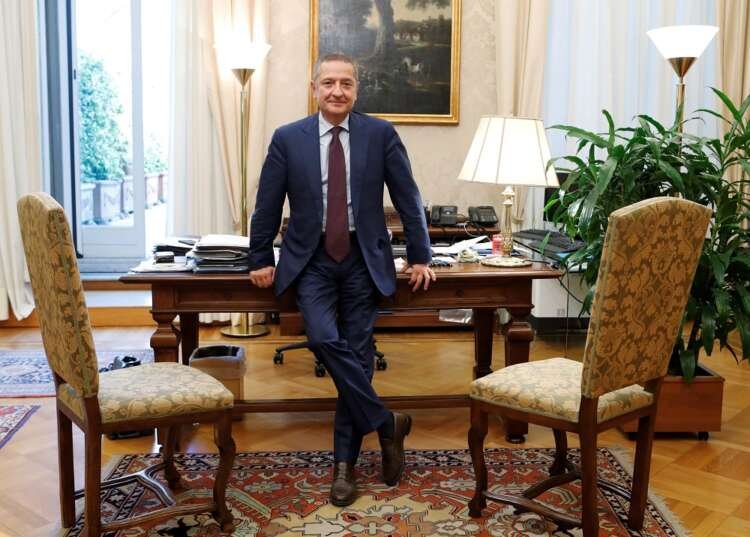
Published by Wanda Rich
Posted on August 23, 2022
2 min readLast updated: February 4, 2026
Add as preferred source on GoogleMILAN (Reuters) -The European Central Bank must exercise caution with further rate hikes as a looming recession could ease inflationary pressures, lessening the need for central bank action, ECB board member Fabio Panetta said on Tuesday.
MILAN (Reuters) -The European Central Bank must exercise caution with further rate hikes as a looming recession could ease inflationary pressures, lessening the need for central bank action, ECB board member Fabio Panetta said on Tuesday.
The ECB raised rates back to zero from negative territory in July and will likely hike again in September, fearing that inflation, now approaching double digits, is at risk of getting embedded in a hard-to-break wage-price spiral.
“We may have to adjust our monetary stance further, but …. we have to be fully aware that the probability of a recession is increasing.” Panetta told a financial conference in Milan.
“If we will have a significant slowdown or even a recession, this would mitigate inflationary pressures,” Panetta said.
Exposing a rift among policymakers, Panetta also argued that interest rates, once adjusted for inflation, are “not too far away” from what is considered neutral, which neither stimulates nor holds back growth.
Fellow board member Isabel Schnabel, however, last week argued that real short-term rates remain deep in negative territory and the ECB was “quite far” from becoming restrictive.
While the ECB has not said where rate hikes will stop, it said that further “normalisation” will be needed, commonly understood as moving towards the neutral rate.
Markets currently price in 62 basis points of rate hikes in September and a combined 131 basis points of moves for the rest of the year, suggesting that a rate hike is seen at each remaining policy meeting.
The top of the rate hike cycle is now seen at around 205 basis points above the current level.
(Reporting by Francesca Landini; Writing by Balazs Koranyi; Editing by Alex Richardson and Tomasz Janowski)
Monetary policy refers to the actions taken by a central bank to manage the money supply and interest rates in the economy to achieve macroeconomic objectives such as controlling inflation and stabilizing currency.
Interest rates are the cost of borrowing money, expressed as a percentage of the amount borrowed. They are set by central banks and influence economic activity by affecting consumer and business spending.
The European Central Bank (ECB) is the central bank for the eurozone, responsible for managing the euro and formulating monetary policy to maintain price stability and support economic growth in the European Union.
Inflation is the rate at which the general level of prices for goods and services rises, eroding purchasing power. It is typically measured by the Consumer Price Index (CPI) or the Producer Price Index (PPI).
A recession is a significant decline in economic activity across the economy, lasting more than a few months, typically visible in GDP, income, employment, manufacturing, and retail sales.
Explore more articles in the Top Stories category











