
Top Stories
Dollar Nears 3-mth Low, Shares Climb After Fed Tests the Brakes
Published by Uma Rajagopal
Posted on November 24, 2022
4 min readLast updated: February 3, 2026
Add as preferred source on Google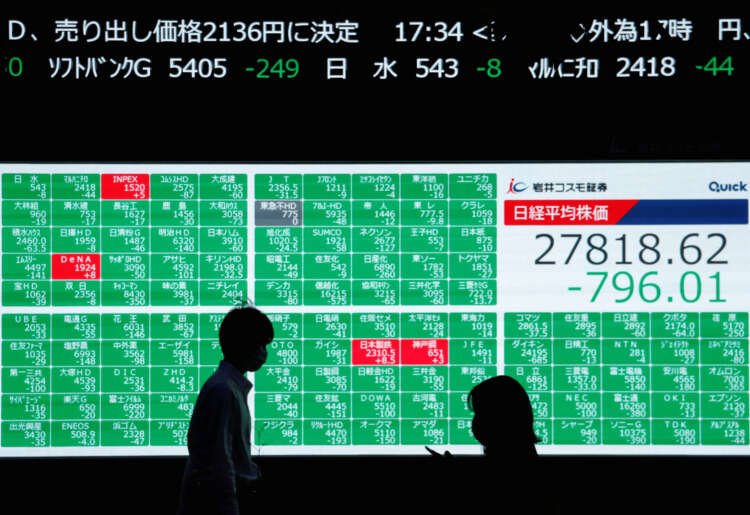
Published by Uma Rajagopal
Posted on November 24, 2022
4 min readLast updated: February 3, 2026
Add as preferred source on GoogleBy Marc Jones
LONDON (Reuters) – World shares touched a two-month high and the dollar swooped towards a three-month low on Thursday, after Federal Reserve meeting minutes pointed to a slower pace of U.S. interest rate rises from next month.
With Wall Street shut for Thanksgiving, it was up to Europe to continue the rebound in market confidence that has been building for more than a month.
It seemed a bit of a struggle early on as London’s FTSE slipped 0.1%, but there were just enough gains in the rest of Europe [.EU] and in Asia [.SS][.T] overnight to ensure things kept shuffling forward.
MSCI’s 47-country index of world stocks touched its highest since mid-September, while German and British government bond yields, which drive Europe’s borrowing costs, fell to their lowest since October and September respectively. [.EU]
“The Federal Reserve minutes signalled that some sensible voices are trying to drown out Fed Chair Powell’s relentless ‘hike, hike, hike’ chant,” said UBS Chief Economist Paul Donovan.
A “substantial majority” of Fed policymakers had agreed it would “likely soon be appropriate” to slow the pace of interest rate rises, the minutes released on Wednesday showed, although “various participants” had also said rates might need to go “somewhat higher than they had previously expected”.
Futures markets show investors now expect U.S. rates to peak just above 5% by next May and are pricing in a roughly 75% chance that the Fed switches to 50 basis point rises rather than the 75 bps it has been using recently.
For the currency markets, it meant the 7-week sell-off in the dollar continued. [/FRX]
The euro rose as high as $1.0447, edging it closer to its recent four-month top of $1.0481, while the dollar weakened 0.6% against the Japanese yen to 138.70 yen and past $1.20 against sterling.
“The dollar could stay pressured for a bit longer, but it’s probably embedding a good deal of Fed-related negatives now,” analysts at ING wrote.
CHINA PROPERTY
The Fed wasn’t the only focus. Sweden’s crown nudged higher as its central bank increased its rates by three-quarters of a percentage point to 2.5% and signalled more next year.
Germany’s closely followed Ifo business climate index also rose more than expected, following on from some upbeat data from France too, while Turkey was expected to slash its rates again later despite eyewateringly high inflation.
Overnight, MSCI’s broadest index of Asia-Pacific shares outside Japan rose 1.3%, while Japan’s Nikkei and South Korean shares both rose around 1%.
The Bank of Korea had reduced its pace of rate increases to 25 basis points. In Japan, data showed manufacturing activity had contracted at its fastest in two years.
Chinese property stocks stormed nearly 7% higher, meanwhile, after banks there pledged at least $38 billion in fresh credit lines to cash-strapped developers.
The country’s COVID cases continued to surge however, reaching a record high, with the economic toll from mobility restrictions and lockdowns piling up.
Investors remained sceptical whether Beijing’s plan to reduce banks’ reserve requirement ratio would do much to restore economic growth while the government sticks to a zero-COVID policy.
The CSI300 index fell 0.4%, while the Shanghai Composite Index lost 0.25%.
In the oil market, prices were slipping toward a major support level established in September. If they breach it, oil could tumble to levels not seen since before late 2021.
Brent crude futures fell 0.3% to $85.13. U.S. crude oil futures eased 0.2% to $77.74 per barrel. They had tumbled more than 3% on Wednesday as the Group of Seven (G7) nations considered a price cap on Russian oil above the current market level. [O/R]
Recession fears remain intense. Wednesday’s post-Fed U.S. bond market moves had seen yields on 10-year notes drop to a huge 79-basis-point deficit relative to two-year yields.
Such a curve inversion has not been seen since the dot-com bust of 2000 and, on the face of it, is a signal that investors expect a deep economic downturn in coming months.
(Additional reporting by Stella Qiu in Sydney; Editing by Robert Birsel)
The Federal Reserve, often referred to as the Fed, is the central banking system of the United States, responsible for implementing monetary policy, regulating banks, and maintaining financial stability.
Currency exchange is the process of converting one currency into another, typically for the purpose of international trade or travel, influenced by exchange rates.
Interest rates are the cost of borrowing money or the return on savings, expressed as a percentage of the principal amount, influencing economic activity and inflation.
Economic growth refers to the increase in the production of goods and services in an economy over a period, often measured by the rise in Gross Domestic Product (GDP).
Inflation is the rate at which the general level of prices for goods and services rises, eroding purchasing power and affecting economic stability.
Explore more articles in the Top Stories category











