
Top Stories
Dollar Gains Before Fed, March Rate Cut Seen Less Likely
Published by Jessica Weisman-Pitts
Posted on January 29, 2024
3 min readLast updated: January 31, 2026
Add as preferred source on Google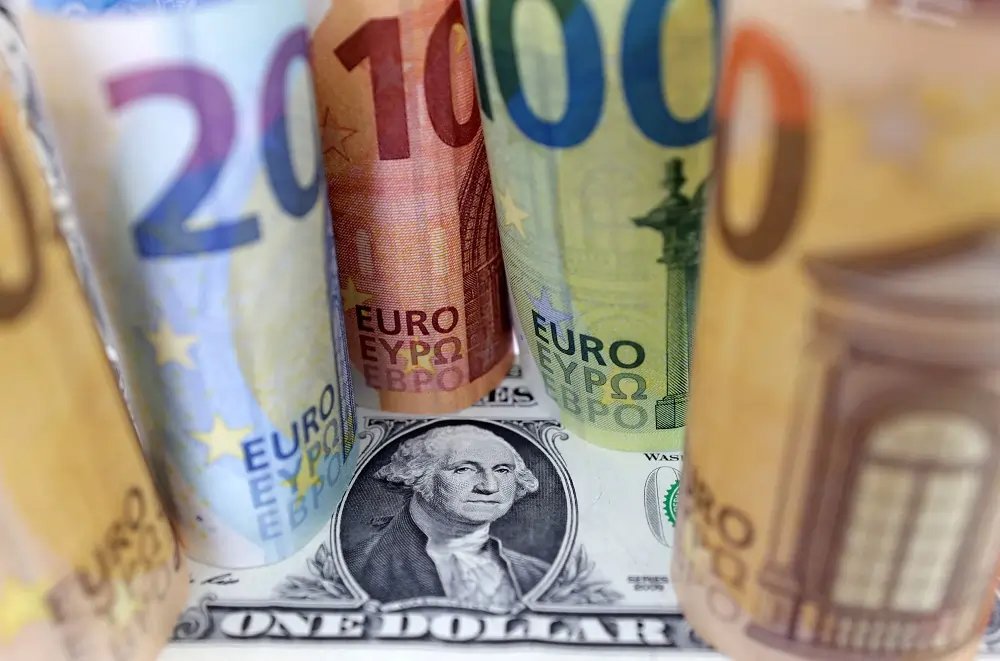
Published by Jessica Weisman-Pitts
Posted on January 29, 2024
3 min readLast updated: January 31, 2026
Add as preferred source on GoogleBy Karen Brettell and Samuel Indyk
NEW YORK (Reuters) – The dollar gained on Monday as investors prepared for the prospect that the Federal Reserve could push back against expectations of an imminent rate cut when it concludes its two-day meeting on Wednesday.
Traders have cut odds that the U.S. central bank will reduce rates to 49%, from 73% a month ago, according to the CME Group’s FedWatch Tool, as data reinforces a view that the U.S. economy remains solid.
That also contrasts to a weaker economic outlook for European countries, which is making the single currency relatively less attractive.
“The macro picture in the U.S. looks a lot better than the macro picture in European union countries and the eurozone in general,” said Helen Given, FX trader at Monex USA in Washington.
The Fed is expected to hold rates steady on Wednesday and investors will focus on comments from Fed Chairman Jerome Powell, after he indicated in December that the Fed is pivoting to a rate cutting cycle.
“We’ll probably see a bit of pushback on the last meeting,” said Given. “I’d expect that a lot of the dollar strength that we’re seeing today, and we should continue to see until that decision release on Wednesday, is coming from shifting expectations.”
The dollar index, which measures the U.S. currency against six rivals, was last up 0.19% at 103.75 and remained close to the six-week high of 103.82 it touched last week. The index is set for a 2.4% gain in January.
The euro dipped 0.39% to $1.08080.
The European Central Bank on Thursday held interest rates at a record-high 4% and reaffirmed its commitment to fighting inflation even as the time to start easing borrowing costs approaches.
The next move will be an interest rate cut but policymakers speaking on Monday disagreed on the exact timing of the move or the trigger for action.
Traders are now fully pricing a move in April, with almost 150 basis points of easing priced in for the year.
Sterling was little changed on the day at $1.26780 ahead of the Bank of England’s policy announcement on Thursday.
The greenback fell 0.18% to 147.88 yen, but the Japanese currency is on course for an almost 5% decline in January, its weakest monthly performance since June 2022, as traders temper their expectations of when the Bank of Japan would exit from its ultra-loose policy.
“Towards the end of December we saw positioning become net long JPY – perhaps fueled by expectations for both, aggressive Fed easing, as well as rapid BOJ policy normalization,” said Sid Mathur, head of Asia macro strategy and emerging market research at BNP Paribas.
“But both those expectations have been scaled back over the past couple of weeks, and the BNPP positioning indicator suggests that those JPY longs have also been reduced.”
Investors are also wary of growing geopolitical risks after three U.S. service members were killed in an aerial drone attack on U.S. forces in northeastern Jordan near the Syrian border.
Such uncertainties could provide the safe-haven yen with a temporary lift, analysts said.
In cryptocurrencies, Bitcoin was little changed on the day at $41,980.
(Reporting by Karen Brettell; Editing by Bernadette Baum)
The Federal Reserve, often referred to as the Fed, is the central bank of the United States responsible for implementing monetary policy and regulating financial institutions.
Monetary policy refers to the actions taken by a central bank to manage the money supply and interest rates to achieve economic goals such as controlling inflation and stabilizing the currency.
A currency index measures the value of a currency against a basket of other currencies, providing an indication of its strength or weakness in the foreign exchange market.
Interest rates are the cost of borrowing money, expressed as a percentage of the amount borrowed, which can influence economic activity and inflation.
Cryptocurrencies are digital or virtual currencies that use cryptography for security, operating on decentralized networks based on blockchain technology.
Explore more articles in the Top Stories category











