Search
00
GBAF Logo
trophy
Top StoriesInterviewsBusinessFinanceBankingTechnologyInvestingTradingVideosAwardsMagazinesHeadlinesTrends

Subscribe to our newsletter

Get the latest news and updates from our team.

Global Banking & Finance Review®

Global Banking & Finance Review® - Subscribe to our newsletter

Company

    GBAF Logo
    • About Us
    • Profile
    • Privacy & Cookie Policy
    • Terms of Use
    • Contact Us
    • Advertising
    • Submit Post
    • Latest News
    • Research Reports
    • Press Release
    • Awards▾
      • About the Awards
      • Awards TimeTable
      • Submit Nominations
      • Testimonials
      • Media Room
      • Award Winners
      • FAQ
    • Magazines▾
      • Global Banking & Finance Review Magazine Issue 79
      • Global Banking & Finance Review Magazine Issue 78
      • Global Banking & Finance Review Magazine Issue 77
      • Global Banking & Finance Review Magazine Issue 76
      • Global Banking & Finance Review Magazine Issue 75
      • Global Banking & Finance Review Magazine Issue 73
      • Global Banking & Finance Review Magazine Issue 71
      • Global Banking & Finance Review Magazine Issue 70
      • Global Banking & Finance Review Magazine Issue 69
      • Global Banking & Finance Review Magazine Issue 66
    Top StoriesInterviewsBusinessFinanceBankingTechnologyInvestingTradingVideosAwardsMagazinesHeadlinesTrends

    Global Banking & Finance Review® is a leading financial portal and online magazine offering News, Analysis, Opinion, Reviews, Interviews & Videos from the world of Banking, Finance, Business, Trading, Technology, Investing, Brokerage, Foreign Exchange, Tax & Legal, Islamic Finance, Asset & Wealth Management.
    Copyright © 2010-2026 GBAF Publications Ltd - All Rights Reserved. | Sitemap | Tags | Developed By eCorpIT

    Editorial & Advertiser disclosure

    Global Banking & Finance Review® is an online platform offering news, analysis, and opinion on the latest trends, developments, and innovations in the banking and finance industry worldwide. The platform covers a diverse range of topics, including banking, insurance, investment, wealth management, fintech, and regulatory issues. The website publishes news, press releases, opinion and advertorials on various financial organizations, products and services which are commissioned from various Companies, Organizations, PR agencies, Bloggers etc. These commissioned articles are commercial in nature. This is not to be considered as financial advice and should be considered only for information purposes. It does not reflect the views or opinion of our website and is not to be considered an endorsement or a recommendation. We cannot guarantee the accuracy or applicability of any information provided with respect to your individual or personal circumstances. Please seek Professional advice from a qualified professional before making any financial decisions. We link to various third-party websites, affiliate sales networks, and to our advertising partners websites. When you view or click on certain links available on our articles, our partners may compensate us for displaying the content to you or make a purchase or fill a form. This will not incur any additional charges to you. To make things simpler for you to identity or distinguish advertised or sponsored articles or links, you may consider all articles or links hosted on our site as a commercial article placement. We will not be responsible for any loss you may suffer as a result of any omission or inaccuracy on the website.

    Home > Top Stories > Dimmed street lights, shorter showers: Germany leads Europe energy savings drive
    Top Stories

    Dimmed street lights, shorter showers: Germany leads Europe energy savings drive

    Published by Jessica Weisman-Pitts

    Posted on July 22, 2022

    5 min read

    Last updated: February 5, 2026

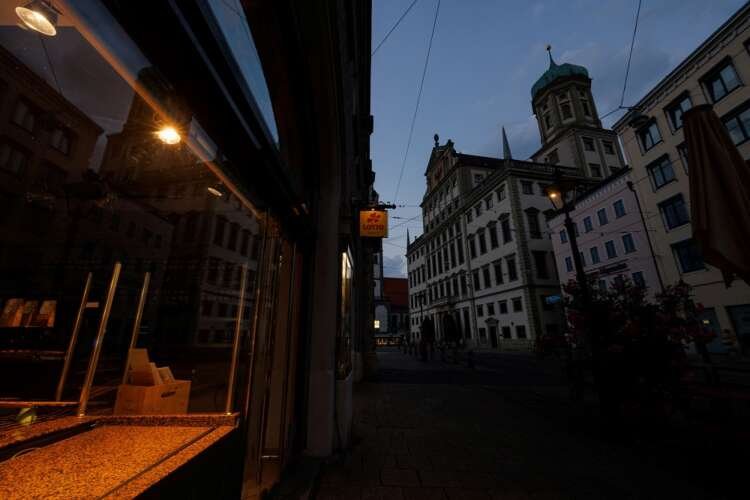
    The image captures the dimmed street lights and unlit historic buildings in Augsburg, Germany, highlighting the city's energy-saving initiatives in response to the ongoing energy crisis caused by reduced Russian gas supplies.
    Dimmed street lights and dark buildings in Augsburg showcase energy-saving efforts amid Germany's energy crisis - Global Banking & Finance Review
    Why waste money on news and opinion when you can access them for free?

    Take advantage of our newsletter subscription and stay informed on the go!

    Subscribe

    Tags:sustainabilityenergy marketeconomic growthfinancial crisisInvestment opportunities

    By Sarah Marsh and Louisa Off

    BERLIN/AUGSBURG, Germany (Reuters) – Summer nights in the wealthy Bavarian city of Augsburg this year are eerily dark and quiet: The facades of historic buildings are not illuminated, street lights are dimmed and most of the fountains are not operating.

    Augsburg is among many cities around Germany to have rolled out a raft of energy savings measures since the start of Russia’s invasion of Ukraine, which sent oil and gas prices soaring and sparked a cost of living crisis.

    Around Europe, countries are looking for ways to cut energy consumption and fill up their gas stores in response to lower Russian gas deliveries and in preparation for a possible total cut-off.

    Germany, as one of the countries most heavily dependent on Russian gas, is leading the charge with a nationwide campaign to save gas so that Europe’s largest economy has enough to get it through the winter, although energy experts say additional measures are needed to achieve energy security.

    Augsburg mayor Eva Weber told Reuters that the city’s energy bills this year were expected to be almost double from last year’s costs of around 15.9 million euros.

    “We want to show the Augsburg citizens that we could be facing really hard times…we all need to look to really save energy,” Weber said.

    The city has also lowered the temperature in its public pools and is checking which traffic lights it can turn off. Like other cities, it wants to limit heating in public buildings.

    Around half of German households rely on gas for their heating and some 13% of electricity is derived from the fossil fuel. Gas also accounts for a third of industry’s energy. In recent years, half of that gas has come from Russia.

    Germany’s economy ministry is seeking to fill its gas caverns ahead of winter when demand typically surges so that it could get by with those as well as new alternative gas sources such as floating liquid natural gas terminals.

    Any gas saved now can help it reach its goal, the government says, which is why it is re-activating coal-fired power plants and aims to launch a gas auction model to encourage industrial consumers to save gas.

    The economy ministry also launched a campaign last month urging citizens to take shorter showers, increase their fridge’s temperature by 1 degree and better insulate their home.

    “I have further significantly reduced my own showering time,” said Economy Minister Robert Habeck, a Green, who announced more binding measures on Thursday, including a ban on heating swimming pools in private homes.

    UP TO TENFOLD PRICE RISES

    Price rises of up to tenfold for new end consumers have already incentivised energy savings, said Thorsten Lenck at think tank Agora Energiewende. Those still on old one- or two-year contracts though have yet to feel the pain.

    Private landlords worry about the exorbitant year-end bills for extra energy costs facing tenants that they might not be able to afford to pay. As such, Germany’s largest residential landlord Vonovia has said it will reduce heating for tenants in many of its apartments at night.

    “We are some way on the path to saving enough energy, but we’re still not there yet,” said Lenck.

    Adjusted for temperature differences, gas consumption was 6.4 % lower in the first five months of the year, and 10.8 % less in May, according to Germany’s power industry association BDEW.

    The European Union told member states on Wednesday they needed to cut gas usage by 15% until March.

    But that’s an average – Germany needs to cut its usage by 30% given its gas reliance, said Simone Tagliapietra, senior fellow at think-tank Bruegel.

    “Politicians don’t like to ask people to sacrifice and they postponed this because they still wanted to believe Russia might not play too much with gas,” he said. “But they will now have to … otherwise Europe simply will have to close down factories because they cannot curtail gas to families.”

    PREPARING FOR WORST CASE SCENARIO

    Germany’s emergency plan prioritizes gas for households and critical institutions like hospitals, whereas industry would be the first to face rationing.

    Nonetheless, across Germany, nervous citizens are stocking up on wood for fireplaces or electric heaters in reaction to rising prices and to brace for a worst case scenario in the winter when temperatures can drop as low as -20 degrees.

    “Demand for wood has gone up 100%,” said Olesja Breuer. “Our delivery times have gone from two weeks to two months”.

    DIY-store chain Hornbach, which has 98 stores in Germany, said sales of different types of fuels and heaters as well as isolation materials and solar modules started shooting up last November, and again after Russia’s invasion of Ukraine.

    “It was driven firstly by the rising energy prices … and also clients’ desire to be autonomous and prepared for emergencies,” said spokesperson Florian Preuss, noting that consumers in other European markets were not behaving in the same way.

    Some cities are planning on opening warm spaces where either the homeless or those who cannot afford heating can escape the winter cold.

    “We have an energy crisis that needs to be solved as a society,” said Augsburg resident Christoph Kleine-Vennekate. “And if (tackling that) is about such irrelevant things as lighting up buildings, we can manage it easily.”

    ($1 = 0.9831 euros)

    (Reporting by Louisa Off and Ayhan Uyanik in Augsburg and Sarah Marsh in Berlin; Additional Reporting by Riham Alkousaa in Berlin, Jan Lopatka in Prague and Leigh Thomas in Paris; Editing by Raissa Kasolowsky)

    Frequently Asked Questions about Dimmed street lights, shorter showers: Germany leads Europe energy savings drive

    1What is energy security?

    Energy security refers to the reliable availability of energy resources at an affordable price. It encompasses the ability to access energy sources and the resilience of the energy supply system.

    2What is the cost of living crisis?

    A cost of living crisis occurs when the prices of essential goods and services rise significantly, making it difficult for individuals and families to afford basic necessities.

    3What is gas dependency?

    Gas dependency refers to the reliance on natural gas as a primary energy source for heating, electricity, and industrial processes, which can pose risks during supply disruptions.

    4What are energy savings measures?

    Energy savings measures are actions taken to reduce energy consumption, such as improving insulation, using energy-efficient appliances, and promoting behavioral changes like shorter showers.

    5What is the role of public pools in energy conservation?

    Public pools can contribute to energy conservation by lowering their heating temperatures and reducing operational hours to save energy during crises.

    More from Top Stories

    Explore more articles in the Top Stories category

    Image for Lessons From the Ring and the Deal Table: How Boxing Shapes Steven Nigro’s Approach to Banking and Life
    Lessons From the Ring and the Deal Table: How Boxing Shapes Steven Nigro’s Approach to Banking and Life
    Image for Joe Kiani in 2025: Capital, Conviction, and a Focused Return to Innovation
    Joe Kiani in 2025: Capital, Conviction, and a Focused Return to Innovation
    Image for Marco Robinson – CLOSE THE DEAL AND SUDDENLY GROW RICH
    Marco Robinson – CLOSE THE DEAL AND SUDDENLY GROW RICH
    Image for Digital Tracing: Turning a regulatory obligation into a commercial advantage
    Digital Tracing: Turning a regulatory obligation into a commercial advantage
    Image for Exploring the Role of Blockchain and the Bitcoin Price Today in Education
    Exploring the Role of Blockchain and the Bitcoin Price Today in Education
    Image for Inside the World’s First Collection Industry Conglomerate: PCA Global’s Platform Strategy
    Inside the World’s First Collection Industry Conglomerate: PCA Global’s Platform Strategy
    Image for Chase Buchanan Private Wealth Management Highlights Key Autumn 2025 Budget Takeaways for Expats
    Chase Buchanan Private Wealth Management Highlights Key Autumn 2025 Budget Takeaways for Expats
    Image for PayLaju Strengthens Its Position as Malaysia’s Trusted Interest-Free Sharia-Compliant Loan Provider
    PayLaju Strengthens Its Position as Malaysia’s Trusted Interest-Free Sharia-Compliant Loan Provider
    Image for A Notable Update for Employee Health Benefits:
    A Notable Update for Employee Health Benefits:
    Image for Creating Equity Between Walls: How Mohak Chauhan is Using Engineering, Finance, and Community Vision to Reengineer Affordable Housing
    Creating Equity Between Walls: How Mohak Chauhan is Using Engineering, Finance, and Community Vision to Reengineer Affordable Housing
    Image for Upcoming Book on Real Estate Investing: Harvard Grace Capital Founder Stewart Heath’s Puts Lessons in Print
    Upcoming Book on Real Estate Investing: Harvard Grace Capital Founder Stewart Heath’s Puts Lessons in Print
    Image for ELECTIVA MARKS A LANDMARK FIRST YEAR WITH MAJOR SENIOR APPOINTMENTS AND EXPANSION MILESTONES
    ELECTIVA MARKS A LANDMARK FIRST YEAR WITH MAJOR SENIOR APPOINTMENTS AND EXPANSION MILESTONES
    View All Top Stories Posts
    Previous Top Stories PostAnalysis-Putin bets on an ancient weapon in Ukraine: time
    Next Top Stories PostBritain’s Queen Elizabeth not due to attend Commonwealth Games in Birmingham