Search
00
GBAF Logo
trophy
Top StoriesInterviewsBusinessFinanceBankingTechnologyInvestingTradingVideosAwardsMagazinesHeadlinesTrends

Subscribe to our newsletter

Get the latest news and updates from our team.

Global Banking and Finance Review

Global Banking & Finance Review

Company

    GBAF Logo
    • About Us
    • Profile
    • Privacy & Cookie Policy
    • Terms of Use
    • Contact Us
    • Advertising
    • Submit Post
    • Latest News
    • Research Reports
    • Press Release
    • Awards▾
      • About the Awards
      • Awards TimeTable
      • Submit Nominations
      • Testimonials
      • Media Room
      • Award Winners
      • FAQ
    • Magazines▾
      • Global Banking & Finance Review Magazine Issue 79
      • Global Banking & Finance Review Magazine Issue 78
      • Global Banking & Finance Review Magazine Issue 77
      • Global Banking & Finance Review Magazine Issue 76
      • Global Banking & Finance Review Magazine Issue 75
      • Global Banking & Finance Review Magazine Issue 73
      • Global Banking & Finance Review Magazine Issue 71
      • Global Banking & Finance Review Magazine Issue 70
      • Global Banking & Finance Review Magazine Issue 69
      • Global Banking & Finance Review Magazine Issue 66
    Top StoriesInterviewsBusinessFinanceBankingTechnologyInvestingTradingVideosAwardsMagazinesHeadlinesTrends

    Global Banking & Finance Review® is a leading financial portal and online magazine offering News, Analysis, Opinion, Reviews, Interviews & Videos from the world of Banking, Finance, Business, Trading, Technology, Investing, Brokerage, Foreign Exchange, Tax & Legal, Islamic Finance, Asset & Wealth Management.
    Copyright © 2010-2025 GBAF Publications Ltd - All Rights Reserved.

    Editorial & Advertiser disclosure

    Global Banking and Finance Review is an online platform offering news, analysis, and opinion on the latest trends, developments, and innovations in the banking and finance industry worldwide. The platform covers a diverse range of topics, including banking, insurance, investment, wealth management, fintech, and regulatory issues. The website publishes news, press releases, opinion and advertorials on various financial organizations, products and services which are commissioned from various Companies, Organizations, PR agencies, Bloggers etc. These commissioned articles are commercial in nature. This is not to be considered as financial advice and should be considered only for information purposes. It does not reflect the views or opinion of our website and is not to be considered an endorsement or a recommendation. We cannot guarantee the accuracy or applicability of any information provided with respect to your individual or personal circumstances. Please seek Professional advice from a qualified professional before making any financial decisions. We link to various third-party websites, affiliate sales networks, and to our advertising partners websites. When you view or click on certain links available on our articles, our partners may compensate us for displaying the content to you or make a purchase or fill a form. This will not incur any additional charges to you. To make things simpler for you to identity or distinguish advertised or sponsored articles or links, you may consider all articles or links hosted on our site as a commercial article placement. We will not be responsible for any loss you may suffer as a result of any omission or inaccuracy on the website.

    Home > Top Stories > China’s high-tech push seeks to reassert global factory dominance
    Top Stories

    China’s high-tech push seeks to reassert global factory dominance

    China’s high-tech push seeks to reassert global factory dominance

    Published by maria gbaf

    Posted on September 22, 2021

    Featured image for article about Top Stories

    By Kevin Yao

    TIANJIN, China (Reuters) – At a factory in China’s north, workers are busy testing an automated vehicle designed to move bulky items around industrial spaces, one of a new generation of robots Beijing wants to shift the country’s manufacturing up the value chain.

    The robot’s Tianjin-based maker has received tax breaks and government-guaranteed loans to build products that modernise China’s vast factory sector and advance its technological expertise.

    “The government is paying great attention to the manufacturing sector and the real economy – we can feel that,” said Ren Zhiyong, general manager of Tianjin Langyu Robot Co, as he gave Reuters a guided tour of his plant.

    China is backing R&D efforts by high-tech manufacturers like Langyu, driven by an urgent desire to reduce reliance on imported technology and reinforce its dominance as a global factory power, even as it cracks down on other parts of the economy.

    Beijing’s pivot puts the focus on advanced manufacturing, rather than the services sector, to steer the world’s second-largest economy past the so-called “middle income trap”, where countries lose productivity and stagnate in lower-value economic output.

    “Pressure is the driving force, and without pressure, it is difficult for companies to develop,” said Ren.

    He expects revenues to more than double to 100 million yuan ($15.52 million) this year from 2020, on increased demand for high-tech products such as Langyu’s automated guided vehicles.

    More broadly, the city of Tianjin plans to invest 2 trillion yuan ($311 billion) between 2021 and 2025, with 60% earmarked for strategic emerging industries, Yin Jihui, head of the Tianjin Industry and Information Technology Bureau, told Reuters.

    The investment, comprising corporate and government outlays, will help boost manufacturing to 25% of economy in 2025 from 21.8% in 2020, Yin said.

    The share of strategic industries in Tianjin’s factory output will also rise to 40%, Yin said, from 26.1% last year.

    “It will be very difficult and challenging to achieve these goals, (as) we need to ensure stable economic development while making a transition from old to new engines,” Yin said.

    ACHILLES’ HEEL

    China’s five-year plan in March pledged to keep manufacturing’s share of GDP “basically stable”, in contrast to the 2016-2020 plan that focused on services to create jobs.

    The coronavirus and the Sino-U.S. trade war have reframed the way policymakers see factories: no longer just grimy relics of an old economy but assets of strategic value.

    During the pandemic, China’s factories have churned out everything from masks and ventilators to work-from-home electronics, propelling the economic recovery from its record slump in early 2020.

    Additionally, the trade war with the United States and Washington’s tech curbs exposed China’s lack of high-tech know-how, hardening Beijing’s resolve to speed up innovation.

    “Rising external pressure since the start of trade war has made policymakers more determined to develop China’s middle- and high-end manufacturing,” said Qu Hongbin, chief China economist at HSBC.

    “The higher external pressure, the more emphasis they put on the manufacturing. That will be turned into actual policy support.”

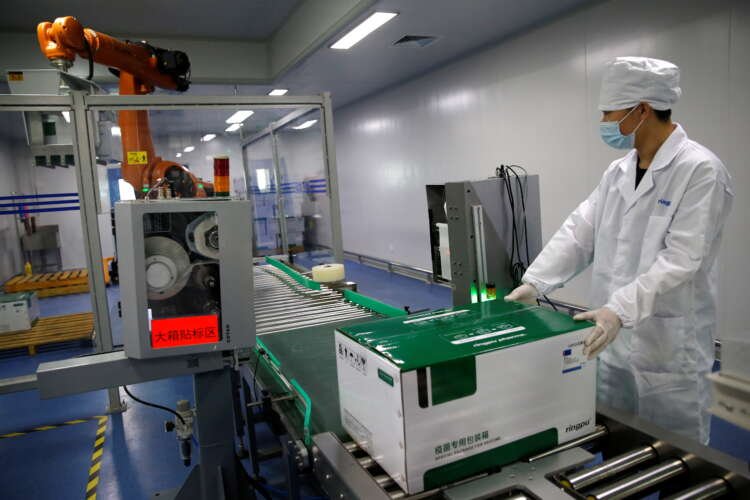
    Tianjin-based Ringpu Biotech, which makes animal vaccines, has faced critical import delays on U.S. equipment and materials used for R&D and quality control.

    “We have taken some measures, including increasing our own R&D capacity, and cooperating with other firms and universities,” Ringpu Vice President Fu Xubin said.

    “We will seek to boost our ability to find substitutes in areas where we face problems.”

    ‘SENSE OF CRISIS’

    Manufacturing’s share of China’s GDP fell to 26.2% in 2020 from 32.5% in 2006, while the services sector has lifted its contribution to 54.5% from 41.8%, according to the World Bank.

    Officials worry too rapid a shift towards services, which employs more people but is less productive than manufacturing, could undermine long-term growth, as it did in some Latin American economies.

    Beijing does not want manufacturing to dip below 25% of GDP, roughly in line with South Korea’s economic profile, government advisers said.

    “Governments at the central and local levels are stepping up support for advanced manufacturers, but achieving industrial upgrading won’t be a smooth ride,” said a government adviser who spoke on condition of anonymity.

    From 2021 to 2025, China aims to boost R&D spending by over 7% annually, focusing on “frontier” technologies such as artificial intelligence, quantum computing and semi-conductors.

    The plan, which broadly supersedes “Made In China 2025” initiative from 2015, targets nine emerging industries: new-generation information technology, biotech, new energy, new materials, high-end equipment, new-energy vehicles, environmental protection, aerospace and marine equipment.

    The central bank has channelled more credit into manufacturing, especially high-tech firms, at the expense of the property sector, which faces fresh curbs against speculative investment.

    (Graphics: China’s resurgent manufacturing, https://graphics.reuters.com/CHINA-ECONOMY/MANUFACTURING/zjpqkjnjxpx/chart.png)

    Langyu, the robotics company, plans to spend about 20 million yuan on R&D this year, or 20% of expected 2021 revenues, helped by greater tax breaks for R&D, Ren said.

    Ringpu channels 8-12% of its revenues into R&D and will spend 1.3 billion yuan between 2020 and 2023 to upgrade automation and production.

    “For China, to achieve tech self-reliance in some sectors is a matter of survival,” said Tu Xinquan, head of China Institute for WTO Studies at University of International Business and Economics.

    “The sense of crisis is a big driving force.”

    ($1 = 6.4333 Chinese yuan)

    (Reporting by Kevin Yao; Editing by Sam Holmes)

    By Kevin Yao

    TIANJIN, China (Reuters) – At a factory in China’s north, workers are busy testing an automated vehicle designed to move bulky items around industrial spaces, one of a new generation of robots Beijing wants to shift the country’s manufacturing up the value chain.

    The robot’s Tianjin-based maker has received tax breaks and government-guaranteed loans to build products that modernise China’s vast factory sector and advance its technological expertise.

    “The government is paying great attention to the manufacturing sector and the real economy – we can feel that,” said Ren Zhiyong, general manager of Tianjin Langyu Robot Co, as he gave Reuters a guided tour of his plant.

    China is backing R&D efforts by high-tech manufacturers like Langyu, driven by an urgent desire to reduce reliance on imported technology and reinforce its dominance as a global factory power, even as it cracks down on other parts of the economy.

    Beijing’s pivot puts the focus on advanced manufacturing, rather than the services sector, to steer the world’s second-largest economy past the so-called “middle income trap”, where countries lose productivity and stagnate in lower-value economic output.

    “Pressure is the driving force, and without pressure, it is difficult for companies to develop,” said Ren.

    He expects revenues to more than double to 100 million yuan ($15.52 million) this year from 2020, on increased demand for high-tech products such as Langyu’s automated guided vehicles.

    More broadly, the city of Tianjin plans to invest 2 trillion yuan ($311 billion) between 2021 and 2025, with 60% earmarked for strategic emerging industries, Yin Jihui, head of the Tianjin Industry and Information Technology Bureau, told Reuters.

    The investment, comprising corporate and government outlays, will help boost manufacturing to 25% of economy in 2025 from 21.8% in 2020, Yin said.

    The share of strategic industries in Tianjin’s factory output will also rise to 40%, Yin said, from 26.1% last year.

    “It will be very difficult and challenging to achieve these goals, (as) we need to ensure stable economic development while making a transition from old to new engines,” Yin said.

    ACHILLES’ HEEL

    China’s five-year plan in March pledged to keep manufacturing’s share of GDP “basically stable”, in contrast to the 2016-2020 plan that focused on services to create jobs.

    The coronavirus and the Sino-U.S. trade war have reframed the way policymakers see factories: no longer just grimy relics of an old economy but assets of strategic value.

    During the pandemic, China’s factories have churned out everything from masks and ventilators to work-from-home electronics, propelling the economic recovery from its record slump in early 2020.

    Additionally, the trade war with the United States and Washington’s tech curbs exposed China’s lack of high-tech know-how, hardening Beijing’s resolve to speed up innovation.

    “Rising external pressure since the start of trade war has made policymakers more determined to develop China’s middle- and high-end manufacturing,” said Qu Hongbin, chief China economist at HSBC.

    “The higher external pressure, the more emphasis they put on the manufacturing. That will be turned into actual policy support.”

    Tianjin-based Ringpu Biotech, which makes animal vaccines, has faced critical import delays on U.S. equipment and materials used for R&D and quality control.

    “We have taken some measures, including increasing our own R&D capacity, and cooperating with other firms and universities,” Ringpu Vice President Fu Xubin said.

    “We will seek to boost our ability to find substitutes in areas where we face problems.”

    ‘SENSE OF CRISIS’

    Manufacturing’s share of China’s GDP fell to 26.2% in 2020 from 32.5% in 2006, while the services sector has lifted its contribution to 54.5% from 41.8%, according to the World Bank.

    Officials worry too rapid a shift towards services, which employs more people but is less productive than manufacturing, could undermine long-term growth, as it did in some Latin American economies.

    Beijing does not want manufacturing to dip below 25% of GDP, roughly in line with South Korea’s economic profile, government advisers said.

    “Governments at the central and local levels are stepping up support for advanced manufacturers, but achieving industrial upgrading won’t be a smooth ride,” said a government adviser who spoke on condition of anonymity.

    From 2021 to 2025, China aims to boost R&D spending by over 7% annually, focusing on “frontier” technologies such as artificial intelligence, quantum computing and semi-conductors.

    The plan, which broadly supersedes “Made In China 2025” initiative from 2015, targets nine emerging industries: new-generation information technology, biotech, new energy, new materials, high-end equipment, new-energy vehicles, environmental protection, aerospace and marine equipment.

    The central bank has channelled more credit into manufacturing, especially high-tech firms, at the expense of the property sector, which faces fresh curbs against speculative investment.

    (Graphics: China’s resurgent manufacturing, https://graphics.reuters.com/CHINA-ECONOMY/MANUFACTURING/zjpqkjnjxpx/chart.png)

    Langyu, the robotics company, plans to spend about 20 million yuan on R&D this year, or 20% of expected 2021 revenues, helped by greater tax breaks for R&D, Ren said.

    Ringpu channels 8-12% of its revenues into R&D and will spend 1.3 billion yuan between 2020 and 2023 to upgrade automation and production.

    “For China, to achieve tech self-reliance in some sectors is a matter of survival,” said Tu Xinquan, head of China Institute for WTO Studies at University of International Business and Economics.

    “The sense of crisis is a big driving force.”

    ($1 = 6.4333 Chinese yuan)

    (Reporting by Kevin Yao; Editing by Sam Holmes)

    Related Posts
    Inside the World’s First Collection Industry Conglomerate: PCA Global’s Platform Strategy
    Inside the World’s First Collection Industry Conglomerate: PCA Global’s Platform Strategy
    Chase Buchanan Private Wealth Management Highlights Key Autumn 2025 Budget Takeaways for Expats
    Chase Buchanan Private Wealth Management Highlights Key Autumn 2025 Budget Takeaways for Expats
    PayLaju Strengthens Its Position as Malaysia’s Trusted Interest-Free Sharia-Compliant Loan Provider
    PayLaju Strengthens Its Position as Malaysia’s Trusted Interest-Free Sharia-Compliant Loan Provider
    A Notable Update for Employee Health Benefits:
    A Notable Update for Employee Health Benefits:
    Creating Equity Between Walls: How Mohak Chauhan is Using Engineering, Finance, and Community Vision to Reengineer Affordable Housing
    Creating Equity Between Walls: How Mohak Chauhan is Using Engineering, Finance, and Community Vision to Reengineer Affordable Housing
    Upcoming Book on Real Estate Investing: Harvard Grace Capital Founder Stewart Heath’s Puts Lessons in Print
    Upcoming Book on Real Estate Investing: Harvard Grace Capital Founder Stewart Heath’s Puts Lessons in Print
    ELECTIVA MARKS A LANDMARK FIRST YEAR WITH MAJOR SENIOR APPOINTMENTS AND EXPANSION MILESTONES
    ELECTIVA MARKS A LANDMARK FIRST YEAR WITH MAJOR SENIOR APPOINTMENTS AND EXPANSION MILESTONES
    Hebbia Processes One Billion Pages as Financial Institutions Deploy AI Infrastructure at Unprecedented Scale
    Hebbia Processes One Billion Pages as Financial Institutions Deploy AI Infrastructure at Unprecedented Scale
    Beyond Governance Fatigue: Making ESG Integration Work in Financial Markets
    Beyond Governance Fatigue: Making ESG Integration Work in Financial Markets
    Why I-9 Verification Matters for Financial Institutions: Building a Culture of Compliance and Trust
    Why I-9 Verification Matters for Financial Institutions: Building a Culture of Compliance and Trust
    Curvestone AI partners with The White Rose Finance Group to enhance compliance file reviews
    Curvestone AI partners with The White Rose Finance Group to enhance compliance file reviews
    LinkedIn Influence in 2025: Insights from Stevo Jokic on Building Authority and Trust
    LinkedIn Influence in 2025: Insights from Stevo Jokic on Building Authority and Trust

    Why waste money on news and opinions when you can access them for free?

    Take advantage of our newsletter subscription and stay informed on the go!

    Subscribe

    Previous Top Stories PostBiden, UK’s Johnson talk trade and trains in White House meeting
    Next Top Stories PostFacebook to launch portable version of Portal video chat device

    More from Top Stories

    Explore more articles in the Top Stories category

    Should You Take the Dealer’s Bike Insurance or Buy Online Yourself? Here’s the Real Difference

    Should You Take the Dealer’s Bike Insurance or Buy Online Yourself? Here’s the Real Difference

    ID-Pal Unveils ID-Detect Enhancements to Counter Surge in Digital Manipulation and Deepfakes

    ID-Pal Unveils ID-Detect Enhancements to Counter Surge in Digital Manipulation and Deepfakes

    TRUST TAKES THE LEAD: HALF OF UK SHOPPERS HAVE ABANDONED ONLINE PURCHASES OVER SECURITY CONCERNS

    TRUST TAKES THE LEAD: HALF OF UK SHOPPERS HAVE ABANDONED ONLINE PURCHASES OVER SECURITY CONCERNS

    Why Choose Premium Driver Service in Miami Over Rideshare Apps for Business Travel and Special Events?

    Why Choose Premium Driver Service in Miami Over Rideshare Apps for Business Travel and Special Events?

    Over 30 Million Users Benefit From Ant International’s Bettr Credit Tech Solutions

    Over 30 Million Users Benefit From Ant International’s Bettr Credit Tech Solutions

    Side-Hustle Economics: How Part-Time Service Work Can Strengthen Your Financial Plan

    Side-Hustle Economics: How Part-Time Service Work Can Strengthen Your Financial Plan

    London to Host Major Summit on “New Horizons” for Islamic Economy in the UK

    London to Host Major Summit on “New Horizons” for Islamic Economy in the UK

    BLOXX Launches World’s First Home Equity Subscription, Creating a New Residential Asset Class

    BLOXX Launches World’s First Home Equity Subscription, Creating a New Residential Asset Class

    LiaFi Addresses Gap Between Business Transaction and Savings Accounts

    LiaFi Addresses Gap Between Business Transaction and Savings Accounts

    Ant Group Chairman Eric Jing Outlines Strategy for Inclusive AI, Collaboration on Tokenised Settlement

    Ant Group Chairman Eric Jing Outlines Strategy for Inclusive AI, Collaboration on Tokenised Settlement

    Deeply Cultivating the Syndicated Loan and Cross-Border Financing Fields: Empowering Chinese Banks’ Global Expansion with Professional Excellence

    Deeply Cultivating the Syndicated Loan and Cross-Border Financing Fields: Empowering Chinese Banks’ Global Expansion with Professional Excellence

    Ant International’s Antom Launches AI‑Powered MSME App for Finance and Business Operations

    Ant International’s Antom Launches AI‑Powered MSME App for Finance and Business Operations

    View All Top Stories Posts