Search
00
GBAF Logo
trophy
Top StoriesInterviewsBusinessFinanceBankingTechnologyInvestingTradingVideosAwardsMagazinesHeadlinesTrends

Subscribe to our newsletter

Get the latest news and updates from our team.

Global Banking & Finance Review®

Global Banking & Finance Review® - Subscribe to our newsletter

Company

    GBAF Logo
    • About Us
    • Profile
    • Privacy & Cookie Policy
    • Terms of Use
    • Contact Us
    • Advertising
    • Submit Post
    • Latest News
    • Research Reports
    • Press Release
    • Awards▾
      • About the Awards
      • Awards TimeTable
      • Submit Nominations
      • Testimonials
      • Media Room
      • Award Winners
      • FAQ
    • Magazines▾
      • Global Banking & Finance Review Magazine Issue 79
      • Global Banking & Finance Review Magazine Issue 78
      • Global Banking & Finance Review Magazine Issue 77
      • Global Banking & Finance Review Magazine Issue 76
      • Global Banking & Finance Review Magazine Issue 75
      • Global Banking & Finance Review Magazine Issue 73
      • Global Banking & Finance Review Magazine Issue 71
      • Global Banking & Finance Review Magazine Issue 70
      • Global Banking & Finance Review Magazine Issue 69
      • Global Banking & Finance Review Magazine Issue 66
    Top StoriesInterviewsBusinessFinanceBankingTechnologyInvestingTradingVideosAwardsMagazinesHeadlinesTrends

    Global Banking & Finance Review® is a leading financial portal and online magazine offering News, Analysis, Opinion, Reviews, Interviews & Videos from the world of Banking, Finance, Business, Trading, Technology, Investing, Brokerage, Foreign Exchange, Tax & Legal, Islamic Finance, Asset & Wealth Management.
    Copyright © 2010-2026 GBAF Publications Ltd - All Rights Reserved. | Sitemap | Tags | Developed By eCorpIT

    Editorial & Advertiser disclosure

    Global Banking & Finance Review® is an online platform offering news, analysis, and opinion on the latest trends, developments, and innovations in the banking and finance industry worldwide. The platform covers a diverse range of topics, including banking, insurance, investment, wealth management, fintech, and regulatory issues. The website publishes news, press releases, opinion and advertorials on various financial organizations, products and services which are commissioned from various Companies, Organizations, PR agencies, Bloggers etc. These commissioned articles are commercial in nature. This is not to be considered as financial advice and should be considered only for information purposes. It does not reflect the views or opinion of our website and is not to be considered an endorsement or a recommendation. We cannot guarantee the accuracy or applicability of any information provided with respect to your individual or personal circumstances. Please seek Professional advice from a qualified professional before making any financial decisions. We link to various third-party websites, affiliate sales networks, and to our advertising partners websites. When you view or click on certain links available on our articles, our partners may compensate us for displaying the content to you or make a purchase or fill a form. This will not incur any additional charges to you. To make things simpler for you to identity or distinguish advertised or sponsored articles or links, you may consider all articles or links hosted on our site as a commercial article placement. We will not be responsible for any loss you may suffer as a result of any omission or inaccuracy on the website.

    Home > Top Stories > China’s factory activity in July grows at slowest pace since Feb 2020
    Top Stories

    China’s factory activity in July grows at slowest pace since Feb 2020

    Published by maria gbaf

    Posted on August 2, 2021

    5 min read

    Last updated: January 21, 2026

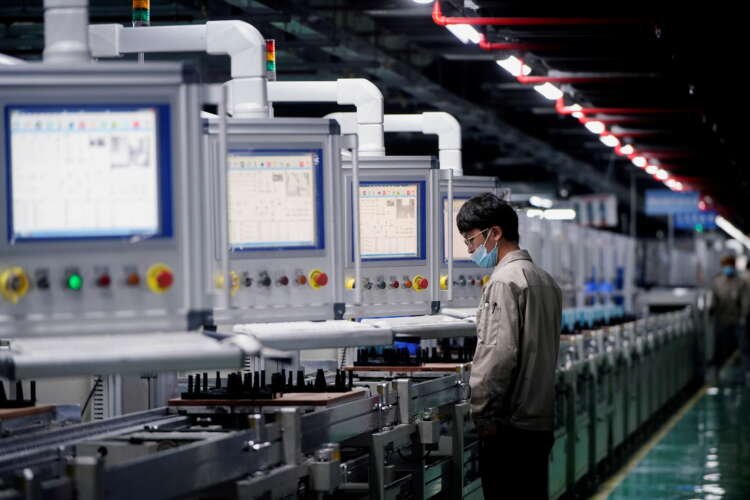
    A visual representation of China's manufacturing sector shows a decline in factory activity due to rising raw material costs and extreme weather conditions, reflecting concerns about the economy's slowdown.
    Factory activity in China slows amid rising costs and extreme weather - Global Banking & Finance Review
    Why waste money on news and opinion when you can access them for free?

    Take advantage of our newsletter subscription and stay informed on the go!

    Subscribe

    BEIJING (Reuters) -China’s factory activity expanded in July at the slowest pace in 17 months as higher raw material costs, equipment maintenance and extreme weather weighed on business activity, adding to concerns about a slowdown in the world’s second-biggest economy.

    The official manufacturing Purchasing Manager’s Index (PMI) eased to 50.4 in July from 50.9 in June, data from the National Bureau of Statistics (NBS) showed on Saturday, but remained above the 50-point mark that separates growth from contraction.

    Analysts had expected it to slip to 50.8. It was the lowest figure since the index slumped to 35.7 in February 2020, after China began lockdowns to control the coronavirus pandemic.

    An NBS official said in a statement the PMI’s sub-index for production slipped to 51.0 from 51.9 in June, pointing to equipment maintenance and extreme weather. The new order sub-index fell to 50.9, from 51.5, reflecting a slowdown in demand.

    “The most alarming signal is the new export order index, which is at lowest level since July last year,” said Zhiwei Zhang, chief economist of Pinpoint Asset Management.

    The sub-index for new export orders has dropped for three straight months starting in May. It stood at 47.7 in July.

    A sub-index for raw material costs stood at 62.9 in July, compared with June’s 61.2, pointing to an increase in costs. High raw material prices have eaten into the profitability of industrial firms and deterred some Chinese exporters from taking on orders.

    Authorities are eager to prevent high factory-gate prices being passed on to consumers, which would only add to current economic headaches as underlying demand remains weak.

    Hit by extreme weather, the construction index dropped to 57.5, from June’s 60.1, and analysts expect the sector to face headwinds amid Beijing’s clampdown on the property market.

    To bolster a slowing economy, the People’s Bank of China (PBOC) in mid-July surprised the market by lowering the reserve requirement ratio (RRR) for banks, releasing around 1 trillion yuan ($154 billion) in long-term liquidity.

    China’s economy has largely recovered from disruptions caused by the pandemic, with the consumption and service sectors gradually catching up to the improvements in exports and manufacturing.

    However, manufacturers are grappling with new challenges including higher raw material prices, surging logistics costs and global supply chain bottlenecks, and the pace of gross domestic product growth is expected to moderate.

    The country is also racing to contain a fresh COVID-19 outbreak of the more infectious Delta variant in the eastern city of Nanjing. China’s zero-tolerance approach could present significant downside risks to the current economic recovery, analysts say.

    Record flooding in central China may have also weighed on business activity in July, along with government moves to curb steel production in line with a drive to reduce emissions.

    The official non-manufacturing Purchasing Managers’ Index (PMI) eased to 53.3 in July, from 53.5 in June, a separate survey from the NBS showed.

    (Reporting by Stella Qiu and Yew Lun Tian; editing by Richard Pullin and Raju Gopalakrishnan)

    BEIJING (Reuters) -China’s factory activity expanded in July at the slowest pace in 17 months as higher raw material costs, equipment maintenance and extreme weather weighed on business activity, adding to concerns about a slowdown in the world’s second-biggest economy.

    The official manufacturing Purchasing Manager’s Index (PMI) eased to 50.4 in July from 50.9 in June, data from the National Bureau of Statistics (NBS) showed on Saturday, but remained above the 50-point mark that separates growth from contraction.

    Analysts had expected it to slip to 50.8. It was the lowest figure since the index slumped to 35.7 in February 2020, after China began lockdowns to control the coronavirus pandemic.

    An NBS official said in a statement the PMI’s sub-index for production slipped to 51.0 from 51.9 in June, pointing to equipment maintenance and extreme weather. The new order sub-index fell to 50.9, from 51.5, reflecting a slowdown in demand.

    “The most alarming signal is the new export order index, which is at lowest level since July last year,” said Zhiwei Zhang, chief economist of Pinpoint Asset Management.

    The sub-index for new export orders has dropped for three straight months starting in May. It stood at 47.7 in July.

    A sub-index for raw material costs stood at 62.9 in July, compared with June’s 61.2, pointing to an increase in costs. High raw material prices have eaten into the profitability of industrial firms and deterred some Chinese exporters from taking on orders.

    Authorities are eager to prevent high factory-gate prices being passed on to consumers, which would only add to current economic headaches as underlying demand remains weak.

    Hit by extreme weather, the construction index dropped to 57.5, from June’s 60.1, and analysts expect the sector to face headwinds amid Beijing’s clampdown on the property market.

    To bolster a slowing economy, the People’s Bank of China (PBOC) in mid-July surprised the market by lowering the reserve requirement ratio (RRR) for banks, releasing around 1 trillion yuan ($154 billion) in long-term liquidity.

    China’s economy has largely recovered from disruptions caused by the pandemic, with the consumption and service sectors gradually catching up to the improvements in exports and manufacturing.

    However, manufacturers are grappling with new challenges including higher raw material prices, surging logistics costs and global supply chain bottlenecks, and the pace of gross domestic product growth is expected to moderate.

    The country is also racing to contain a fresh COVID-19 outbreak of the more infectious Delta variant in the eastern city of Nanjing. China’s zero-tolerance approach could present significant downside risks to the current economic recovery, analysts say.

    Record flooding in central China may have also weighed on business activity in July, along with government moves to curb steel production in line with a drive to reduce emissions.

    The official non-manufacturing Purchasing Managers’ Index (PMI) eased to 53.3 in July, from 53.5 in June, a separate survey from the NBS showed.

    (Reporting by Stella Qiu and Yew Lun Tian; editing by Richard Pullin and Raju Gopalakrishnan)

    More from Top Stories

    Explore more articles in the Top Stories category

    Image for Lessons From the Ring and the Deal Table: How Boxing Shapes Steven Nigro’s Approach to Banking and Life
    Lessons From the Ring and the Deal Table: How Boxing Shapes Steven Nigro’s Approach to Banking and Life
    Image for Joe Kiani in 2025: Capital, Conviction, and a Focused Return to Innovation
    Joe Kiani in 2025: Capital, Conviction, and a Focused Return to Innovation
    Image for Marco Robinson – CLOSE THE DEAL AND SUDDENLY GROW RICH
    Marco Robinson – CLOSE THE DEAL AND SUDDENLY GROW RICH
    Image for Digital Tracing: Turning a regulatory obligation into a commercial advantage
    Digital Tracing: Turning a regulatory obligation into a commercial advantage
    Image for Exploring the Role of Blockchain and the Bitcoin Price Today in Education
    Exploring the Role of Blockchain and the Bitcoin Price Today in Education
    Image for Inside the World’s First Collection Industry Conglomerate: PCA Global’s Platform Strategy
    Inside the World’s First Collection Industry Conglomerate: PCA Global’s Platform Strategy
    Image for Chase Buchanan Private Wealth Management Highlights Key Autumn 2025 Budget Takeaways for Expats
    Chase Buchanan Private Wealth Management Highlights Key Autumn 2025 Budget Takeaways for Expats
    Image for PayLaju Strengthens Its Position as Malaysia’s Trusted Interest-Free Sharia-Compliant Loan Provider
    PayLaju Strengthens Its Position as Malaysia’s Trusted Interest-Free Sharia-Compliant Loan Provider
    Image for A Notable Update for Employee Health Benefits:
    A Notable Update for Employee Health Benefits:
    Image for Creating Equity Between Walls: How Mohak Chauhan is Using Engineering, Finance, and Community Vision to Reengineer Affordable Housing
    Creating Equity Between Walls: How Mohak Chauhan is Using Engineering, Finance, and Community Vision to Reengineer Affordable Housing
    Image for Upcoming Book on Real Estate Investing: Harvard Grace Capital Founder Stewart Heath’s Puts Lessons in Print
    Upcoming Book on Real Estate Investing: Harvard Grace Capital Founder Stewart Heath’s Puts Lessons in Print
    Image for ELECTIVA MARKS A LANDMARK FIRST YEAR WITH MAJOR SENIOR APPOINTMENTS AND EXPANSION MILESTONES
    ELECTIVA MARKS A LANDMARK FIRST YEAR WITH MAJOR SENIOR APPOINTMENTS AND EXPANSION MILESTONES
    View All Top Stories Posts
    Previous Top Stories PostBritain to offer vaccine booster shots for 32 million next month -The Telegraph
    Next Top Stories PostPfizer and Moderna raise prices for COVID-19 vaccines in EU- FT